

Promotional pricing is a temporary price cut used to drive sales, clear stock or win new shoppers, from a 20% weekend sale to Black Week and the January clearance. Every promotion trades margin for volume, and the trade is steeper than it looks: a 20% discount on a product with a 40% margin halves the margin on every unit, so the promotion has to double sales just to earn what full price would have. In The Nordic E-commerce Pricing Benchmark, 36% of retailers sell more than a quarter of their online revenue at a discount, and 36% can't say what each product earned in a campaign.
Promotions are part of everyday trading in high-competition e-commerce, where shoppers compare prices across Prisjakt, PriceRunner and Google Shopping and expect a campaign every few weeks.
Competitors run their own promotions on the same products, so a discount that looks generous on its own can still leave you behind the cheapest offer on the comparison site.
A promotion planned around the margin, the reference price and the competitor price can win sales the shop would never have made at full price, while one planned around a headline number tends to give away margin on products that would have sold anyway.
Retailers that judge the result on revenue rarely see the difference, because sales rise in both cases and only the margin per product shows which promotion paid.
Competitive pricing, discount campaigns and insights in one system.
Online retailers use a handful of promotion types, and each one puts a different amount of margin at risk:
Whatever the type, the same three questions decide whether the promotion pays: how much margin each sale gives up, which products deserve the discount and which price the discount is measured from.
A discount comes straight out of the margin, because the product costs the same to buy whatever it sells for.
To earn the same total margin as before, the promotion has to sell enough extra units to make up the difference.
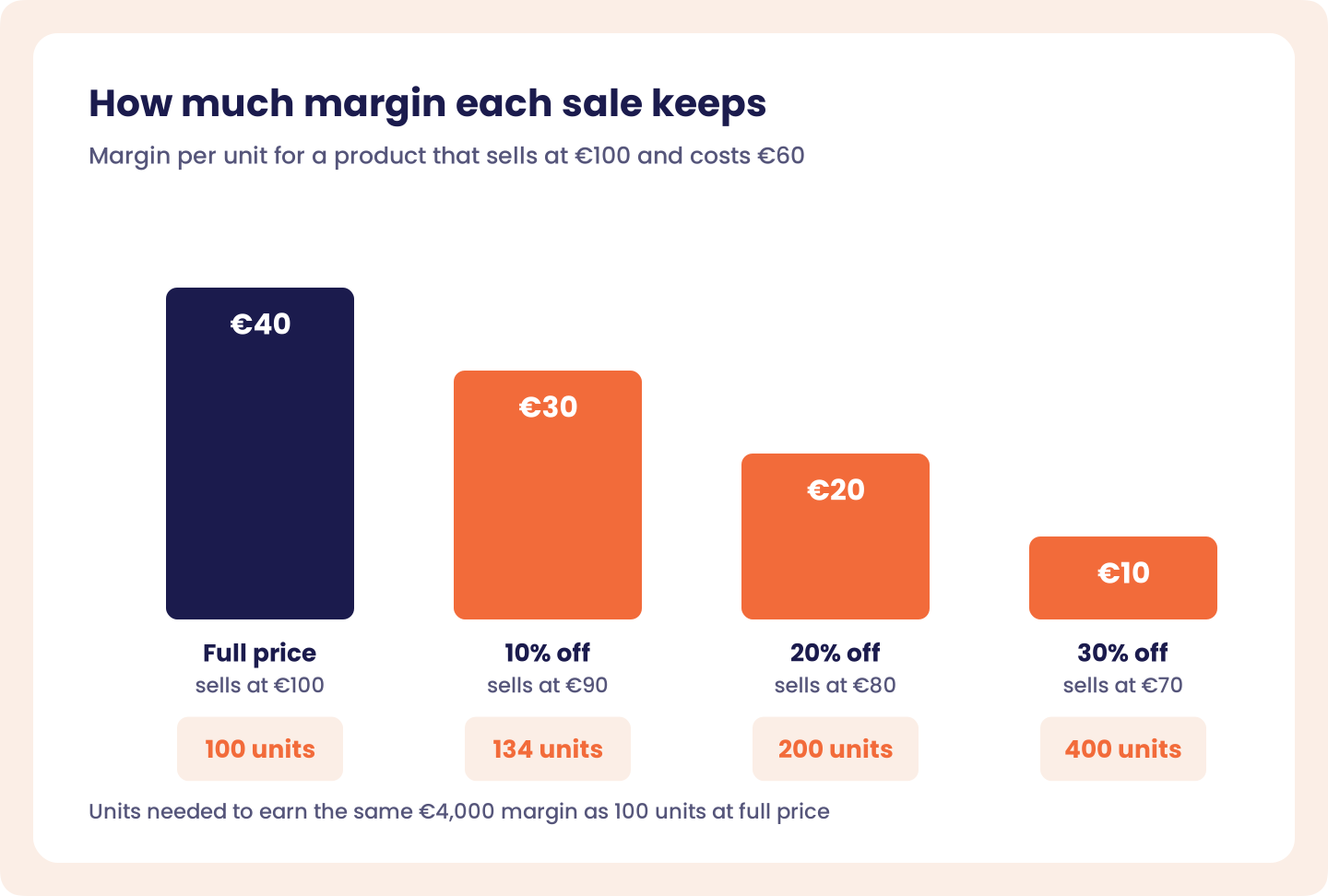
Take a product that sells for €100 and costs €60, leaving €40 of margin per unit.
At 10% off the margin falls to €30, at 20% off to €20 and at 30% off to €10. Earning the €4,000 that 100 full-price units bring in takes 134 units at 10% off, 200 units at 20% off and 400 units at 30% off.
The break-even sales lift for any promotion is the discount divided by the margin left after it.
With a 40% margin, a 10% discount needs a third more sales, a 20% discount needs twice the sales and a 30% discount needs four times the sales.
Products with thinner margins hit that wall sooner, which is why a single discount depth across a whole campaign gives away far more on some products than others.
The strongest promotion candidates are products that would not sell at full price in the time you have, such as end-of-season stock, slow movers tying up cash and products about to be replaced by a new model.
A smaller group of well-known products can also earn a deeper discount because shoppers use them to judge the whole shop, and a sharp price on those brings traffic to the rest of the range.
Products already selling well at full price are the weakest candidates, because every unit that would have sold anyway now earns less.
The same goes for products where you are already the cheapest seller by a wide gap, since the shopper was already choosing you, and those are often better candidates for raising the price to just below the next competitor than for a discount.
Check the competitor price before setting the discount.
A 20% discount that still leaves you above the cheapest offer on a comparison site wins few extra clicks, while a 10% discount that moves you to first place can win more sales than the deeper one.
Under the EU's 30-day rule, an advertised discount has to be measured from the lowest price the product had in the 30 days before the promotion.
A product that was in another campaign three weeks ago has that campaign price as its reference, so a new "30% off" may be a much smaller discount in legal terms, or none at all.
The Nordic E-commerce Pricing Benchmark found that 31% of retailers measure discounts from their normal price or the supplier's recommended price, and 43% raised prices shortly before a sale in the last 12 months, the practice the rule was written to stop.
Headline claims follow the same logic: an "up to 50% off" banner needs a representative share of the promotion to reach 50% on each product's own reference price, as set out in the rules for "up to" discount claims.
Promotions run alongside everyday competitive pricing, and the two can undercut each other.
An automatic rule that follows a competitor can move a campaign product's price in the middle of the promotion, and a price raised in the weeks before a campaign changes the reference price the discount is measured from.
Retailers that run competitive prices and campaigns from the same system avoid most of those clashes, and the benchmark shows it in their results: 72% of them grew margin last year, compared with 52% of retailers using separate systems.
Running both from the same data means each promotion is planned with the current market price, the margin and the stock position in view, and competitive pricing and discount campaigns stop working against each other.
Revenue makes almost every promotion look successful, because volume rises whenever prices fall.
The useful measure is the margin each product earned after the discount, set against what it would have earned at full price, which shows which discounts paid for themselves and which ones gave margin away.
Retailers that measure campaign margin product by product grew margin at a rate of 72%, compared with 54% of those judging campaigns on revenue.
A full picture of campaign profit also takes in the costs that come with the promotion, such as advertising, shipping and returns.
Reprice builds discount campaigns from the same product data as its competitive pricing, so every promotion starts from the current market price and the margin on each product.
Before a campaign goes live, each product is checked against its own 30-day lowest price and marked as ready, needing attention or not to be discounted yet, with its old price, new price and margin shown side by side.

Progressive pricing deepens a discount in steps for products that need longer to sell, and campaign products stay protected from the everyday competitive rules so a scheduled discount holds until the promotion ends.
Afterwards, campaign results are reported by revenue, margin, stock and product, so the next promotion is planned from what each product earned.
A promotion makes money when the discount is chosen after the margin, the reference price and the competitor price are known, and loses it when the headline number comes first.
Working out the break-even lift for each product, keeping full-price sellers out of the campaign and measuring the result per product gives every discount a number behind it.
The retailers that do this well treat promotions as part of the same pricing process as their everyday prices.
They plan each campaign with the market in view, check every discount against the rules before launch and feed the result back into the next one, so each campaign is planned from what the last one earned.
Competitive pricing, discount campaigns and insights in one system.
Data: The Nordic E-commerce Pricing Benchmark