

A product priced €20 below every competitor wins the same shopper as one priced €2 below. The other €18 is margin handed over for nothing. Every catalogue has these products, often hundreds of them, left behind when a competitor raised a price and yours stayed put. The fix is a simple rule: when you're the cheapest by a wide gap, move up to just under the next offer.
Price gaps open without anyone deciding to create them.
A rival raises a price, a competitor's sale ends, or a campaign price stays live after the campaign is over, and a price that was right on the day it was set ends up far below the market a month later.
Nobody on the team has a reason to look at it, because the product is selling.
A product that sells well looks healthy in every report, and no report asks whether it would sell just as well at a higher price.
Competitive pricing, discount campaigns and insights in one system.
On price comparison sites like Prisjakt, PriceRunner and Google Shopping, offers are sorted by price.
A shopper comparing four sellers picks the first one.
Whether the first offer leads by €2 or €20 makes no difference to the ranking, and almost none to the click.
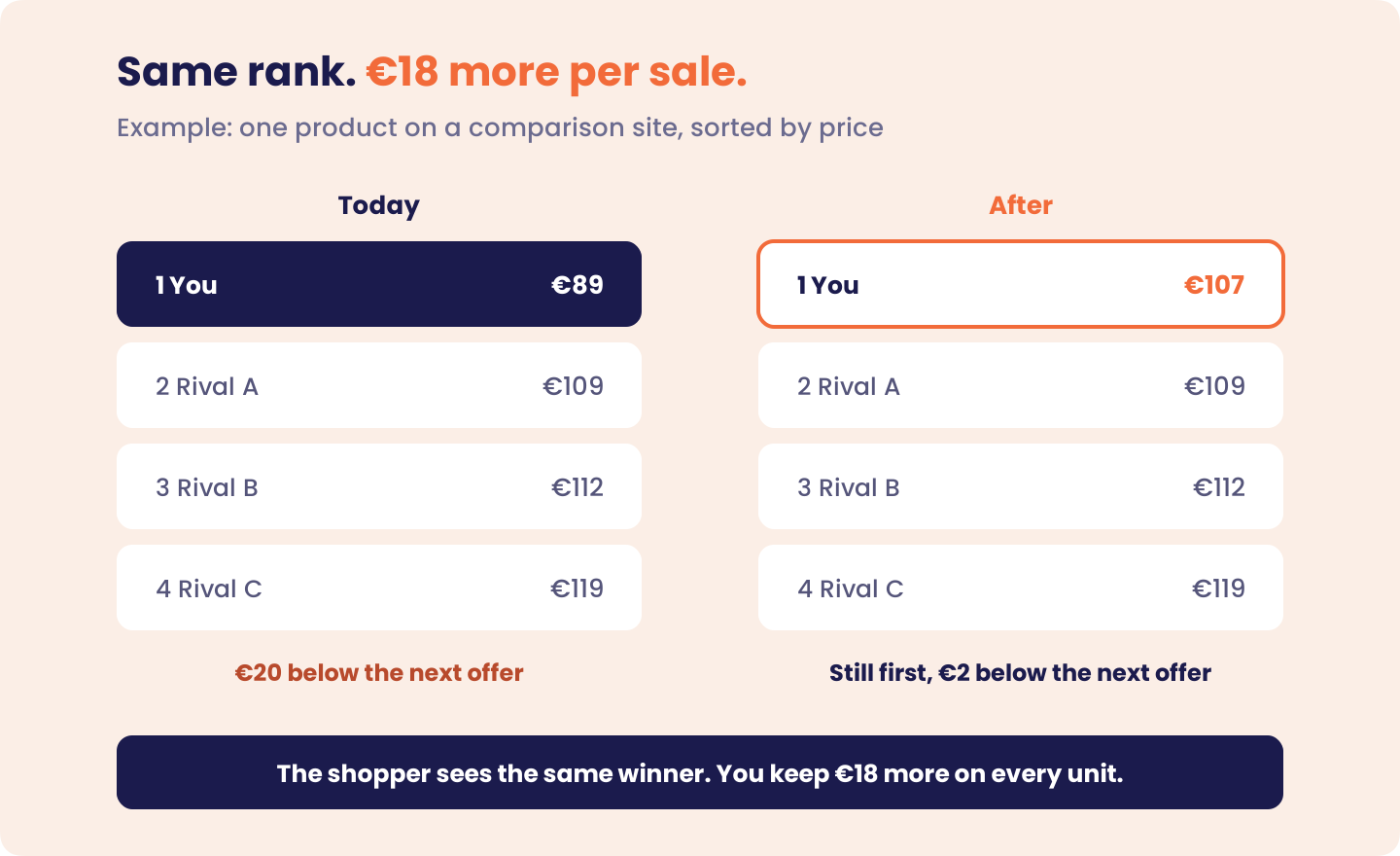
Say you sell a product for €89 and the three other sellers charge €109, €112 and €119.
You're first on the list, €20 below the next offer.
Move your price to €107 and you're still first and still the cheapest, now €2 below Rival A, so the shopper sees the same winner and you keep €18 more on every unit.
Start with the products where you're the cheapest seller, then check how far below the next real competitor each one sits.
Where the gap is bigger than a threshold you set, such as €5 or 5% of the price, move up to just under the next offer.
Leave a small buffer when you do it.
Landing €2 or 2% below the next competitor keeps you first even if they trim their price slightly.
Landing exactly on their price turns a clear lead into a tie.
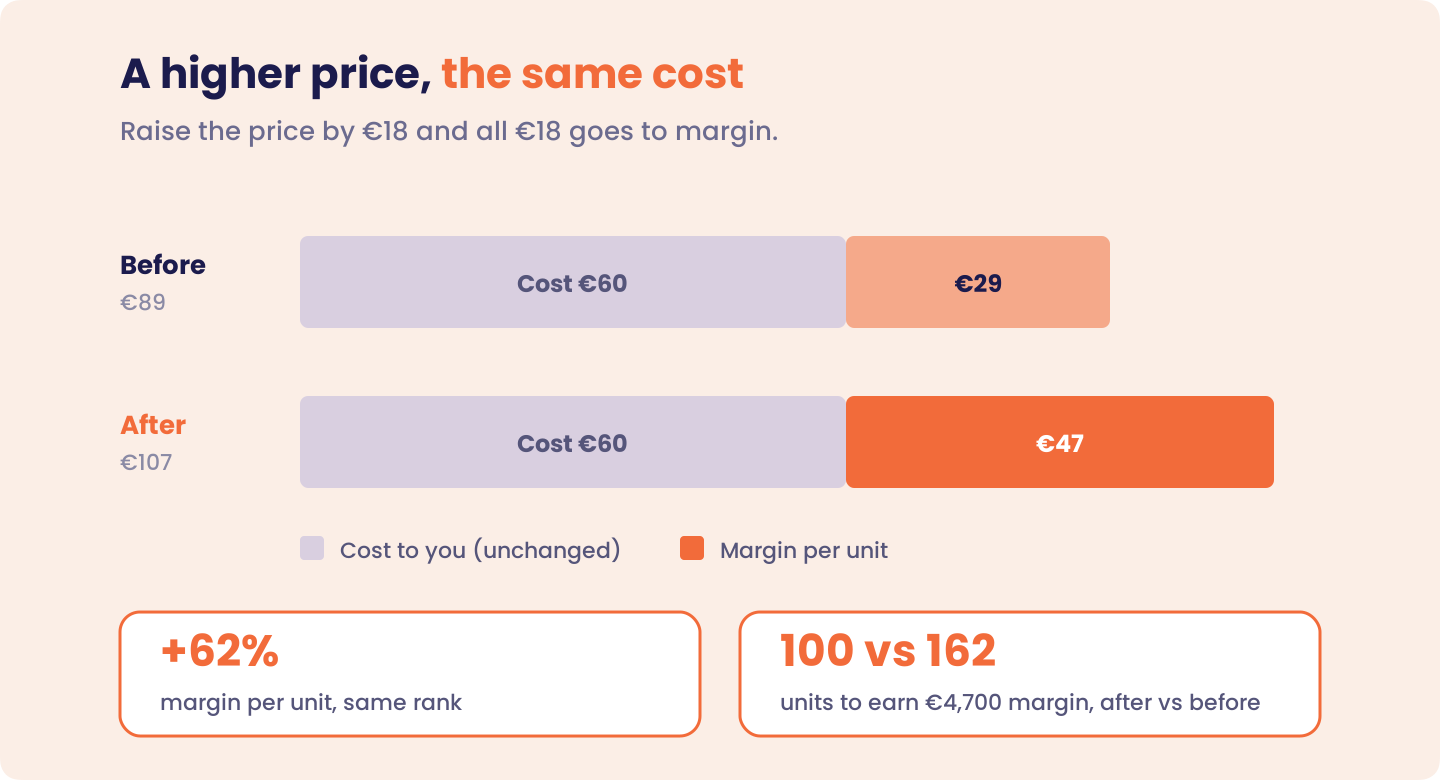
The cost of the product doesn't change, so every euro of the increase lands as margin.
In the example, margin per unit goes from €29 to €47, up 62%, with the same rank on the same comparison sites. Earning €4,700 in margin used to take 162 units, and now it takes 100.
Across a catalogue of thousands of products, the gaps add up quickly.
As an illustration, say 200 products sit more than €5 below the next offer, each sells 15 units a month, and you close an average of €8 of the gap. That's 200 × 15 × €8, or €24,000 a month in extra margin, close to €290,000 a year without dropping a single rank.
The gaps sit mostly outside the products your team watches.
Campaign products and bestsellers get checked every week, while the long tail gets priced once and left, which is why pricing the whole assortment matters as much as pricing the headline items.
In our Black Friday Freeze research, 30% of retailers changed no prices at all during their busiest week of the year.
Prices that don't move fall behind the market in both directions, and the ones that fall too low never show up as a problem.
Competitors keep moving, so new gaps open every week and closing them is ongoing work.
How often to check depends on how fast each product's market moves, the same logic behind repricing frequency.
Reprice matches your products to competitors using the GTIN, the barcode number that identifies one exact product, so every gap is measured against the same item and not a lookalike.
Its recommendations flag the products where you're the cheapest and well below the next competitor, so you don't have to build that list by hand.

Each suggestion shows the new price next to its effect on margin, so you see what you gain before anything changes.
Some gaps only exist because the next seller is a cross-border shop or a reseller your customers never buy from.
Exclude that competitor and the comparison resets to the rivals that matter.
From there you approve changes one by one, or let competitive pricing rules apply them automatically, always above the margin floor you've set.
Every price change is logged, so you can see what moved, when and why.
Reprice's pricing insights then show where your prices sit against each matched competitor as the market shifts.
Some products are cheap on purpose.
Shoppers judge a store's prices by a handful of products they know well, and on those, a visible lead can be worth more than the margin.
Keep those deliberate, and close gaps on the rest.
The same judgment applies to price matching: not every competitor's price deserves a response.
Check the next offer is real before you move.
A competitor who is out of stock, or a seller your customers don't buy from, isn't setting the market.
Measure the gap against the next seller who can take the sale.
Mind the timing if a discount is coming. Under the EU 30-day rule, a discount must be measured from the lowest price you charged in the 30 days before it. Raise a price today and run a campaign next week, and the "before" price in that campaign is still the old, lower one. Close gaps well ahead of a planned campaign, or after it ends.
Competitive pricing, discount campaigns and insights in one system.
Data: The Black Friday Freeze, a survey of 180 European e-commerce companies.