

Every pricing article tells you to protect your margin. Almost none show the mechanics. The truth is that margin protection isn't a mindset — it's a set of specific rules: a hard floor on every product, a margin guard across the catalogue, min and max bounds that keep automated pricing sane, and a clear order of precedence for when two rules disagree. Get those right and you can automate pricing without ever waking up to a product selling below cost.
The reason this matters more as you grow is simple math.
Manual pricing review breaks down somewhere around 200 SKUs — past that, no human reliably catches every price that's drifted below where it should be.
So the protection has to live in the rules themselves, checked on every price change before it goes live, not in someone's end-of-month spreadsheet review.
Here's how to build that, piece by piece.
Competitive pricing, discount campaigns and insights in one system.
The floor is the foundation, and it's non-negotiable: the lowest price a product can ever be sold at, and the one line no automated rule is allowed to cross.
You calculate it from the bottom up — landed unit cost (product plus inbound and handling), plus fees, plus the minimum contribution margin you need to keep — and then you add a small buffer for fee swings and coupon stacking.
The floor is per-product because costs are per-product.
A rule that says "never discount more than 30%" isn't a floor — 30% off a thin-margin product can still be a loss.
The floor has to be an actual price, grounded in that product's real cost, so that whatever the competitive or campaign logic decides, the answer can never come out below it.
Get this one thing in place before you automate anything else.
Everything above it is optimization; the floor is survival.
A floor protects one product.
It doesn't protect your blended margin — and that's a different risk.
If a handful of aggressively repriced products each sit right at their floor, every one of them is technically "compliant," but together they can drag your overall margin somewhere you never intended.
That's what a margin guard is for.
Where the floor is a per-SKU hard stop, the margin guard watches the aggregate — your blended margin across a category or the whole catalogue — and holds it above a threshold.
External analyses put well-run dynamic pricing at 5–10 margin points of upside, but that only holds if the downside is capped.
The floor caps it per product; the guard caps it in total — the same guard that keeps a progressive markdown from clearing stock at a loss.
Min and max bounds are the guardrails that keep automated pricing from doing something absurd when the market does something strange.
The minimum is usually your floor.
The maximum is a ceiling — the highest price where you still convert, set to protect brand positioning and to stop a repricer from spiking a price to €99 when every competitor happens to sell out at once.
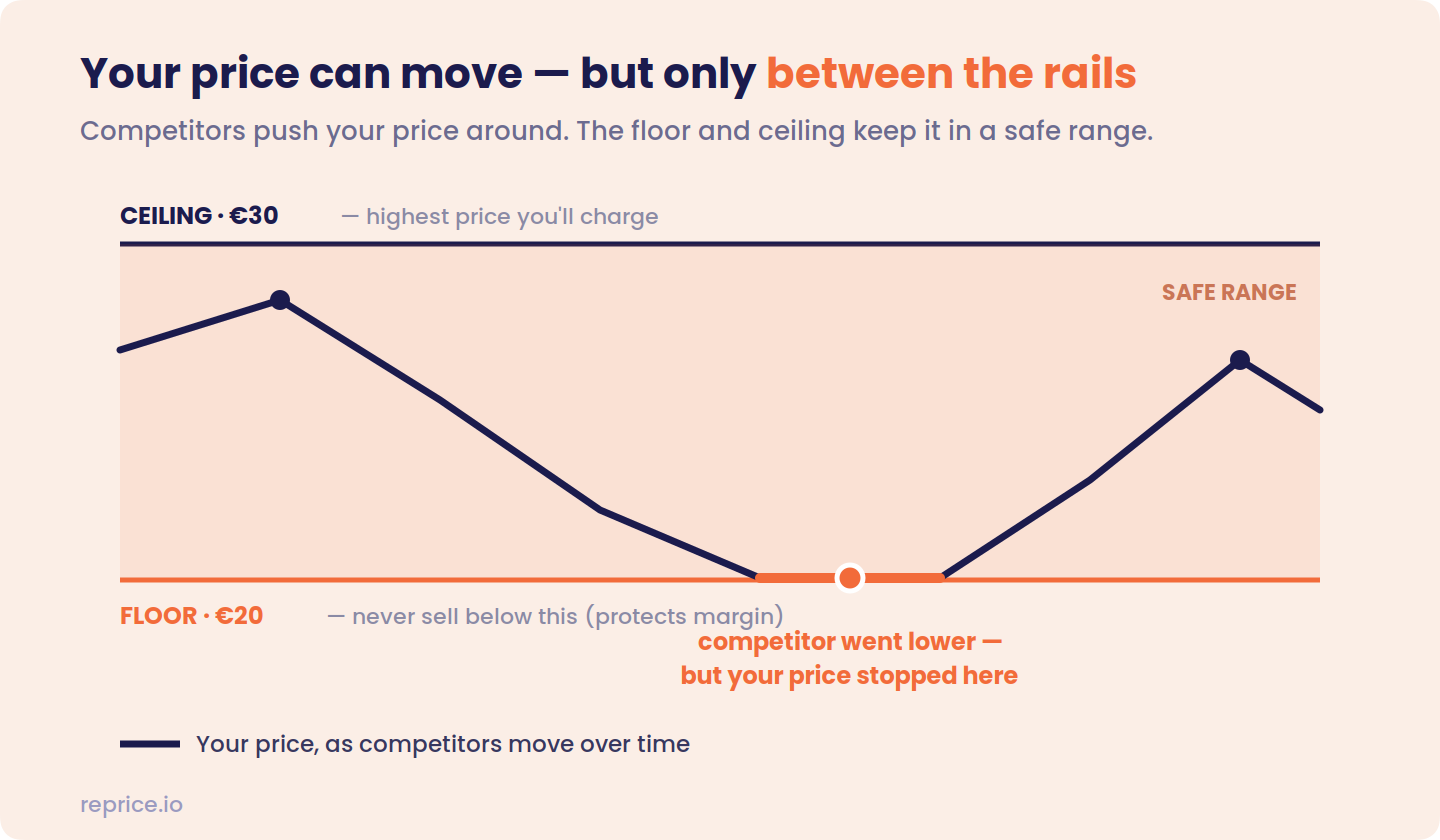
Inside those two lines, your competitive rule has room to work — matching rivals, following the market down, climbing back up when it can — across the whole assortment, not just the products you're watching.
Outside them, nothing happens.
The band is what lets you automate confidently: the price can move all it likes, as long as it moves between the rails.
This is the part almost nobody explains, and it's where margin protection is actually won or lost.
Once you have more than one rule — a competitive rule, a campaign rule, a floor — they will eventually disagree about the same product on the same day.
What happens then isn't luck.
It's precedence, and it's a setting you control.
The safe order is almost always the same: the floor wins over everything.
A competitor rule might want to match a rival at €18, a Black Week campaign might want 20% off down to €20 — but if the floor is €21.50, the price goes live at €21.50 and both other rules are overruled.
The competitor and campaign logic get to fight over the price above the floor; they never get to breach it.
This is also exactly where everyday competitive pricing and campaign pricing collide when they're run in separate tools — because nothing arbitrates between them.
A daily competitor rule in one system doesn't know a campaign rule in another exists, so the last one to write wins, floor or no floor.
Precedence only works when every rule lives in the same engine.
Rules aren't set-and-forget.
Costs change, fees change, and a floor calculated on last quarter's landed cost stops protecting you.
The floor is only as good as the cost data underneath it, so the cost inputs need to stay live — which is far easier when pricing sits on the same product data as your stock and cost, rather than in a spreadsheet reconciled after the fact.
The same discipline is what stops the Black Friday compliance and margin mistakes most teams make under deadline: a floor and a precedence order defined in advance mean the busiest week of the year runs on rules already agreed, not decisions made in a panic.
A product with margin protection done right has four things: a hard floor from real cost, a margin guard watching the blend, min/max bounds around the competitive logic, and a precedence order where the floor always wins.
Set once, checked on every price change, enforced before anything publishes.
That's what Reprice's rule engine is built to do.
Floors, guards, bounds and precedence live together, applied to every product on every change — so competitive pricing and campaigns can be as aggressive as you like at the surface, while the catalogue stays mathematically incapable of selling below margin underneath.
Competitive pricing, discount campaigns and insights in one system.
Margin-upside figures are vendor-reported industry estimates, not peer-reviewed. Pricing behaviour data: The Black Friday Freeze, a survey of 180 European e-commerce companies.