

Most high-competition retailers run two pricing motions at once. One keeps the whole range matched to the market, every day. The other runs promotions — Black Week, brand deals, clearance — on selected products, for a fixed window. They sound like the same thing. They're not, and treating them as one job in one spreadsheet, or splitting them across two tools that don't talk, is where margin leaks out.
Walk into most e-commerce teams and you'll find a competitor-monitoring tool doing the first job and a spreadsheet doing the second. The monitoring tool watches the market and nudges everyday prices. The campaign lives in a separate file, built by hand, and pushed live through the store or the ERP.
For a while, that works.
Then the two motions collide — a daily rule cuts a price that's supposed to be locked in a promotion, or a "50% off" ships without anyone checking it against the 30-day rule. Nobody decided to make those mistakes. The setup made them for you.
Here's why the two jobs are genuinely different, and what it costs to keep them apart.
Competitive pricing, discount campaigns and insights in one system.
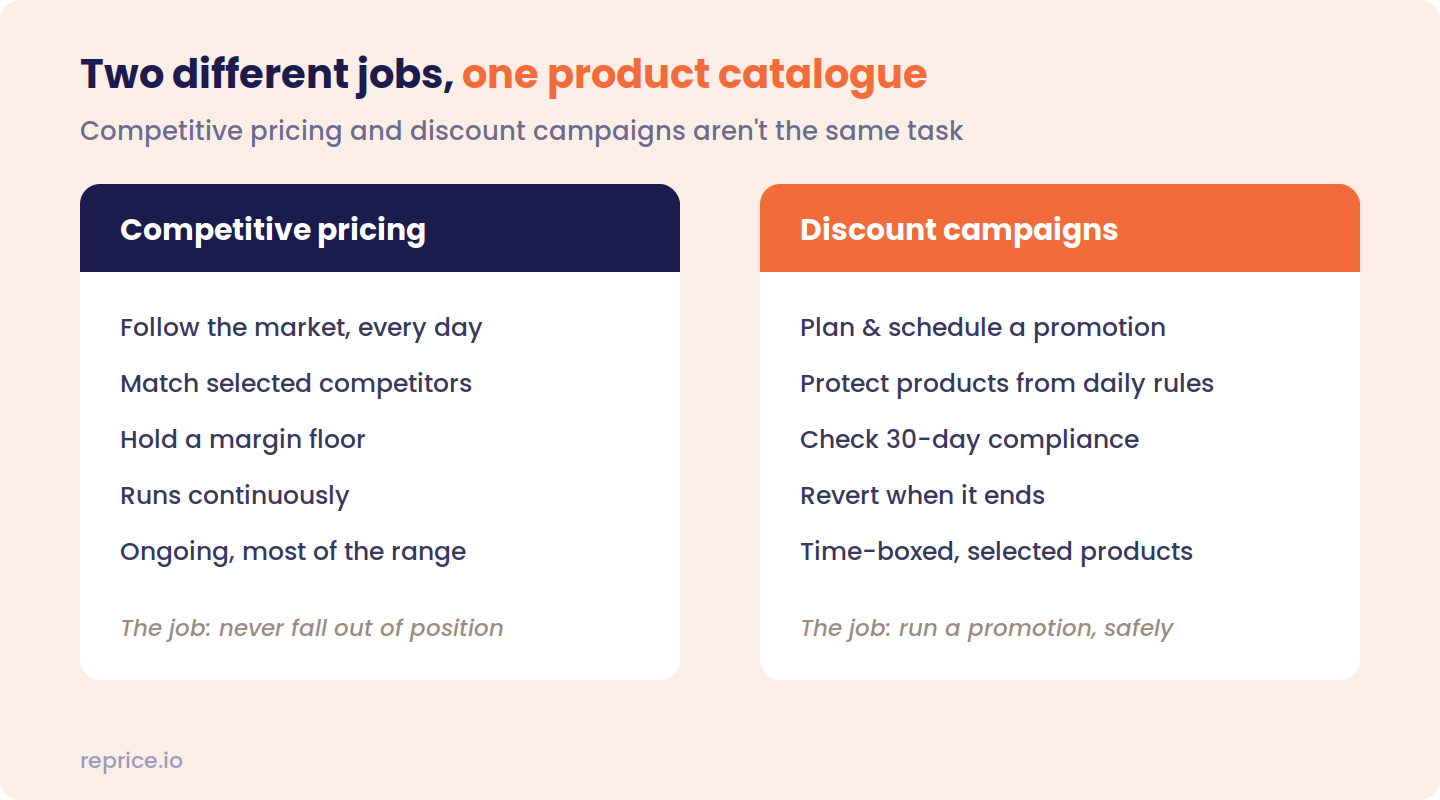
Competitive pricing is a standing task.
In categories where customers compare, your price position decides whether you show up and whether you sell. So you match selected competitors, hold a margin floor underneath, and let the rules run across most of the range, every day, whether or not anyone's watching.
It's ongoing, it's broad, and it's mostly invisible when it works. The goal is simple: never fall out of position on a product that matters.
This is the job competitor-monitoring tools are built for, and the good ones do it well — real-time data, price matching, automated rules.
If that were the whole of pricing, a monitoring tool would be enough.
It isn't the whole of pricing.
The second job is a campaign — a deliberate, time-boxed promotion on a chosen set of products. Black Week, a brand event, an end-of-season clearance.
A campaign is a different shape of work. You select products by brand, category, stock or margin. You set a deal. You protect those products from your everyday rules, so daily price-matching can't undo the promotion.
You check each one against the 30-day rule before it goes live.
You schedule it, push it to the store and ERP, and revert it cleanly when it ends. Then you report on what it did by revenue, by margin, by product.
None of that is competitor monitoring. It's campaign management. A monitoring tool can bolt on a discount rule — smarter markdown depth per product, so you don't over-discount where you'd have won the sale anyway.
That's useful, and worth having.
But optimizing the discount number is not the same as running the campaign.
The planning, the protection, the compliance check, the revert, the report — that's a workflow, and it needs to run from the same product data as your everyday pricing, not from a file on the side.
The moment the two motions live in separate systems, you're maintaining two copies of the truth. Your everyday rules know one thing; your campaign plan knows another. Nothing reconciles them except a person.
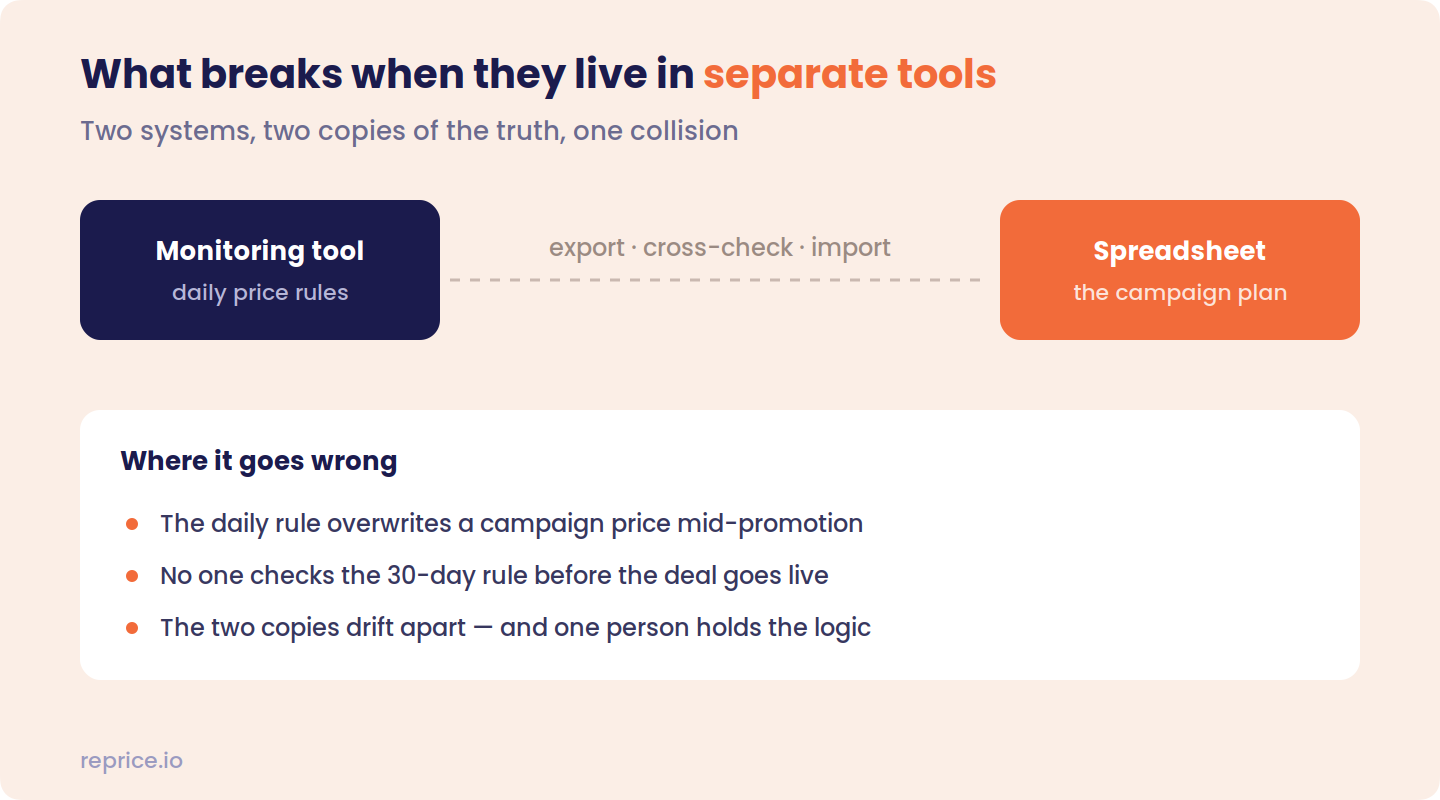
So the daily rule doesn't know a product is on promotion, and overwrites the campaign price. The campaign plan doesn't know the 30-day history, and ships a discount that breaks the rule.
The two copies drift, and the only thing holding it together is one person who remembers how the file works, until they're on holiday during Black Week.
This isn't hypothetical.
In our Black Friday Freeze report, a survey of 180 European e-commerce companies, 38% still run their biggest campaign of the year in spreadsheets or by changing prices one product at a time — the exact setup where these collisions happen.
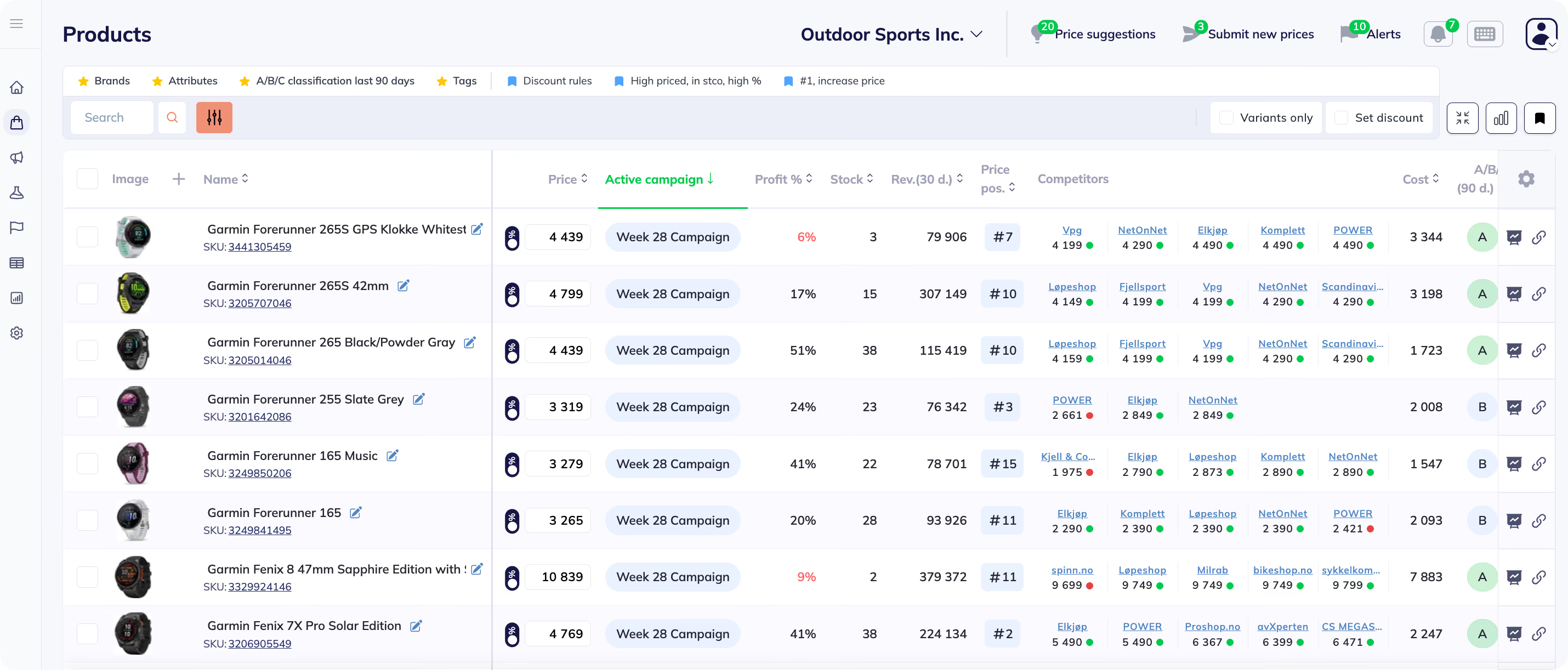
This is the cost that never shows up as a line item. It's margin given away by a rule that fired when it shouldn't have, a compliance risk nobody signed off on, and hours spent moving data between tools instead of deciding what to price.
The two jobs are different, but they act on the same products.
That's the whole point.
A product is either following the market or it's in a campaign — and the system needs to know which, at every moment, so the two motions never collide.
That's what Reprice is built to do.
Competitive pricing and discount campaigns run from the same product data, so a product moved into a campaign is automatically protected from daily rules, checked for compliance before launch, and returned to everyday pricing when the promotion ends. One catalogue, one source of truth, both jobs — a price change is a click, not a project.
Competitive pricing, discount campaigns and insights in one system.
Data: The Black Friday Freeze, a survey of 180 European e-commerce companies. All respondents are leaders involved in price strategy and price optimization at companies that run Black Friday campaigns.