

If you advertise a discount in the EU, the "before" price isn't your choice — it's the lowest price you charged in the previous 30 days.
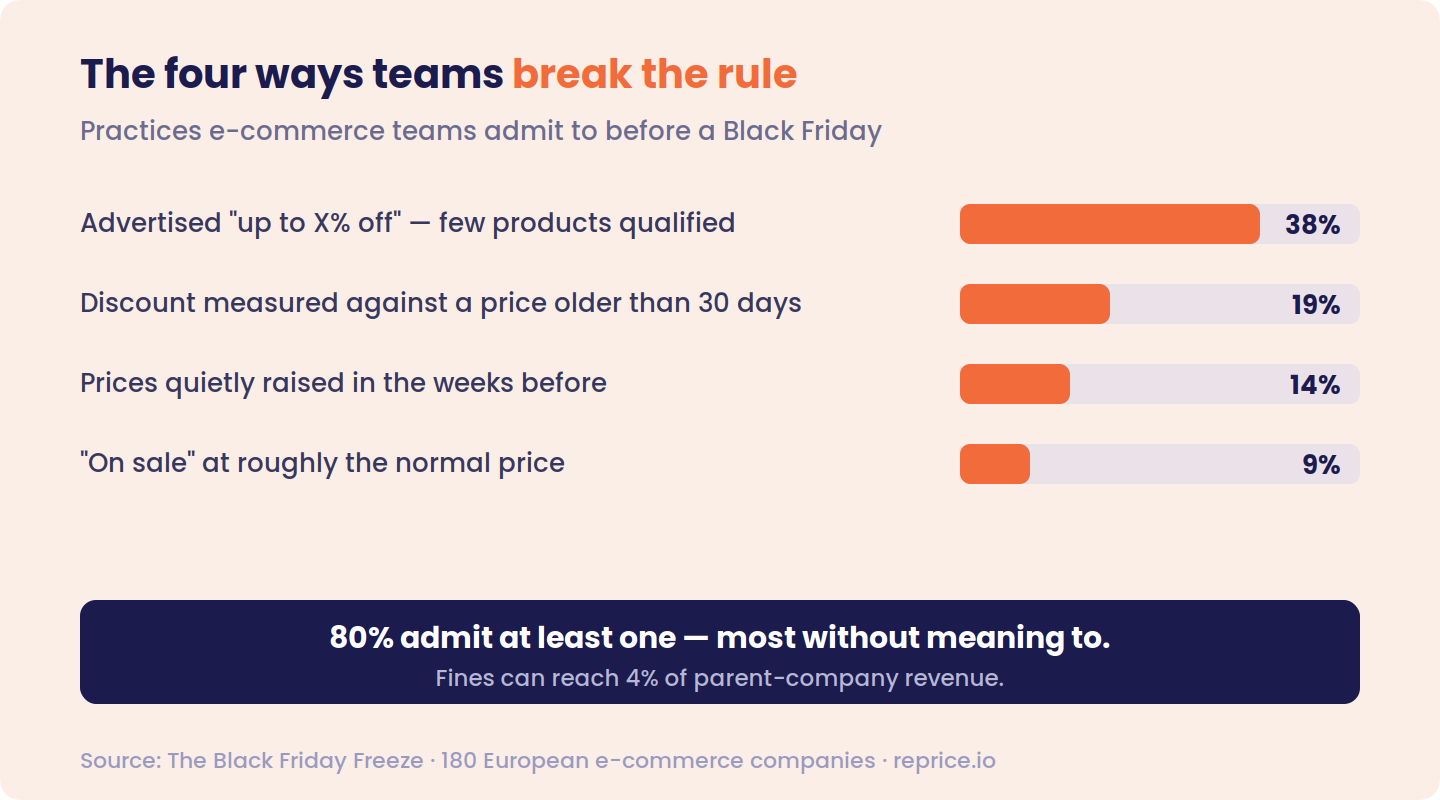
Get it wrong and the discount is illegal. Most teams do. 80% admit to a pricing practice a regulator would question, with fines up to 4% of revenue. The rule is simple.
Applying it across thousands of products, on a Black Friday deadline, is where it breaks.
The 30-day rule comes from the EU Omnibus Directive (Directive (EU) 2019/2161), which in 2022 added Article 6a to the older Price Indication Directive.
The European Commission's official guidance on Article 6a is the authoritative reference if you want the source text. It exists to kill one specific trick: quietly raising a price, then "discounting" it back down so the sale looks bigger than it is.
The rule closes that loophole with a single requirement.
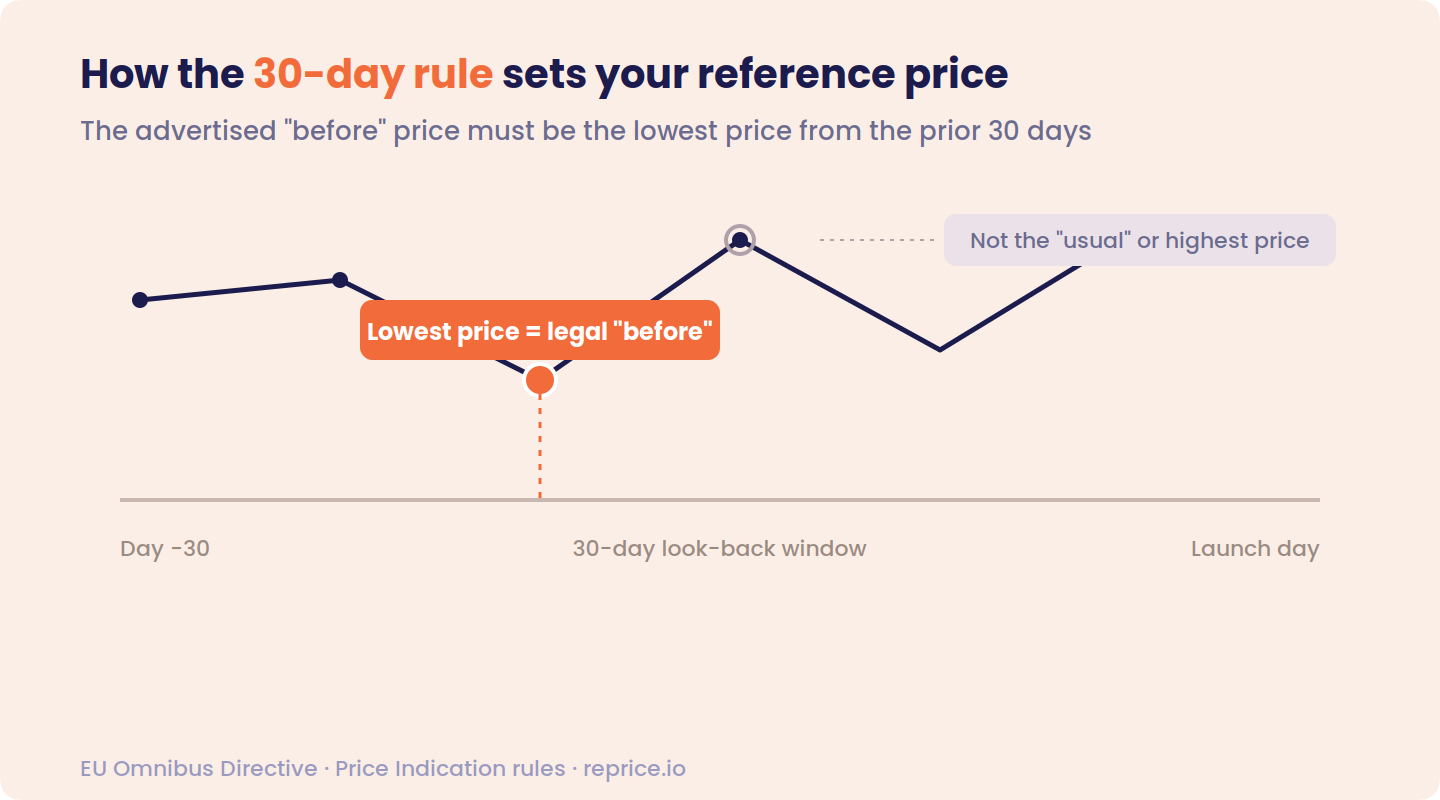
Any time you announce a price reduction, a strikethrough price, a "30% off," a sale banner over individual items, the prior price you reference has to be the lowest price you actually charged for that product in the 30 days before the discount.
It sounds like a small piece of admin.
In practice it decides whether every deal in your Black Friday campaign is legal, and it's almost impossible to check by hand at scale. Here's how it actually works.
Competitive pricing, discount campaigns and insights in one system.
Article 6a is short.
When you announce a price reduction, you have to show the prior price, and the prior price is defined as your lowest price in the 30 days before the reduction.
It's the same "lowest price in 30 days" line you now see next to strikethrough prices across the EU.
Lowest. Not your usual price, not the RRP, not what it cost last week. If you dropped the price to €80 for a flash sale two weeks ago, €80 is your reference, even if the product sat at €120 the rest of the month.
Applied. It has to be a price you genuinely charged, available to all your customers. A price that existed on the tag for a day to reset the baseline doesn't count, and that's exactly the behaviour the rule was written to catch.
30 days. It's a rolling window that ends the moment the discount starts. For every campaign launch date, you need the lowest price from the 30 days immediately before it. Some member states extend this to 60 days for seasonal sales, so the window isn't always the same length depending on where you sell.
Almost nobody sets out to break this rule. They break it because the reference price is hard to track and the campaign is big.
Four patterns show up again and again.
In our Black Friday Freeze report — a survey of 180 European e-commerce companies — 38% admitted to this one alone.
The rule isn't absolute, and a few carve-outs matter for real campaigns.
Progressive reductions are the big one. If you run a single sale campaign where the discount deepens in stages — 20% off, then 30%, then 40% — you can keep the original pre-sale price as the reference throughout, rather than resetting it at each new markdown.
This is what makes a legitimate multi-stage Black Week campaign possible without tripping the rule at every step.
There are also standard exceptions for perishable goods and for products that have been on the market for less than 30 days, since neither has a meaningful 30-day price history.
And personalized discounts such as a unique coupon code, a loyalty-card price, a birthday offer, may fall outside the rule entirely, because they aren't general price reductions announced to all consumers.
Exactly how these apply varies by member state.
If you sell across several EU markets, you're complying with the strictest version that touches your catalogue, not the most convenient one.
The rule is simple to understand and brutal to operate.
To do it properly, you need the true lowest price from a rolling 30-day window, for every product in the campaign, on the exact day it launches — and you need to prove it afterwards if anyone asks.
For a few dozen products, a careful person with a spreadsheet can manage. For a few thousand, it's the failure our Black Friday Freeze report kept surfacing — the 80% who admit a questionable practice aren't cutting corners on purpose, they're losing track at scale.
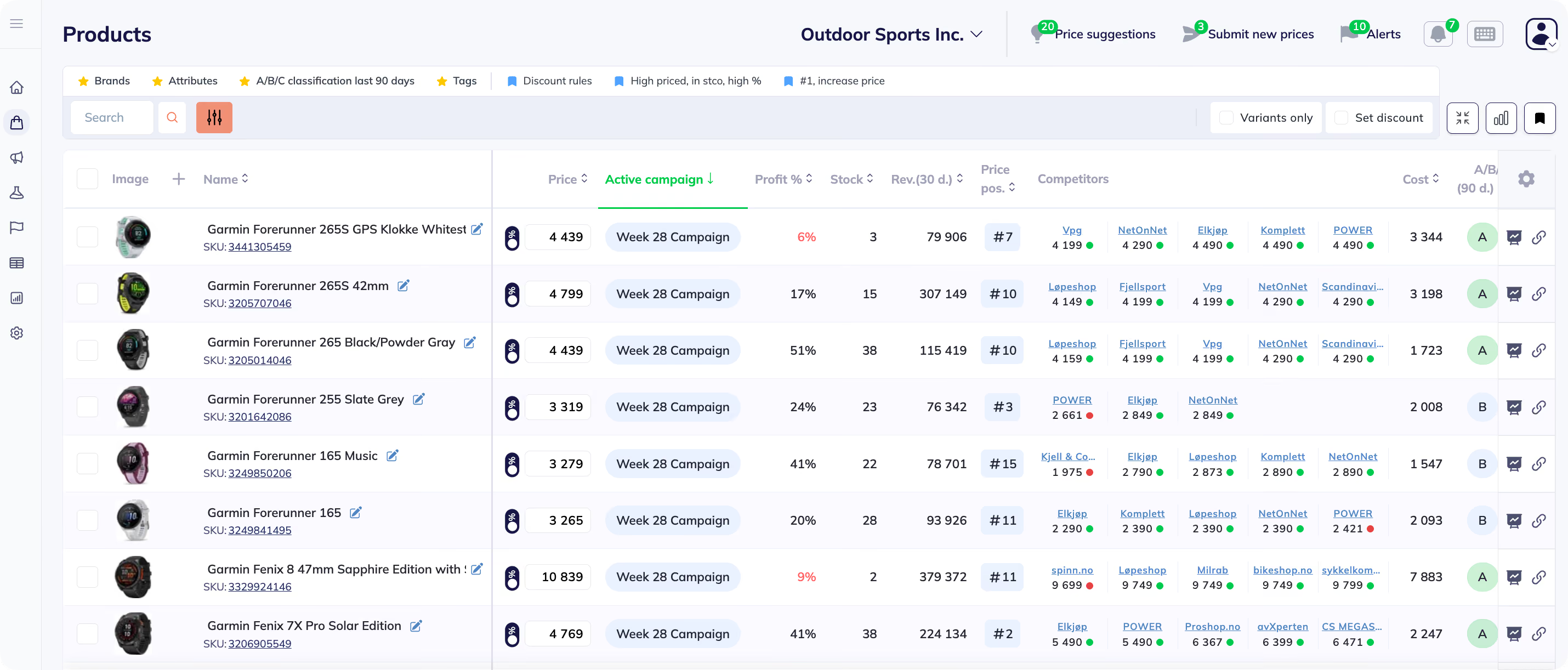
The 30-day history lives in one system, the campaign prices are built in another, and the check to reconcile them happens by eye, the week before launch, when the team is at its busiest. Nobody manually audits the price history of 3,000 SKUs under that pressure. So the check gets skipped, and the exposure ships with the campaign.
The fix isn't more diligence.
It's connecting the price history to the campaign, so the reference price is checked automatically before anything goes live.
That's the difference between hoping a campaign is compliant and knowing which products aren't yet ready to discount.
That's the whole idea behind Reprice. Competitive pricing and discount campaigns run from the same product data, so every campaign price is checked against its own 30-day history before it goes live, and the products that would break the rule are flagged, not shipped.
Competitive pricing, discount campaigns and insights in one system.
This guide is general information, not legal advice. The Omnibus Directive is implemented differently across EU member states — confirm the specifics for the markets you sell in. Compliance stats: The Black Friday Freeze, a survey of 180 European e-commerce companies.