

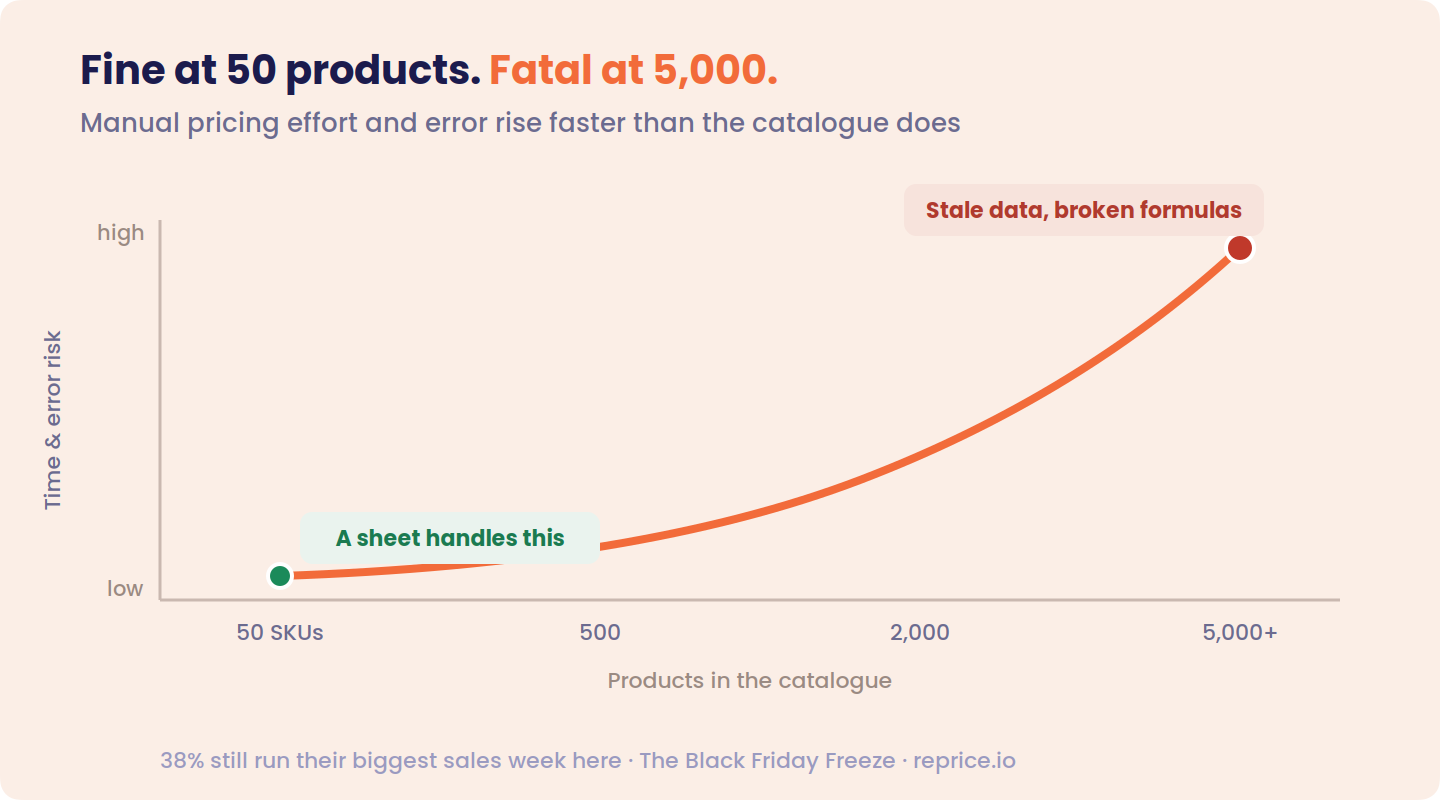
A pricing spreadsheet is a great tool to start with. It scales fine to a few dozen products, then turns into the riskiest file in the business. In our research, 38% of e-commerce companies still run their biggest sales week of the year in spreadsheets or by changing prices one product at a time. Here's what breaks when you price thousands of SKUs by hand — and why it always breaks at the worst possible moment.
The spreadsheet earns its place early.
When you sell fifty products and check three competitors, a sheet is faster than any software and bends to exactly how you work.
Nothing wrong with that.
The trouble is that the spreadsheet doesn't scale the way the catalogue does. Add products, add competitors, add channels, add a Black Week campaign on top of everyday pricing, and the same file that felt like control starts hiding more than it shows.
Nobody decides to outgrow it. You just wake up one day maintaining a spreadsheet that only one person fully understands.
Here's what that looks like in practice.
Competitive pricing, discount campaigns and insights in one system.
Manual pricing isn't one task, it's a loop.
Export the product list from your store or ERP. Cross-reference competitor prices in a separate tool or a browser tab.
Check by eye that nothing breaks the rules. Import the whole thing back. Then a competitor moves, a cost changes, or stock shifts — and you run the loop again.
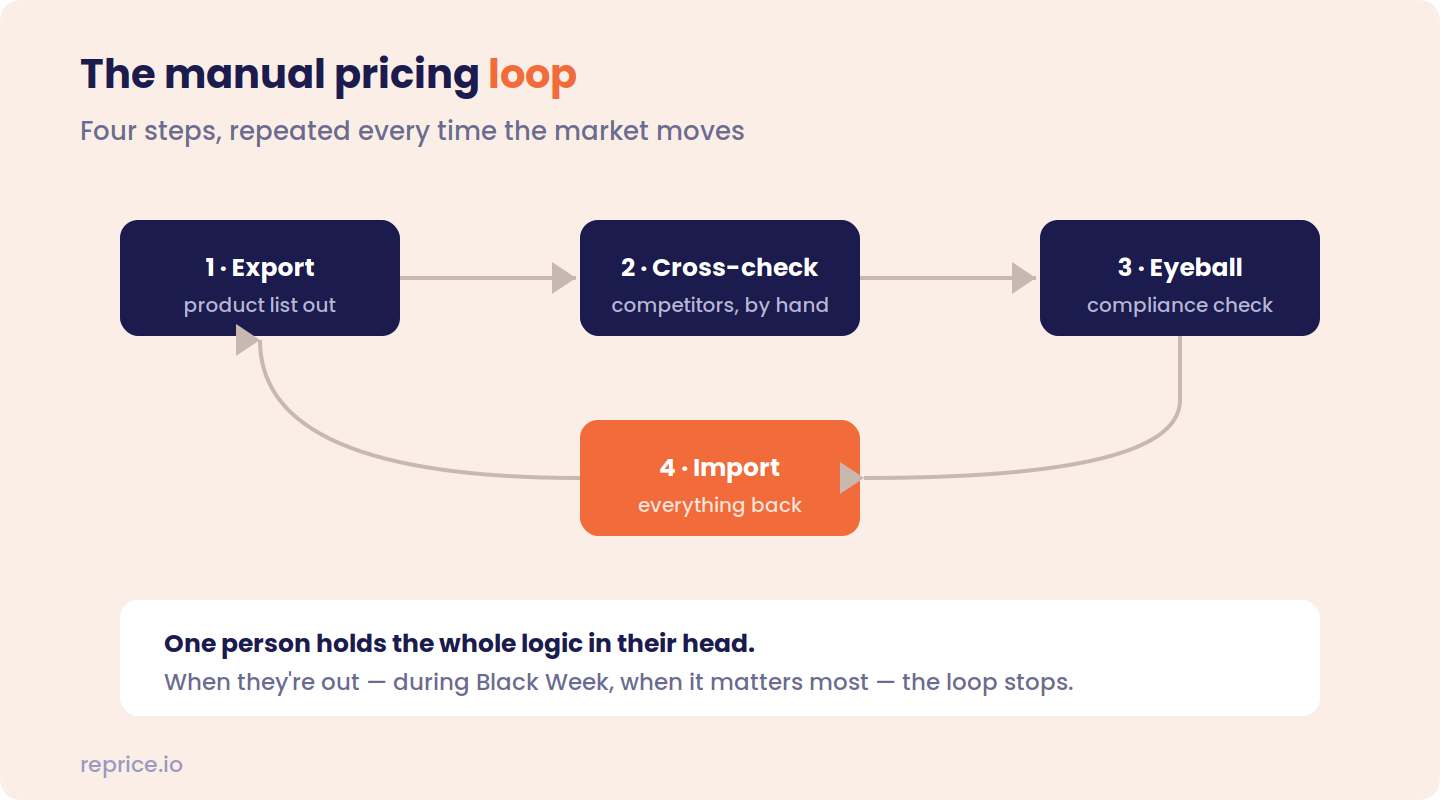
Every lap through that loop costs time and adds a place for something to go wrong.
And the loop has a single point of failure: the person who knows how the file works. When they're on holiday — which, during Black Week, someone always is — the pricing stops with them.
The failures aren't dramatic. They're small, quiet, and they compound.
By the time you have thousands of SKUs, the sheet is working against you in five ways at once.
Competitor prices go stale before you finish. A formula breaks in row 2,400 and nobody notices until a product ships at the wrong price. The 30-day rule goes unchecked because nobody hand-audits the price history of 3,000 products the week before launch.
Two copies of the file drift apart, and no one's sure which is right. And the update that's supposed to happen every morning doesn't, precisely during the week the market moves most.
None of these is a catastrophe on its own. Together, they're the reason margin leaks and compliance risk ship inside your biggest campaign.
The instinct is to fix this with more care — a stricter process, a tidier file, a second person to check the first. It doesn't work, because the problem isn't effort.
It's that the spreadsheet sits outside every system that holds the real data.
Your competitor prices are in one tool. Your stock and cost are in the ERP. Your campaign plan is in the sheet. Your store is somewhere else again.
The spreadsheet's job is to be the human bridge between all of them — and a human bridge is slow, error-prone, and only as available as the one person maintaining it.
That's the same gap whether you're doing competitive pricing or running discount campaigns: the data lives in one place, the decision in another, and a person carries it across by hand.
Our old system looked like an Excel file. It worked when we had few products, but it would never be acceptable today. Now prices export straight from Reprice to the ERP and the store.
— Caroline Tønder, Business analyst, Get Inspired
Getting off spreadsheets doesn't mean adding another monitoring tool next to the sheet — that just swaps one export for another.
It means the data and the decision live in the same place, so the loop disappears.
That's what Reprice does. Competitor position, stock, margin, sales and campaign status sit together for every product, so you're not exporting and cross-checking — you're just deciding. Everyday pricing follows your rules automatically. Campaigns are planned in the same system, checked against the 30-day rule before launch, and protected from daily rules while they run.
No file that breaks, no version that drifts, no single person holding it all together. The Black Friday Freeze report found the teams that priced best through Black Week had one thing in common: they'd stopped moving data between tools. The spreadsheet was the first thing to go.
Competitive pricing, discount campaigns and insights in one system.
Data: The Black Friday Freeze, a survey of 180 European e-commerce companies.