

Ask an e-commerce team where their pricing attention goes and the honest answer is: the campaign. The discounted products, the Black Week deals, the brand promotions — those get watched closely. Everything else, which is usually most of the catalogue and most of the revenue, gets set once and left alone. That neglected majority is exactly where competitors take share and margin leaks out, one un-repriced product at a time.
It's easy to see how it happens.
Campaign products are visible, deadline-driven, and someone's job. The other 90% of the range has no deadline, no owner, and no alarm when it drifts out of position. So it just…drifts.
The problem is that customers don't only shop your campaign.
They compare prices across your whole catalogue, and so do your competitors. A product that hasn't been repriced in two months isn't stable — it's just unwatched, winning or losing sales on a price you set and forgot.
This is the pricing gap almost nobody talks about, and it's the one worth closing first.
Competitive pricing, discount campaigns and insights in one system.
Pricing effort follows attention, and attention follows the campaign.
The discounted products get checked daily; the rest of the range gets a glance when someone remembers. But the split of effort doesn't match the split of revenue — most of your sales come from products getting almost none of the pricing.
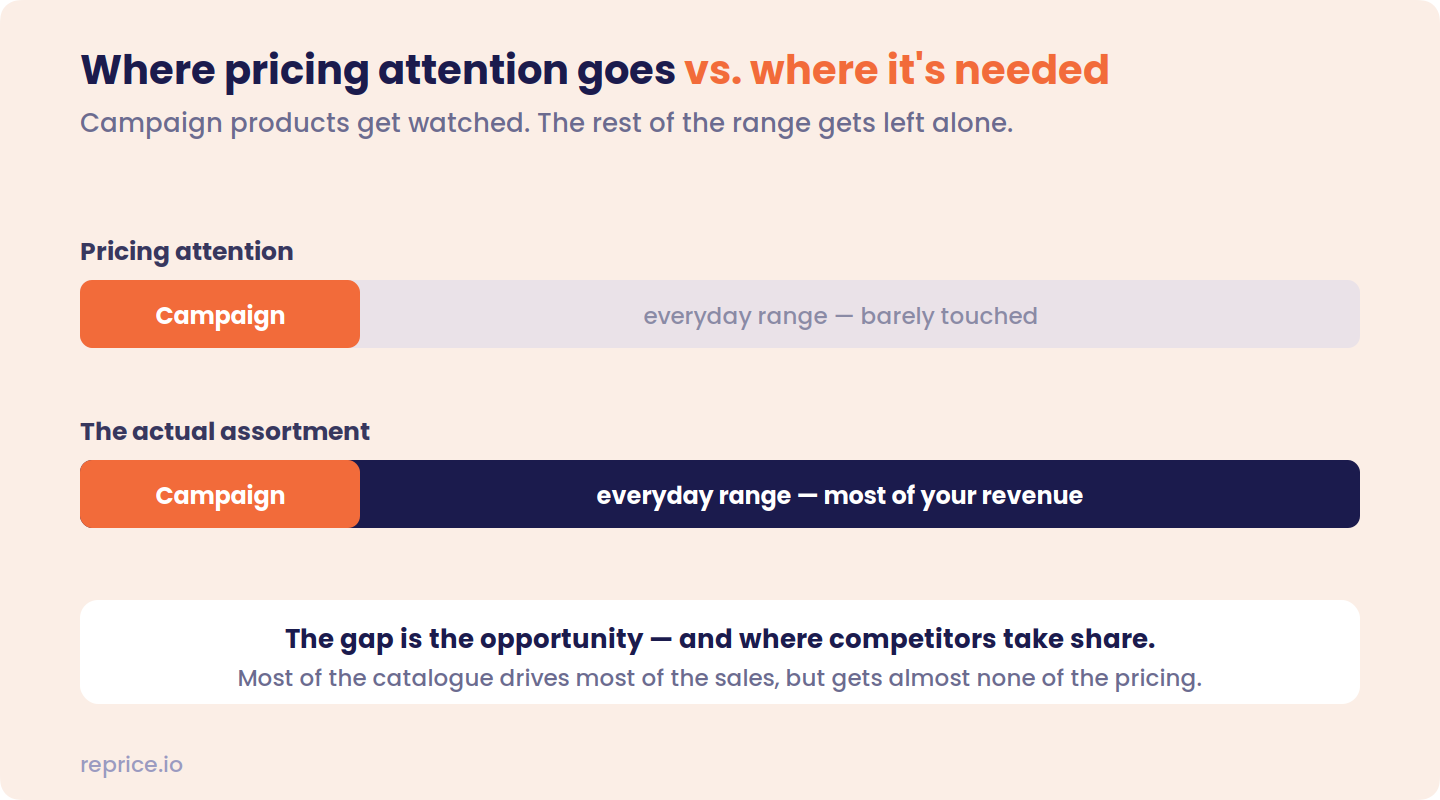
That mismatch is the whole problem in one picture.
The campaign is a sliver of the catalogue getting the majority of the attention, while the everyday range — most of what you sell — coasts on prices nobody has looked at in weeks.
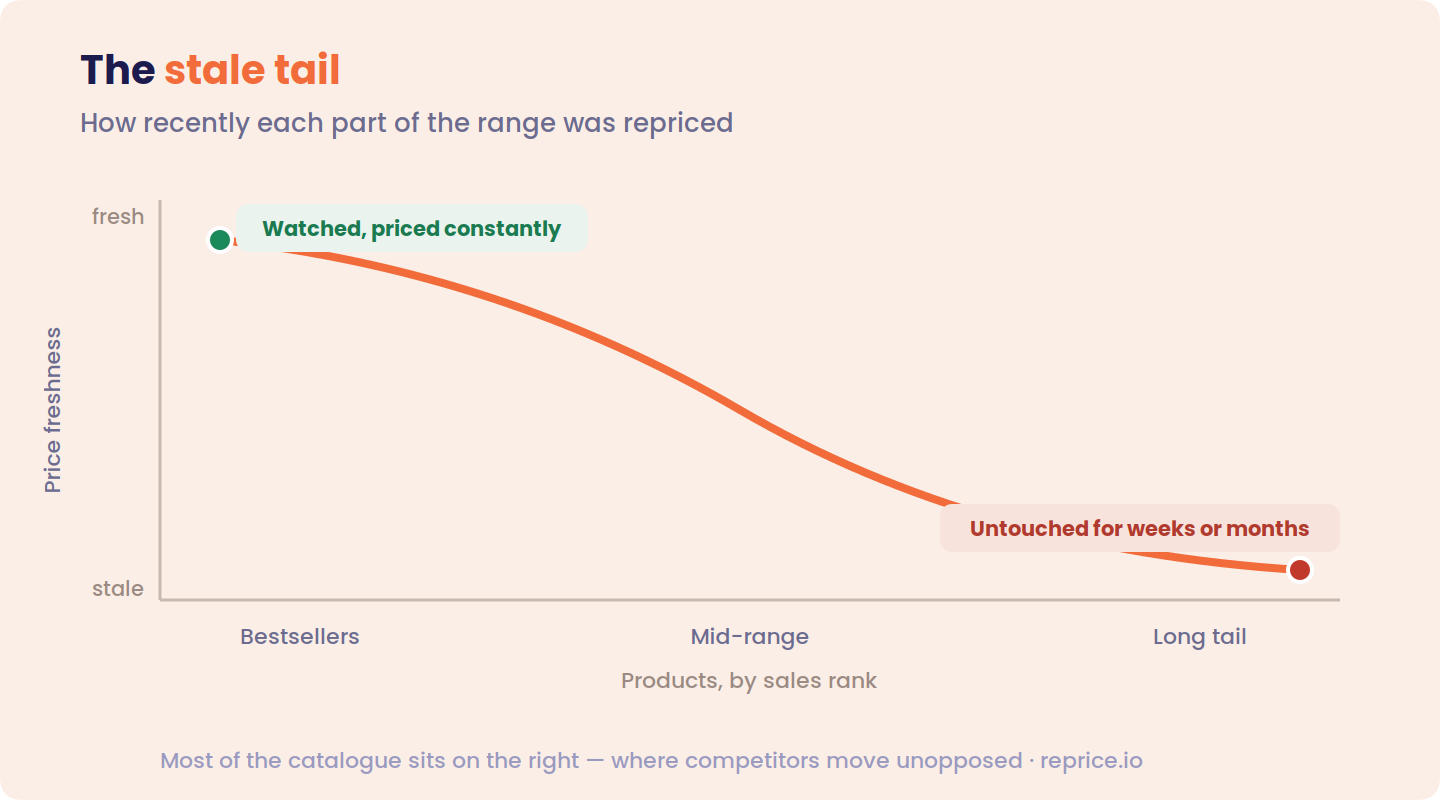
Line your products up by sales rank and look at how recently each was repriced, and you'll see the same shape every time.
Bestsellers are fresh — watched, repriced constantly, defended. The further down the tail you go, the staler the price gets, until you reach products that haven't been touched in months.
Here's why that tail matters.
It's not dead inventory — it's live products still taking orders, still shown next to competitors, still shaping whether a customer trusts your prices. A competitor who undercuts you on a long-tail product you've forgotten wins that sale unopposed, because you're not even watching.
And when that product does finally go on promotion, its neglected price history is exactly what trips the 30-day rule.
Multiply that across thousands of neglected SKUs and the leak is real, even though no single product ever sets off an alarm.
None of this is a discipline failure. It's structural.
The campaign has a system — a plan, a deadline, a list of products, a person.
Everyday pricing across the full range has none of that, so it defaults to manual, and manual doesn't scale past the products someone can personally keep an eye on.
This is the same root cause behind the Black Friday Freeze: during the one week that matters most, teams narrow their focus to the discounted products and the rest of the assortment stops being priced at all.
The freeze isn't just a campaign-week problem. It's the everyday state of most catalogues, made visible by the pressure of Black Week.
The fix isn't more people watching more products.
It's giving the whole range the same automated attention the campaign gets by hand — everyday competitive pricing and campaign pricing running together, from the same product data, so no product falls off the radar just because it isn't on promotion.
A pure monitoring tool can keep the tail priced, but leaves the campaign in a spreadsheet — you need both from one place.
When everyday pricing runs automatically, the tail stops going stale.
Every product follows a rule — match selected competitors, hold a margin floor — so the long tail stays in position without anyone touching it.
Your attention goes to the exceptions and the campaigns, not to manually chasing 3,000 prices.
That's what Reprice is built for. Competitive pricing runs continuously across your entire catalogue, campaigns are pulled from the same product data when you need them, and nothing gets left behind — not the long tail during a quiet week, and not the everyday range during Black Week.
Getting off the pricing spreadsheet is what makes it possible: the moment pricing is automated, "the whole assortment" stops being an aspiration and becomes the default.
Competitive pricing, discount campaigns and insights in one system.
Data: The Black Friday Freeze, a survey of 180 European e-commerce companies.