

Most pricing advice starts with the competition — match them, undercut them, react to them. But clearing slow-moving stock isn't a competitor problem. It's an inventory problem, and you already own the two numbers that solve it: how old the stock is and how fast it's selling. A progressive markdown reads those signals and steps the price down on its own — no competitor monitoring, no manual watching, no guessing when to cut.
Slow stock is expensive in a way that's easy to ignore, because the cost never lands as a single invoice.
A product that isn't selling ties up cash, takes up space, and loses relevance every week it sits. Inventory carrying costs run an estimated 15–30% of stock value per year — so the longer you wait to act, the more a unit costs you before it ever sells.
The instinct is to wait for a reason to discount: a seasonal sale, a competitor's move, a Black Week campaign.
But slow stock doesn't need an occasion. It needs a rule that watches its performance and acts before the carrying cost eats the margin you were trying to protect.
Competitive pricing, discount campaigns and insights in one system.
To decide whether a product needs a markdown, you don't need to know what a competitor charges.
You need two things you already track: how long the stock has been sitting, and how fast it's moving relative to what you expected.
Sell-through velocity and stock age tell you everything about whether a product is stuck.
That's what makes slow-stock clearance different from competitive pricing.
Competitive pricing looks outward — at the market. Clearing slow stock looks inward — at your own performance.
Both matter, but they answer different questions, and the second one doesn't need the competition in the room at all.
A progressive markdown is a staged discount that deepens over time until the stock clears.
Instead of one big cut, the price steps down in stages, each triggered by the product still being slow at a checkpoint.
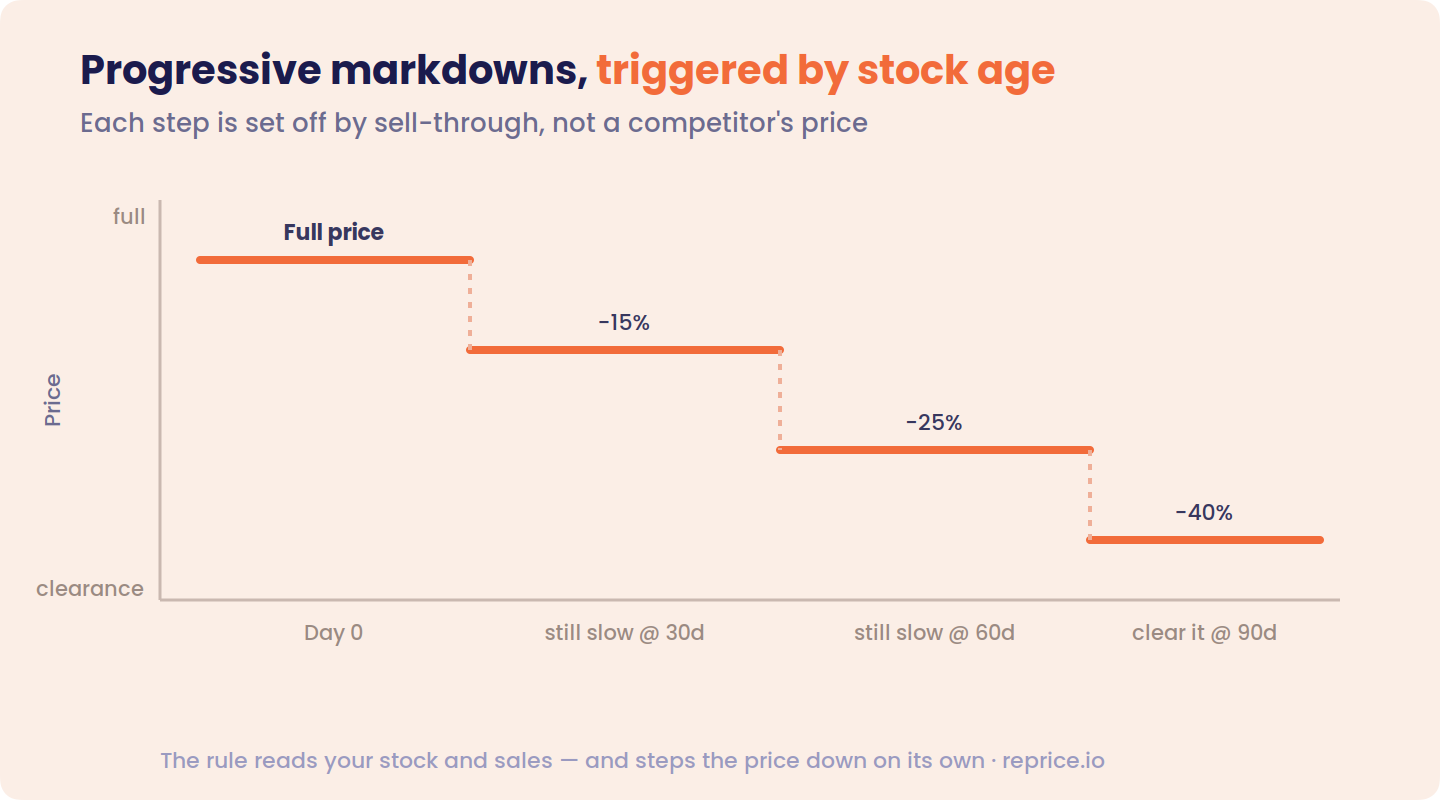
The mechanism matters. Because each step is triggered by the product's own performance, not a calendar date or a competitor's price, you only discount what actually needs it.
A product that starts selling after the first markdown holds at that level.
One that's still stuck keeps stepping down until it moves. You capture full price from every customer willing to pay it, and clear the rest before it goes stale — without a person watching each SKU.
Done this way, a staged markdown also stays clean under the 30-day rule: a single planned campaign of successive reductions can reference the original pre-markdown price throughout, rather than resetting at each step.
The reason to automate this is that the alternative — waiting until someone notices the stock is stuck — is more expensive than the discount you're avoiding.
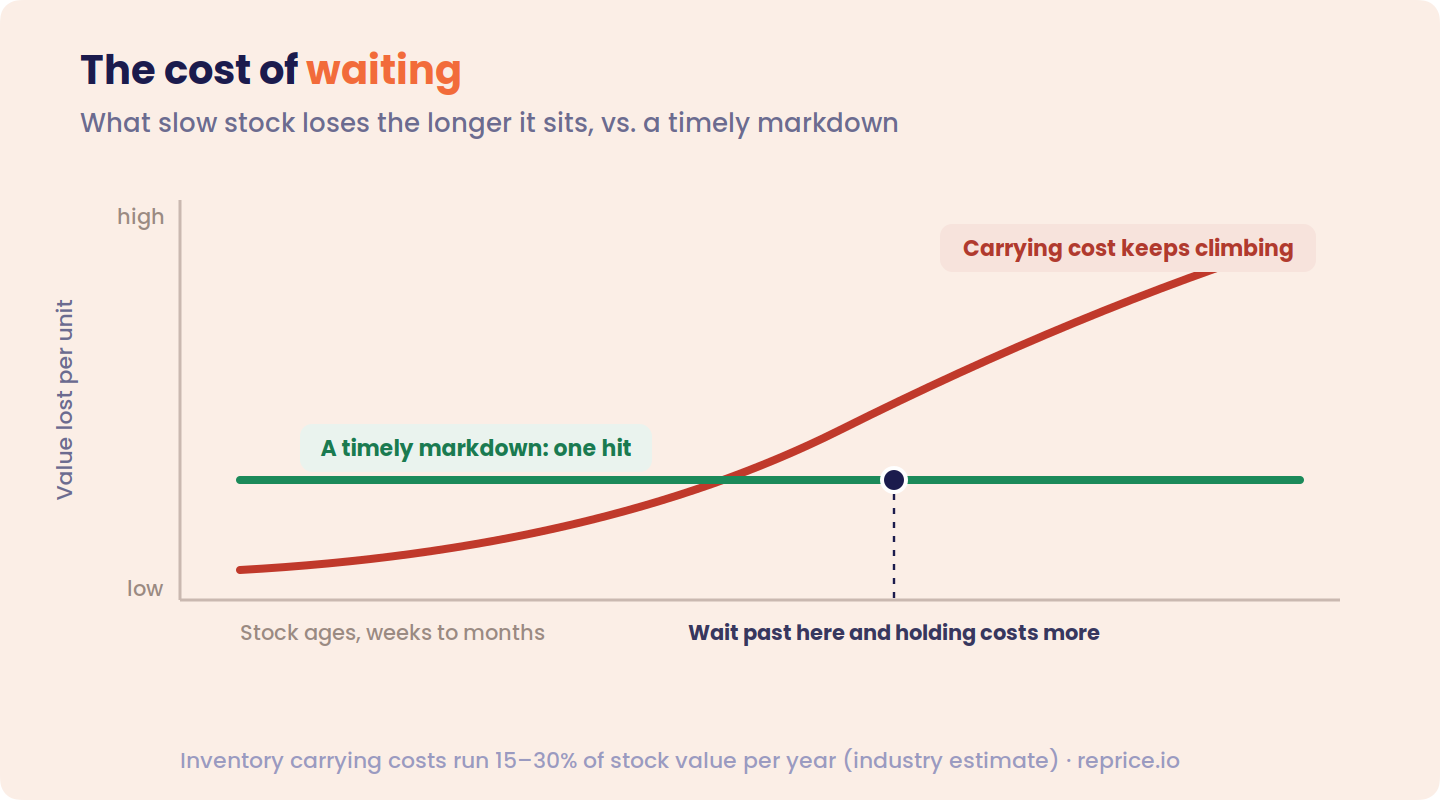
Every week a slow product sits, the carrying cost climbs — storage, tied-up capital, lost relevance. A timely markdown is a single, known hit to margin. Waiting is an open-ended one.
The crossover point comes faster than most teams expect, and by the time a stuck product is obvious enough to notice manually, you're usually well past it.
A rule that acts at the first sign of slow movement catches the product while the discount is still small.
Here's where it comes together.
Slow-stock markdowns and competitive pricing pull on the same products from different directions — one watching the market, one watching your inventory.
Run them in separate tools and they collide, the same way everyday pricing and campaigns collide when they're split: a competitor rule undercuts a markdown, or a markdown ignores a competitor who's already cheaper.
Reprice runs both from the same product data. Competitor position, stock age, sell-through and margin sit together for every product, so a slow-stock rule and a competitive rule work off one source of truth instead of fighting over it.
You clear aging stock on internal signals, stay competitive on external ones, and never reconcile the two in a spreadsheet afterward. It's the same principle behind the Black Friday Freeze finding: the teams that priced best had stopped moving data between tools and let one system watch every signal at once.
Competitive pricing, discount campaigns and insights in one system.
Carrying-cost estimate: widely cited industry range for annual inventory holding costs. Pricing behaviour data: The Black Friday Freeze, a survey of 180 European e-commerce companies.