

Black Friday pricing goes wrong in predictable ways. Teams plan for months, then freeze their prices the moment the week starts; they lock discounts too early, skip the compliance check, and can't say afterward whether any of it made money. We surveyed 180 European e-commerce companies to find the exact gaps — and turned them into a 12-point checklist you can run before November. Work through it below, or grab the free PDF and tick it off with your team.
This isn't a generic "have a plan" list.
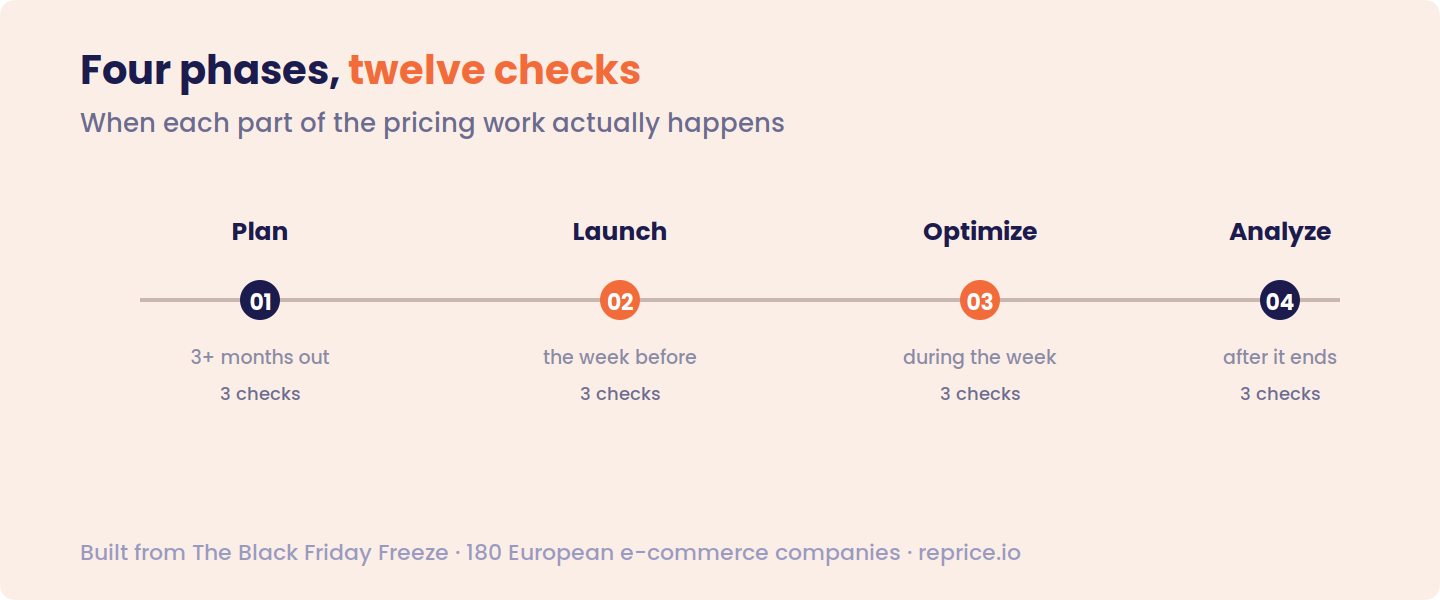
Every check maps to a specific mistake the research surfaced, organized by when the work actually happens: planning months out, launching the week before, optimizing during the week, and analyzing after it ends.
You can read the whole thing here.
The downloadable version is built to print, share, and run as a team.
12 pricing checks across planning, launch, optimization and analysis — built from what 180 e-commerce companies got wrong.
Good Black Friday pricing isn't one push before the week — it's four distinct jobs spread across the year.
Planning happens months out, when you decide what competes on price and set your margin floors.
Launch is the week before, when compliance and campaign setup have to be right. Optimization happens live, during the week itself. And analysis comes after, when you find out whether any of it actually made money.
Most teams do the first two well and let the last two slide — which is exactly where the research found the biggest gaps. The twelve checks below follow that timeline.
1. Segment the assortment before you plan
Split your products into the ones you compete on price and the ones where you protect margin. A single discount list treats both the same and races everything to the bottom.
This is the foundation the rest of the checklist rests on — price the whole range with this split in mind, not just the campaign.
2. Set margin floors, not just discount depths
Every campaign price needs a floor it cannot cross, including when a competitor forces a mid-week reaction. A discount depth without a floor is how a "good" campaign loses money.
3. Keep prices decidable, not locked in October
In the research, 57% lock their discounts a month or more before launch — deciding when the information is oldest. Plan the strategy early, but keep the actual prices adjustable until they matter.
4. Verify every deal against the 30-day rule
Check each campaign product against its own 30-day price history before launch. 80% of companies admit to at least one practice a regulator would question — most without meaning to.
If you're not sure how the rule works, here's the plain-English version.
5. Make sure "up to X% off" is honest
The single most common violation is a headline discount only a handful of products actually reach. Confirm the claim matches the catalogue before it goes live.
6. Protect campaign products from daily rules
If you run everyday competitive pricing, stop it from overwriting a promotional price mid-campaign.
This is where competitive pricing and campaigns collide when they're not in one system — lock campaign products, or they'll drift.
7. Keep the whole range priced, not just the campaign
30% of companies change zero prices during Black Friday week.
Competitors don't stop at your campaign list, so everyday pricing has to keep running on the rest of the catalogue while the promotion is live.
8. Define reaction rules in advance
Decide now which products get defended, how far you'll follow a competitor down, and who approves a change.
If the answer requires a meeting on Black Friday, the answer arrives too late.
9. Remove the export–import loop
74% face a real barrier to changing prices mid-week — usually because it takes a spreadsheet, an approval, and a file upload. If reacting is that heavy, it won't happen.
Getting off the spreadsheet is what makes mid-week reaction possible at all.
10. Measure margin per product, not revenue per week
Half of companies can't say precisely whether their last Black Friday was profitable.
Decide before launch how you'll measure margin after discounts, ad spend, shipping and returns — a top-line revenue number hides a campaign that lost money.
11. Name your best and worst products
You should be able to point to your single most and least profitable campaign product. If you can't, the measurement wasn't set up properly — fix that for next year.
12. Turn the result into next year's plan
Feed what worked and what didn't straight back into next year's segmentation and floors, so the plan improves instead of repeating.
The teams that get better every year are the ones that close this loop.
The checklist works best as a shared artifact — printed, passed around, and ticked off together in the weeks before Black Week.
The full data behind every check is in the Black Friday Freeze report, and the same logic behind avoiding the manual-reaction trap is why teams eventually move competitive pricing and campaigns into one system instead of running them apart.
12 pricing checks across planning, launch, optimization and analysis — built from what 180 e-commerce companies got wrong.
Data: The Black Friday Freeze, a survey of 180 European e-commerce companies.