

Ask how often you should reprice and the usual answers are a single number: daily, weekly, continuously. That number is wrong before you pick it, because the right frequency isn't the same for any two products. A phone case on a dozen comparison sites and a niche product with no real competition need completely different cadences, and most stores run one rhythm for both. In our survey of 180 European e-commerce companies, 67% changed their prices at most twice during Black Friday week, the week competitors move the most.
Repricing frequency gets set once and applied to the whole catalogue: pick a schedule, roll it out to everything, move on.
Pricing guides answer the question with a single number too, weekly or daily for everything you sell.
But your products don't all move at the same speed. Some sit in markets where competitors change price every hour; others barely move all year.
Apply one frequency to both and you reprice the quiet products far more than they need, and the fast ones nowhere near enough.
There's no single repricing frequency. The right cadence is per product, set by how fast its market moves.
During the one week competitors move the most, the majority of retailers barely move at all.
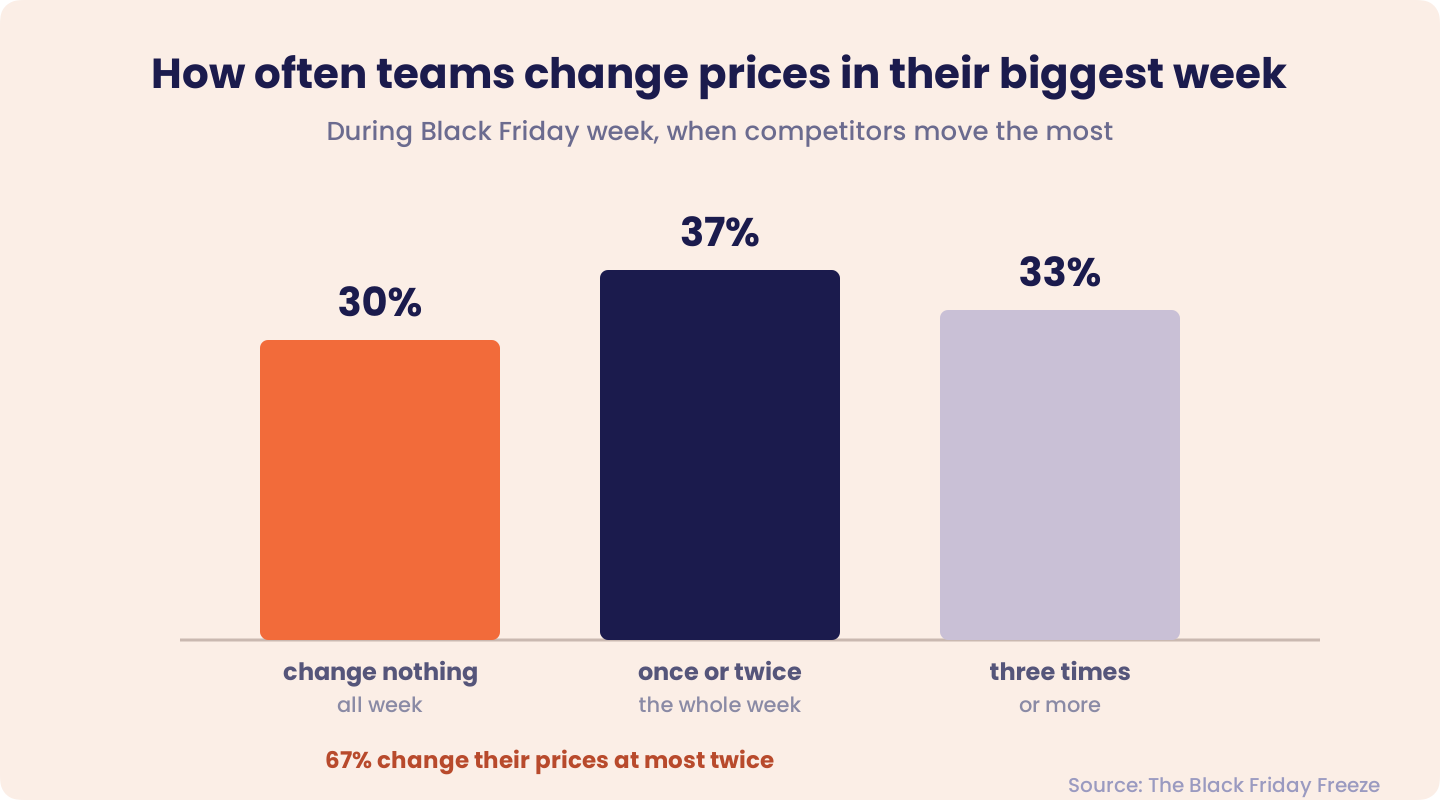
30% change no prices during Black Friday week. Another 37% change them once or twice. Only 33% change prices three or more times.
That's two-thirds making at most two moves across the busiest, most volatile week of their year, from the Black Friday Freeze report.
A standing weekly or monthly cadence looks fine on paper and leaves you flat-footed exactly when prices around you are moving daily.
The instinct this comes from is reasonable: changing prices by hand is work, so teams do it as seldom as they can get away with.
The result is a single slow cadence applied to the whole catalogue, including the products that needed a dozen changes that week.
A product's repricing frequency comes down to two questions: How often do its competitors change price? And how much does a stale price cost you on it?
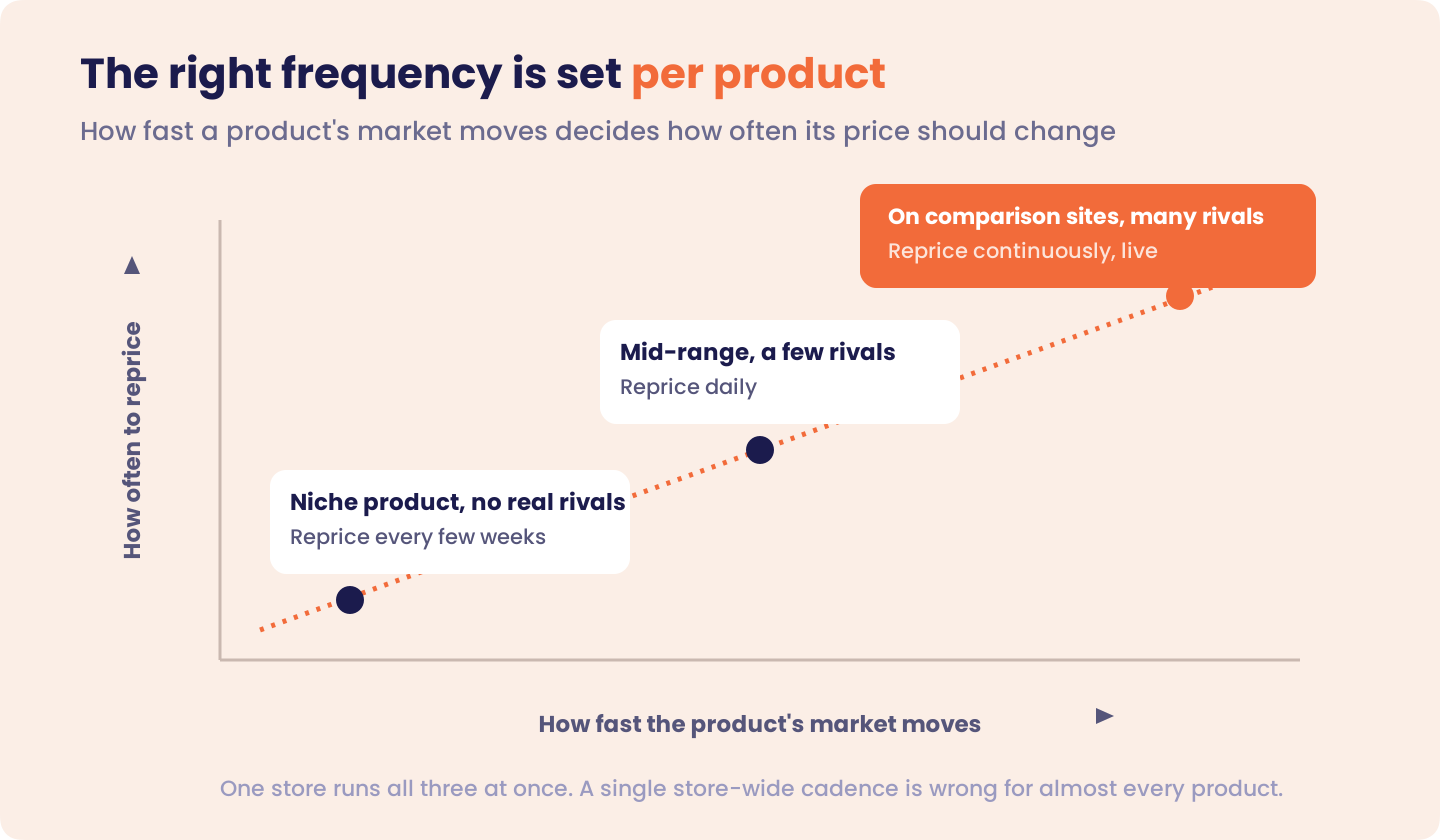
Take three products from the same store.
A niche item with no real competitor can hold its price for weeks, because nothing is moving against it and a day-old price costs nothing.
A mid-range product with a few tracked rivals should be checked daily, because a competitor could undercut it overnight.
A high-demand product listed across the comparison engines, where buyers sort by price and rivals reprice continuously, needs to move continuously too, because every hour above the cheapest offer is lost traffic.
Same store, three different right answers.
The frequency follows the product's market, not a calendar you set once for everything.
Too slow is the obvious failure.
A fast-moving product left on a weekly schedule spends most of the week mispriced, either sitting above competitors and losing the sale, or sitting below them and giving away margin you didn't need to.
Too fast has a cost as well.
Repricing a stable product many times a day burns effort for nothing, and jumpy prices on products customers watch can read as unreliable. The target is to change each price as often as its market demands and no more, which on a quiet product might mean leaving it untouched for weeks.
This is why "reprice everything daily" and "review prices monthly" are both wrong. Each is a single speed imposed on a catalogue that contains many.
You can't track dozens of different repricing schedules by hand across thousands of products.
The reason most teams default to one slow cadence is that one cadence is all a person can hold in their head.
Rules remove that limit.
In competitive pricing, you set the logic once per group of products: match these competitors on these products, down to a margin floor, and let the rule act whenever a qualifying competitor moves.
A product in a fast market then reprices the moment its competitors do, continuously if that's what the market demands.
A product in a quiet market stays put until something actually changes, because nothing triggers the rule.
You stop choosing a frequency for the catalogue and start letting each product's own market set its pace, which is the only cadence that was ever right.
There's no single repricing frequency. The right cadence is per product, set by how fast its market moves.
Data: The Black Friday Freeze, a survey of 180 European e-commerce companies.