

In the Nordics, the sale is often won before a shopper ever reaches your store. They start on Prisjakt, PriceRunner or Google Shopping, compare every retailer selling the same product, and click the best offer. These engines sort primarily on price — so your placement, and a large share of your traffic, is decided by where your price sits against competitors at that exact moment. If you're not pricing to win on the comparison engines, you're paying for products to sit below rivals you could have beaten.
For a Nordic retailer in a competitive category, this is where competitive pricing actually pays off or doesn't. Prisjakt is the most-visited comparison site in both Sweden and Norway. PriceRunner — now owned by Klarna and folded into Klarna's shopping app — sits right behind it, extending that reach across Sweden, Denmark and beyond. Google Shopping overlays the whole market.
The mechanics of all three are close enough to treat together. Here's how they decide your position, and what it takes to win it.
Competitive pricing, discount campaigns and insights in one system.
Strip away the details and a comparison engine does one thing: it takes every retailer selling a given product and sorts them, with price the dominant factor.
The cheapest in-stock offer sits at the top. That top position gets the overwhelming majority of the clicks, because shoppers rarely scroll far.
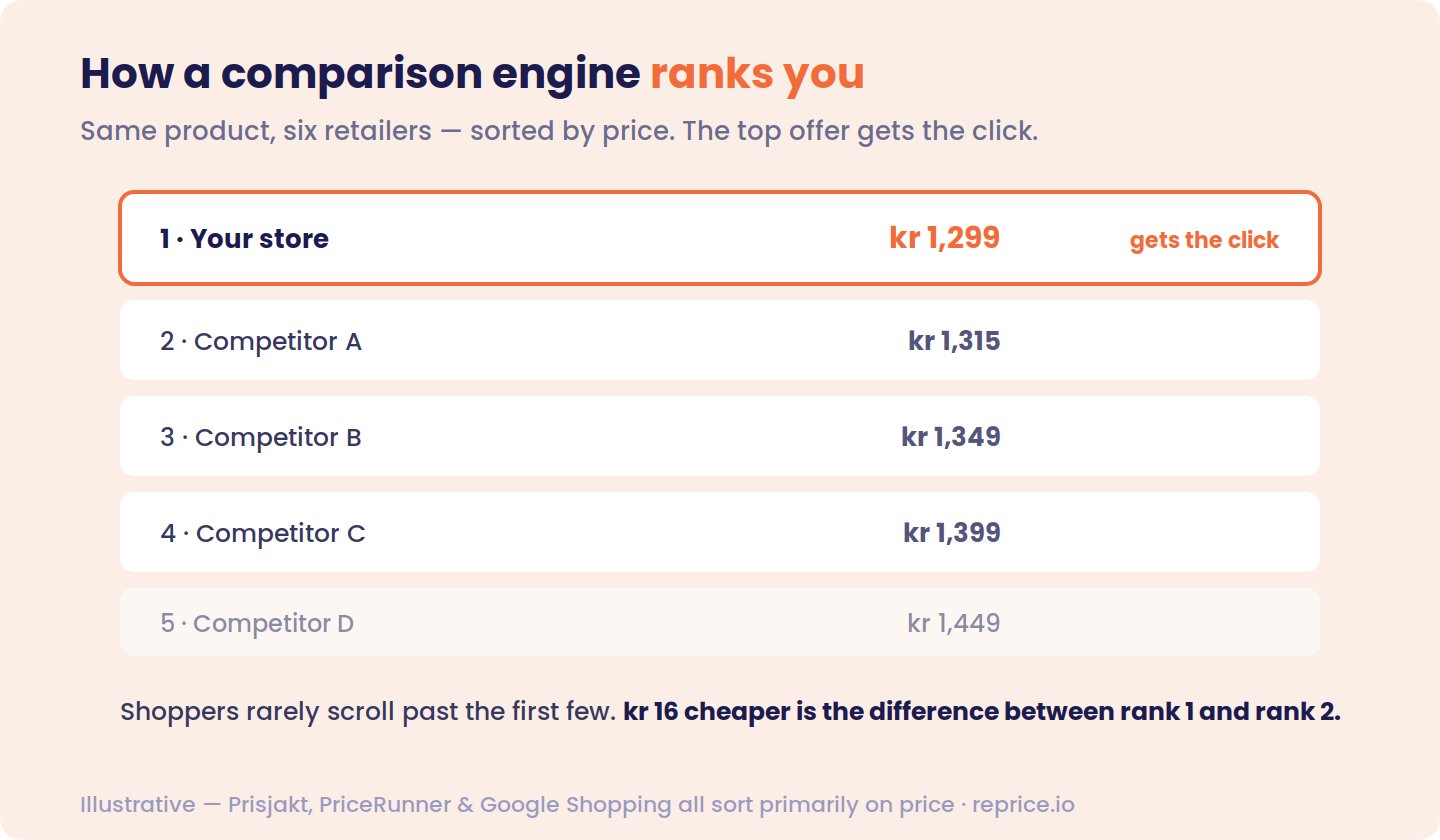
The brutal part is how small the margins of victory are.
The difference between first and second place might be a few kroner.
Price your product at kr 1,315 when the leader is at kr 1,299, and you don't get 98% of their visibility — you get a fraction of it, sitting one row down where far fewer shoppers look. The ranking is a cliff, not a slope.
Price is what's ranked, but price isn't the only thing that decides whether you rank at all.
Everything the engine knows about you arrives through your product feed, and three parts of it have to be right at once.
Your price has to be current and competitive, checked against what rivals are charging right now, not last week. Stock status has to be accurate, because an out-of-stock offer gets demoted or dropped — winning the top spot on a product you can't ship helps no one.
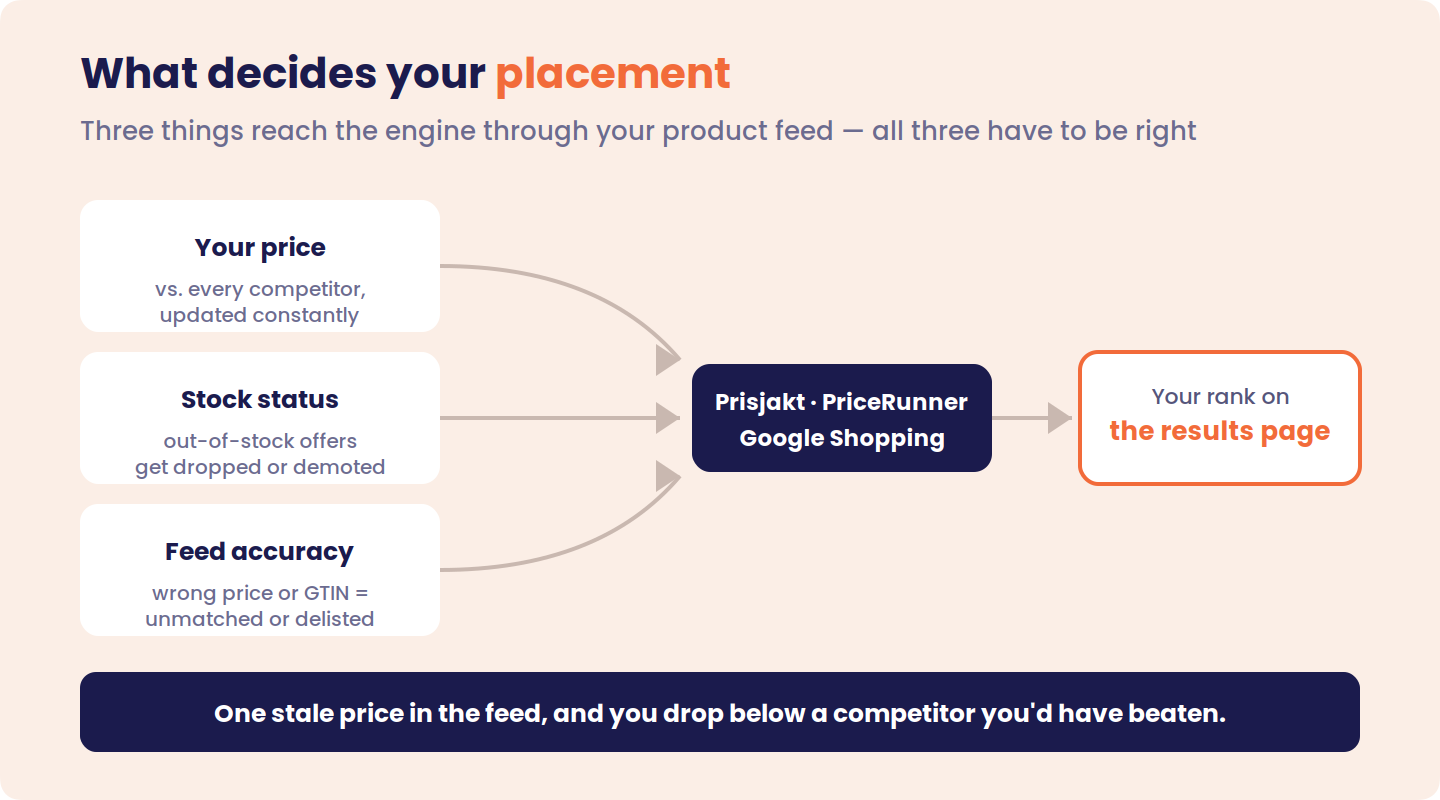
And the feed itself has to be clean: a wrong price, a missing GTIN, or a bad product match means your offer is unmatched or delisted, invisible regardless of how sharp your price is.
Win on all three and you place.
Miss one and you don't.
Placement on these engines isn't a marketing task you set once.
It's a live competitive-pricing problem, because the thing that decides your rank — your price relative to every competitor — changes every time one of them moves. A price that won you the top spot this morning can be in third place by lunch, without you touching anything.
That's why winning here means pricing your whole assortment continuously, not just your campaign products.
Every product in your feed is competing for placement, all the time.
The retailers who win Nordic comparison traffic aren't checking prices manually — they can't, because the feed is too big and the market moves too fast, the same wall that breaks manual pricing in a spreadsheet.
The obvious risk is that "price to win placement" becomes "always be cheapest," which is a race to the bottom that clears your margin along with your competitors'.
It doesn't have to work that way.
The point isn't to be cheapest on everything — it's to be competitively placed on the products where placement is worth winning, while a margin floor stops any rule from chasing a competitor below profitability.
That balance — aggressive on placement, protected on margin — is exactly what a rules engine is for.
You decide which products fight for the top spot and how hard, and the floor guarantees no automated move ever wins a placement that loses money.
Prisjakt, PriceRunner and Google Shopping all reward the same thing: a current, competitive, accurate price on an in-stock product, fed reliably.
That's not three problems — it's one, solved once.
When your competitive pricing runs continuously across the whole assortment and pushes clean prices to every channel, placement takes care of itself.
That's what Reprice does for Nordic retailers.
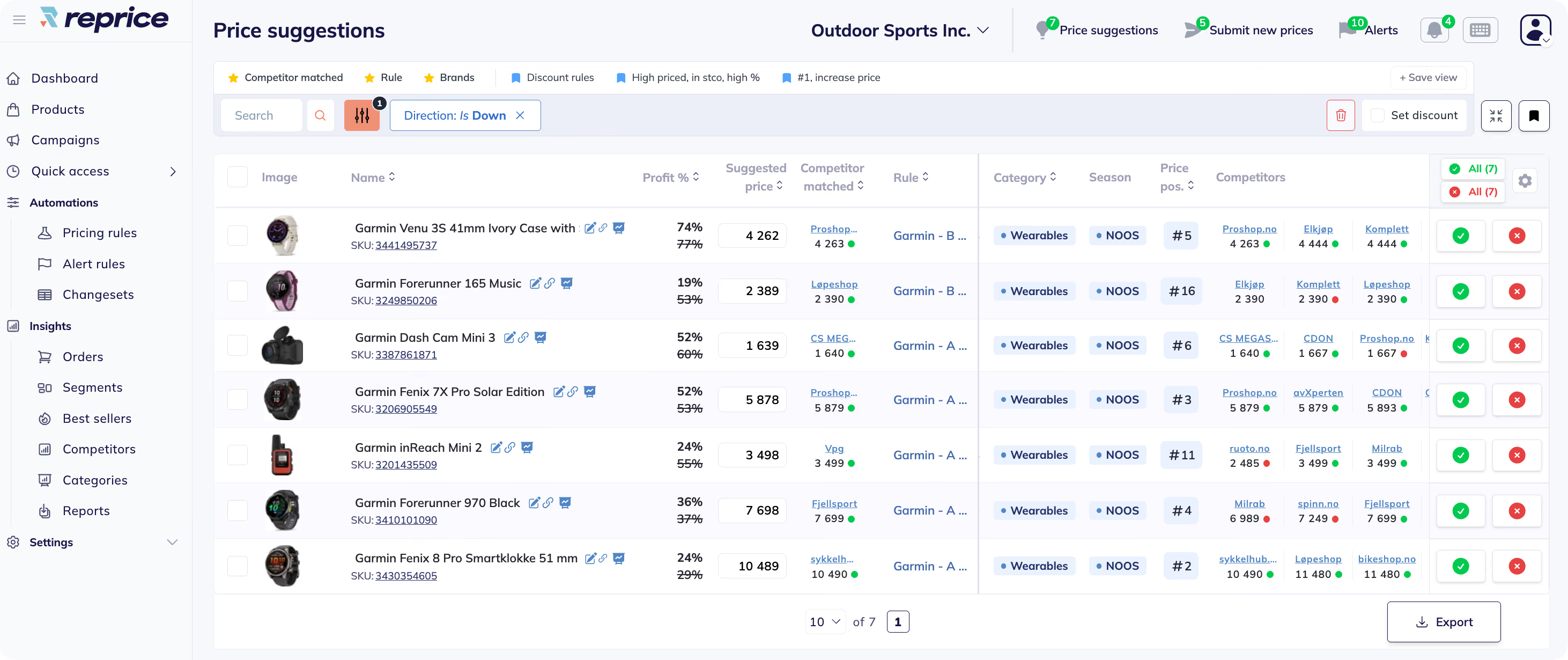
Competitor prices, stock and margin sit together for every product; rules keep each one in the position you've chosen; and the resulting prices flow out to your store and your feeds — so you win on the engines that decide Nordic e-commerce without watching them by hand.
It's the same single-system logic that the teams in our Black Friday research used to stay competitive when it mattered most.
Competitive pricing, discount campaigns and insights in one system.
Comparison-site rankings reflect publicly reported market position (Similarweb, 2026); PriceRunner is owned by Klarna. Pricing behaviour data: The Black Friday Freeze, a survey of 180 European e-commerce companies.