

Price matching sounds simple: a competitor drops their price, you match it, you keep the sale. The problem is that matching every rival who goes lower is a straight line to a price war and a bled-out margin — and matching none of them cedes the products where price actually decides the sale. The skill isn't matching or not matching. It's knowing which competitor moves are worth following and which to ignore, and having a floor underneath so no match ever costs you money.
First, a quick distinction, because "price matching" means two different things
There's the consumer-facing policy — "show us a lower price and we'll match it at checkout."
This article isn't about that.
It's about the operational version: automatically adjusting your own prices to stay competitive against rivals selling the same product.
That's the one that decides your margin, your comparison-engine placement, and whether you're in a price war you didn't choose.
Done well, it's one of the most powerful levers you have. Done reflexively, it's the fastest way to give your margin away.
Here's how to tell the difference.
Competitive pricing, discount campaigns and insights in one system.
The two extremes are easy to rule out.
Always matching means every time any competitor drops their price, you follow — which hands control of your prices to your most desperate rival and drags the whole category into a race to the bottom.
When they cut again, you cut again, and the only winner is the customer.
Never matching is just as costly in the other direction.
On the products where shoppers actively compare prices, being visibly more expensive than an in-stock competitor loses the sale outright, especially on the comparison engines that sort by price.
Refusing to move on principle cedes your highest-visibility products to whoever's cheapest.
The right answer sits between them, and it's a decision made per product, per competitor, per moment — not a blanket policy.
When a competitor goes lower, run their move through four checks before you follow it. If all four are yes, match. A single no means hold.
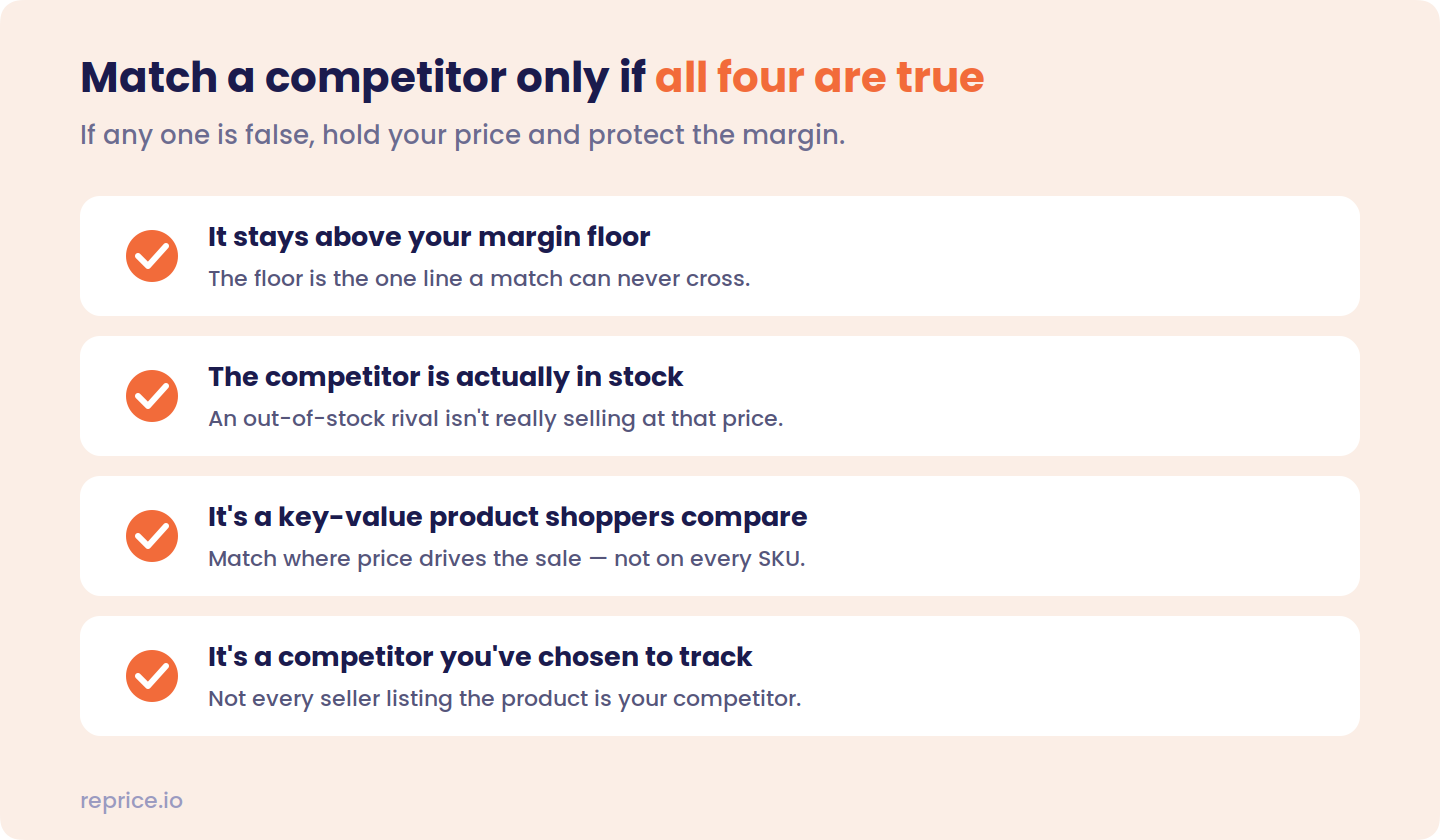
The first question is the non-negotiable one: does matching still leave you above your margin floor?
The floor — your landed cost plus the minimum margin you need — is the one line a match can never cross. If matching would breach it, you hold, full stop.
That single guardrail is what makes aggressive matching safe everywhere else, and it's the heart of pricing rules that protect your margin.
The second is about reality: is the competitor actually in stock?
A rival showing the lowest price on a product they can't ship isn't really selling at that price — matching them just lowers your margin against a phantom.
The third narrows it to where it counts: is this a key-value product shoppers genuinely compare?
Match on the items where price drives the decision; on everything else, price position matters far less than protecting margin.
And the fourth: is this a competitor you've actually chosen to track?
Not every seller listing the same product is your competitor — a grey-market reseller or an irrelevant marketplace listing shouldn't set your price.
That second and fourth question deserve a closer look, because the single most common price-matching mistake is treating the lowest number on the page as the price to beat. It usually isn't.
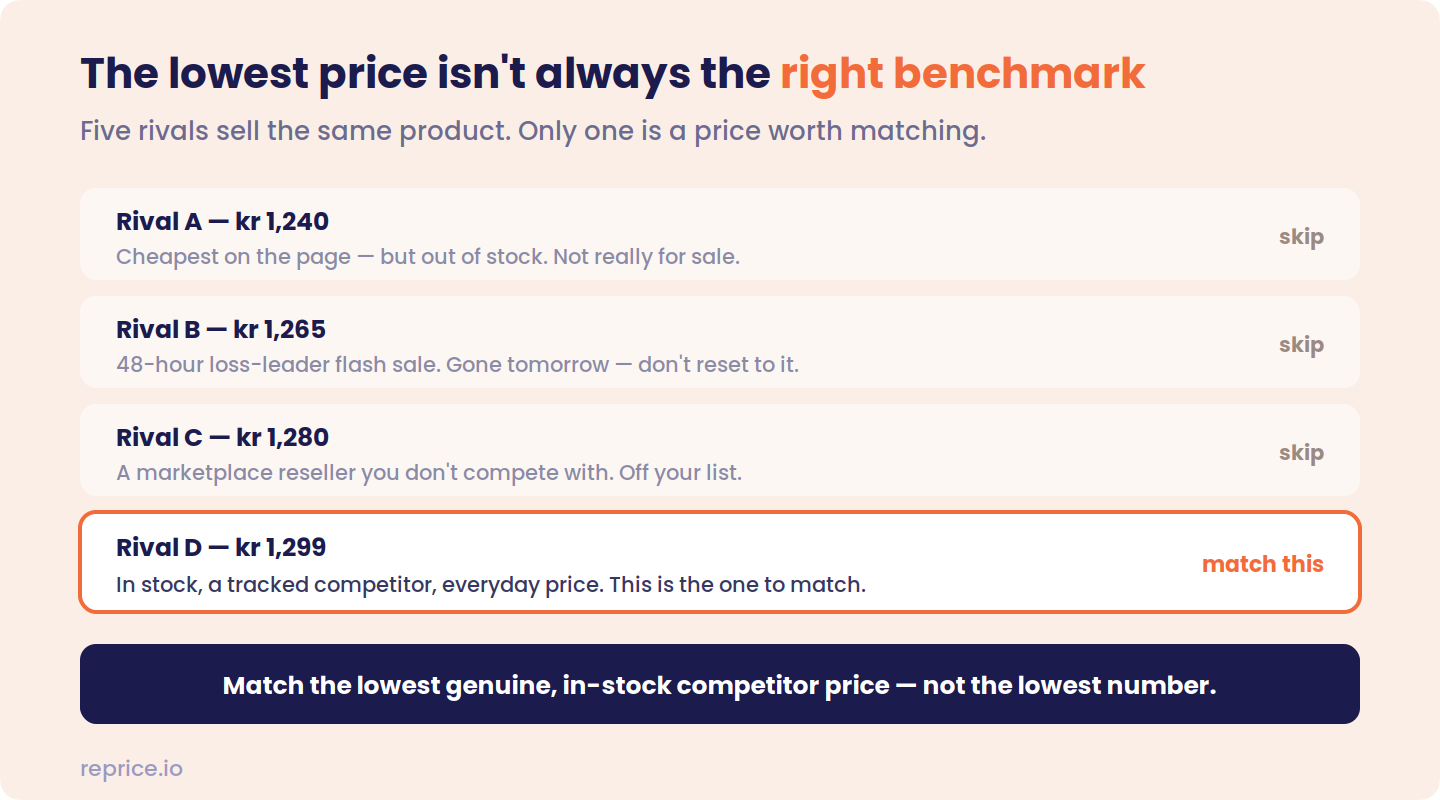
The lowest listed price is often the least useful one.
It's the out-of-stock rival, the 48-hour loss-leader that'll be gone tomorrow, or the marketplace reseller you don't actually compete with.
Reset your everyday price to any of those and you've cut your margin to chase a price that isn't real or won't last.
The benchmark that matters is the lowest price from an in-stock competitor you've chosen to track, at their normal price — not the lowest number on the screen.
Some products should stay out of automatic matching entirely.
Your hero products and brand-defining items carry a price that says something about your positioning — matching a discounter on those can cheapen how customers see you, even when the margin math works.
The same goes for products where you offer something the competitor doesn't: faster shipping, better warranty, bundled service.
There, the price gap is justified, and matching would give away value you've earned.
This is the same line between what to automate and what to keep in human hands that governs pricing automation generally.
Price matching isn't a policy you set once.
It's a continuous decision across thousands of products and constantly moving competitors — which is exactly why it can't be done by hand at any real scale, and why the teams still managing it in a spreadsheet end up either matching blindly or not at all.
Everything above becomes manageable the moment it's expressed as rules instead of judgment calls repeated by hand.
Match selected competitors, on chosen products, down to a floor you set, ignoring out-of-stock and irrelevant listings — that's not a philosophy, it's a rule set a system can run continuously.
That's what Reprice does.
You choose which competitors and which products to match, the floor guarantees no match ever costs you money, and out-of-stock and untracked rivals are filtered out automatically — so you match where it wins the sale and hold where it protects the margin, across the whole catalogue, without watching it by hand.
It's the balance our Black Friday research found the best-performing teams had struck: competitive on the products that matter, protected everywhere else.
Competitive pricing, discount campaigns and insights in one system.
Data: The Black Friday Freeze, a survey of 180 European e-commerce companies.