

Most teams hesitate to automate pricing for one reason: the fear that once they hand over control, the system undercuts a hero product, starts a price war, or sells below cost while nobody's watching. The fix isn't to trust the algorithm. It's to automate the safe, reversible products first, keep the judgment calls in human hands, and widen the automated zone only as the rules prove themselves.
The hesitation is common.
In our Black Friday Freeze research, 38% of European e-commerce companies still price their biggest sales week in spreadsheets or by changing products one at a time.
Many held back by exactly this fear of handing over control. But automation doesn't have to be all-or-nothing, and it shouldn't be.
The teams that get burned are the ones who flip the switch on their entire catalogue at once, then discover an edge case at 2am on a product that mattered.
The teams that succeed treat it as a ramp: a small, safe start that earns the right to expand.
So the real question isn't "should I automate pricing?" It's "what should I automate first, and what should I never fully hand over?"
Here's a framework for both.
Competitive pricing, discount campaigns and insights in one system.
Everything below comes down to a single principle.
Automate first where a mistake would be small, obvious, and easy to undo, and keep manual control where a mistake would be expensive, subtle, or irreversible.
That's it.
Get that ordering right and automation feels safe from day one, because the worst thing that can happen early is minor and recoverable.
This is also why "automate everything at once" fails so reliably.
It's not that broad automation is wrong. It's that launching it everywhere on day one means your first edge case could land on your most important product, at the worst possible time.
A phased rollout hits fewer surprises, and the ones it does hit are cheap.
Three groups of pricing decisions are safe to hand over early, because each is high-volume, rule-shaped, and forgiving of the occasional miss.
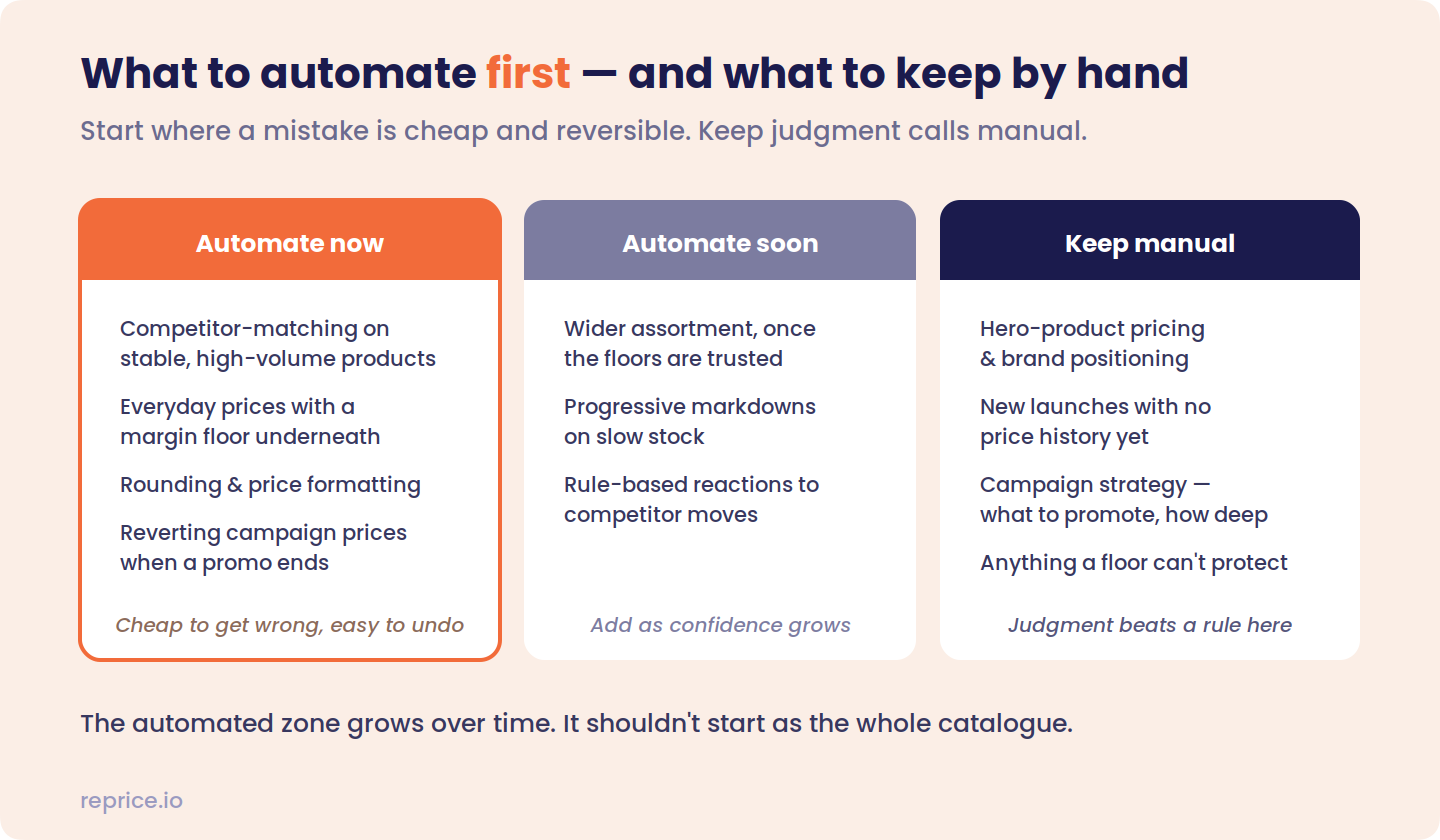
Start with competitor-matching on your stable, high-volume products — the ones with a known price history and steady demand.
These are exactly where manual pricing wastes the most time and where a rule does the job better anyway.
Underneath it, put a margin floor so no automated match can ever go below profit — that single guardrail is what makes the whole thing safe.
Then the genuinely mundane: rounding and price formatting, and reverting campaign prices when a promotion ends
Both are pure mechanics with a right answer, and both are things humans forget under pressure. Automating them removes error, not judgment.
Once the floors have held for a few weeks and you've watched the automated products behave, widen the zone.
Extend competitive rules across more of the assortment, not just the busiest products.
Turn on progressive markdowns for slow stock, where the rule reacts to your own sell-through. Let rule-based reactions to competitor moves run without a manual approval each time.
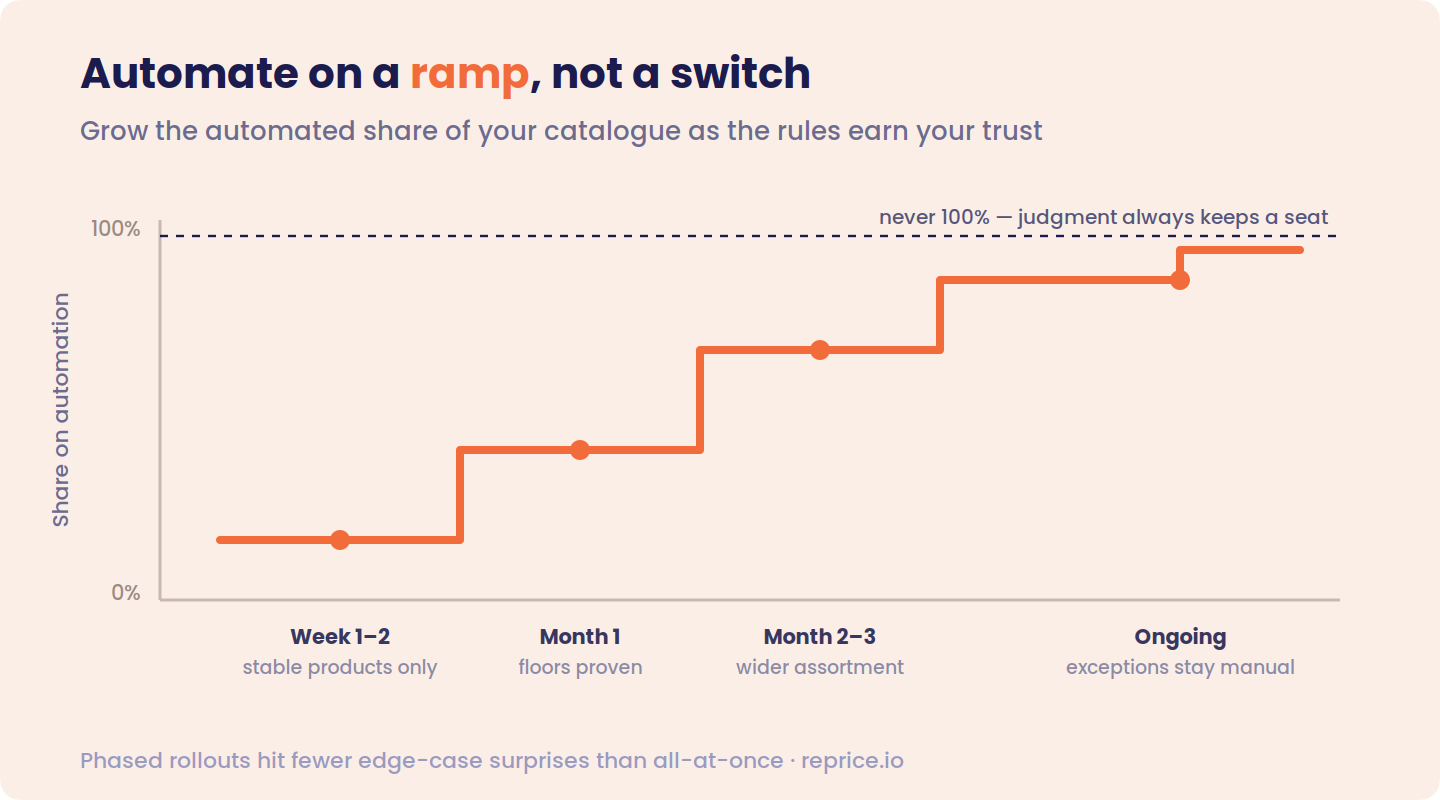
The shape that matters is the ramp.
The automated share of your catalogue should climb steadily as the rules earn trust — not jump to the whole catalogue on launch day, and not stall at a nervous 10% forever.
Each expansion is a small, deliberate decision, made because the last stage worked.
Some pricing decisions shouldn't be fully automated, and knowing which ones is what separates confident automation from reckless automation.
Keep human judgment on hero products and brand positioning, where price signals something about your brand that a competitor-matching rule can't read.
Keep it on new launches with no price history yet, where there's no data for a rule to stand on.And keep it on campaign strategy — which products to promote and how deep to go is a commercial decision, even when the execution around it is automated.
The test is simple: if a margin floor can't protect the decision, a human should be making it.
Automation is brilliant at enforcing rules consistently at scale.
It's poor at judgment, and pretending otherwise is exactly how an automated price ends up somewhere it never should have.
A staged rollout only works if your pricing tool lets you stage it — automate some products while others stay manual, set floors that can't be crossed, and see clearly what changed and why before you widen the zone.
A tool that's all-or-nothing forces the exact leap of faith that makes teams nervous in the first place.
That's the way Reprice is built to work.
You choose which products run on rules and which stay in your hands, every automated price is checked against its floor before it publishes, and everyday pricing and campaigns run from the same product data — so expanding automation is a series of small, safe steps, not one nerve-wracking switch.
It's the same logic that helped the teams in our Black Friday research stay in control when the stakes were highest — and the natural next step once you've moved off the pricing spreadsheet.
Competitive pricing, discount campaigns and insights in one system.
Phased-rollout guidance reflects widely reported implementation best practice. Pricing behaviour data: The Black Friday Freeze, a survey of 180 European e-commerce companies.