

In our survey of 180 European e-commerce companies, 38% admitted inflating "up to X% off" claims, making it the most common questionable pricing practice we found. An "up to" banner tells shoppers that a meaningful share of the sale reaches the headline number, and regulators expect you to prove it. Each of those discounts also has to be measured from the product's own 30-day lowest price, which shrinks the share faster than most teams expect.
Retailers often treat the words "up to" as cover, on the basis that the claim holds as long as one product hits the number.
Consumer authorities read the claim from the shopper's side.
Someone who sees "up to 70% off" across a sale expects to find 70% off on a fair number of the products they browse, so a banner that only one or two items can back up gives a false picture of the whole sale.
Since the EU's 30-day rule came in, every advertised discount has to be calculated from the lowest price the product had in the 30 days before the sale.
A product that was on promotion three weeks ago may show 70% off its normal price while its real, legal discount is much smaller, and that product no longer counts toward your headline.
Five checks and a one-page calculation to run before any "up to X% off" banner goes live. Free, no form.
Norway, Denmark and Finland all apply the same principle: the headline discount has to be available on a real share of the products it covers, and the retailer has to be able to prove it.
None of them sets a fixed percentage, which leaves the judgment with you and makes the documentation behind the banner more important.
The Nordic guidance comes down to one test: if most shoppers browsing your sale will never see the headline discount, the headline misleads them.
UK rulings, the only ones backed by a published number, show how quickly that happens in practice, with an "up to 70% off" claim failing when 8.6% of items carried the maximum, most of them low-priced.
A count of products at the headline discount only holds up if each discount is measured from the right price.
Under the EU 30-day rule, that is the lowest price in the 30 days before the sale, and for any product that was recently on promotion it sits well below the normal shelf price.
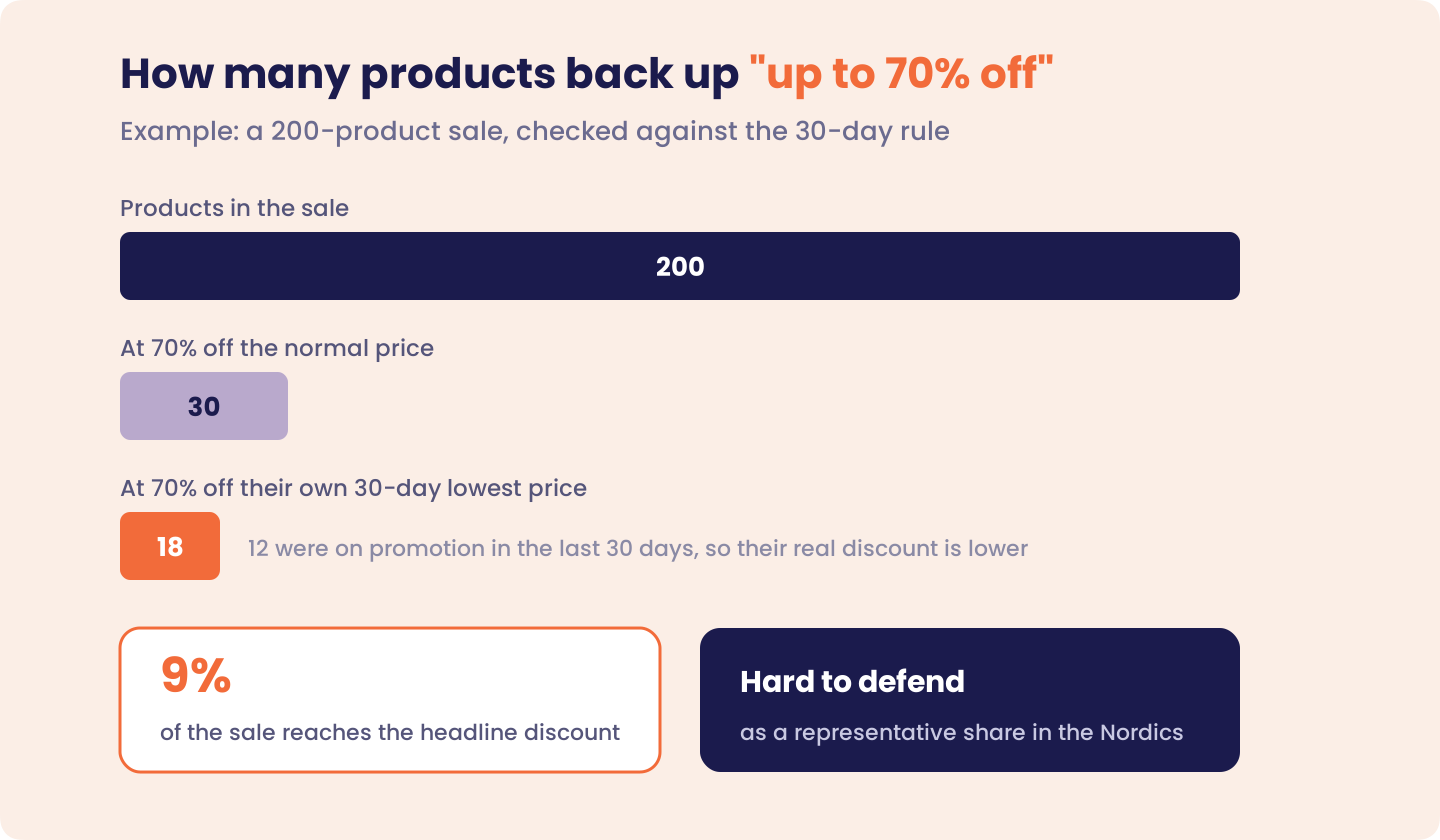
Take a sale of 200 products advertised as "up to 70% off".
Thirty of them are priced 70% below their normal price, which looks like a comfortable 15% of the range.
Twelve of those thirty were part of a campaign in the previous month, though, so their reference price is the lower campaign price and their real discount is closer to 50%.
Only 18 products are 70% below their own 30-day lowest price, which is 9% of the sale and hard to present as a representative share, before anyone has looked at which products they are.
Regulators also look at the spread.
A headline backed mostly by €10 accessories tells a shopper looking at €200 jackets something that isn't true for them, because the discount they were promised doesn't exist in the part of the range they're browsing.
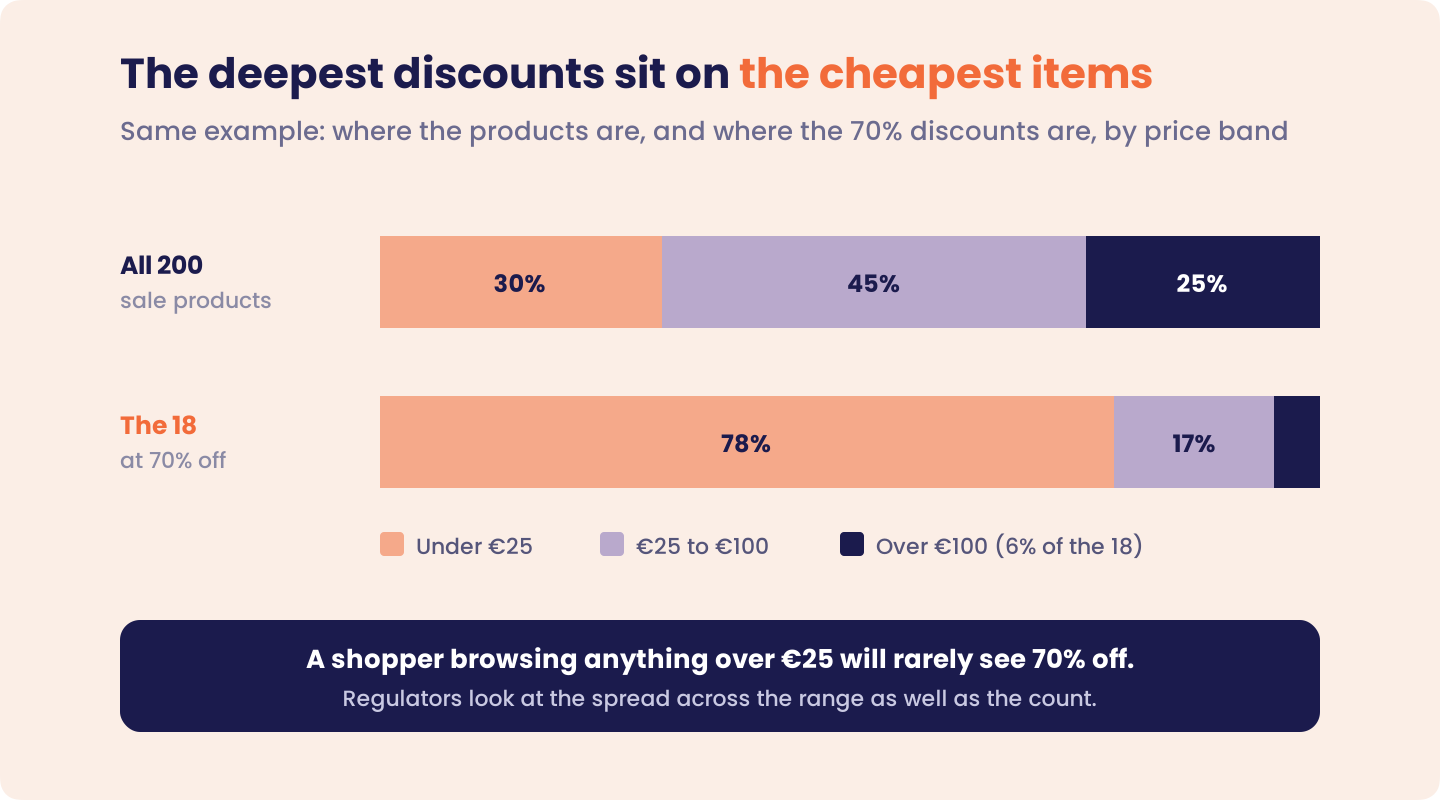
In the same example, 30% of the sale costs under €25, but 78% of the products at 70% off are in that cheapest band.
Only one product over €100 reaches the headline, even though a quarter of the sale sits in that range.
A shopper browsing the mid-range and premium products will almost never meet the discount the banner promised, which is exactly the false picture all four regulators describe.
Reprice checks the 30-day rule before a campaign goes live, so every product in a discount campaign is measured against its own lowest price in the previous 30 days.
The campaign view shows which products are ready, which need attention and which shouldn't be discounted yet, along with each product's old price, new price and margin.

With every product's real discount in one list, you can count how many reach the headline figure on their legal reference price, and see which price bands they come from, before the banner is written.
In our Black Friday Freeze research, 80% of retailers admitted at least one pricing practice a regulator would question, and an inflated "up to" claim was the most common of them.
The check takes four numbers, all measured on the products the banner covers:
If the share is small or the spread is lopsided, lower the headline to a number the range can support.
A sale where 25% of products reach 50% off makes a stronger and safer claim at "up to 50%" than at "up to 70%", and it keeps the documentation simple if a regulator or competitor asks.
Keep the calculation with the campaign records, because the Norwegian and Finnish guidance both put the burden of proof on the retailer.
The order of work keeps an "up to" claim safe.
Build the campaign first, measure every product's real discount against its 30-day lowest price, and only then choose the number for the banner, so the headline describes the sale you're running.
eams that write the banner first end up hunting for products to justify it, which is how a 70% headline ends up resting on a handful of €10 accessories.
A lower headline you can prove also earns more trust.
Shoppers who click "up to 50% off" and find 50% on products across the range come back for the next sale, while a 70% banner they can't find teaches them to ignore the next one.
Misleading price claims can also carry fines of up to 4% of revenue under the EU's Omnibus rules, so a headline the whole range supports is the safer choice as well as the more credible one.
Five checks and a one-page calculation to run before any "up to X% off" banner goes live. Free, no form.
This is general information, not legal advice; rules and enforcement vary by market. Example figures are illustrative. Data: The Black Friday Freeze, a survey of 180 European e-commerce companies.