

Black Friday is the week most e-commerce teams stake their year on, and the week they're most likely to misprice. The cost rarely shows up as one obvious mistake. It shows up as four separate ones: sales lost while your price sits still, a compliance slip that can cost 4% of revenue, margin given away on discounts that were too deep, and the same errors repeated bigger next year because no one measured them. Together they decide whether your biggest week made money.
That's what makes these costs so easy to miss.
No one invoices you for the sale that went to a cheaper rival, or for the margin you gave away when you discounted a product that would have sold anyway. So the mistakes repeat, year after year, at a bigger scale each time.
We surveyed 180 European e-commerce companies to put a number on each one. Here's what getting Black Week pricing wrong actually costs.
Competitive pricing, discount campaigns and insights in one system.
Getting Black Friday pricing wrong can affect your business in different ways.
You could lose sales because you didn't respond to competitor price changes. You could face penalties if your discounts don't comply with pricing regulations. Or you could give away margin by offering bigger discounts than necessary.
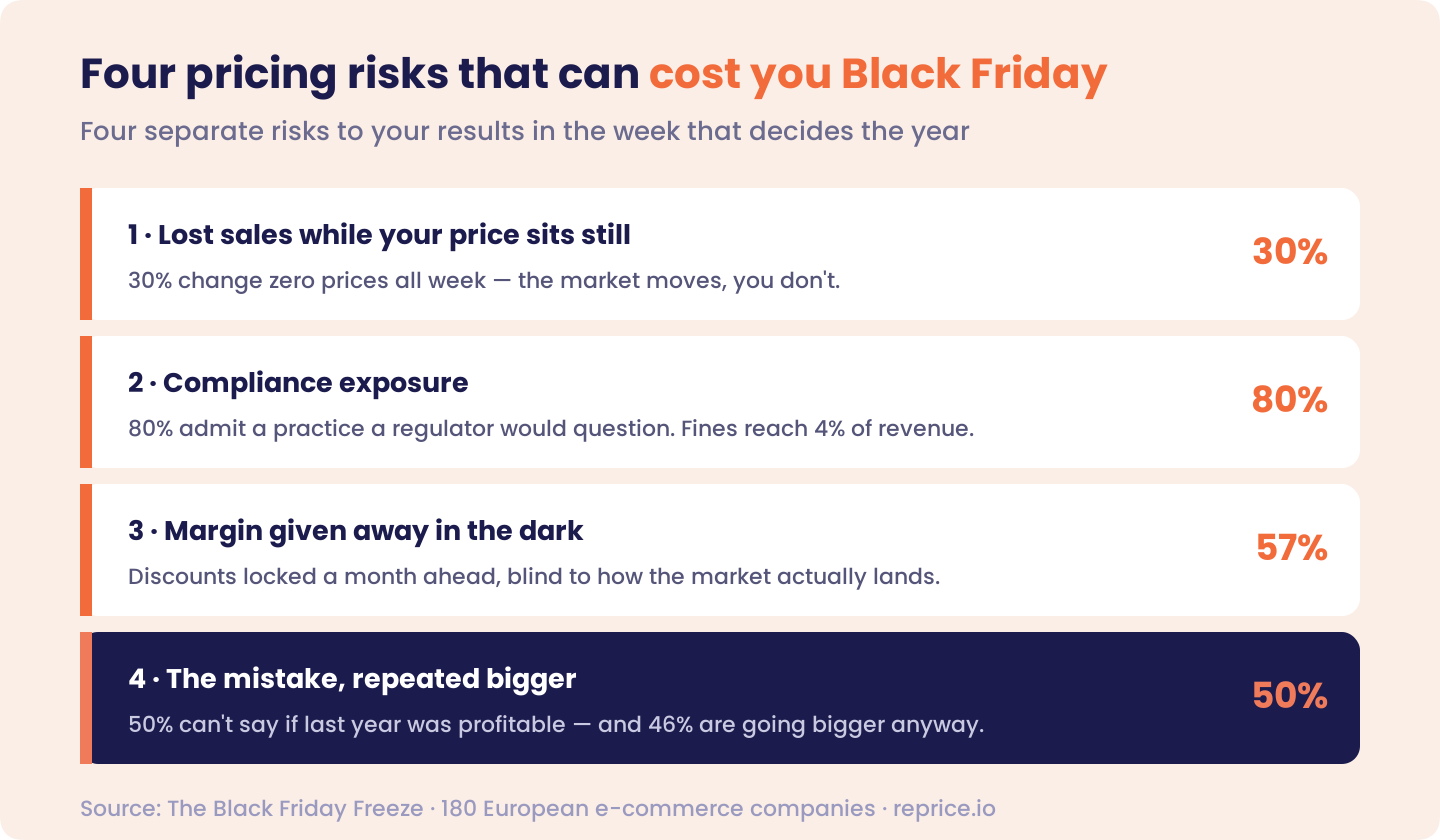
And if you don't review what worked and what didn't, you risk repeating the same mistakes next year.
Our research highlights how common these challenges are among e-commerce retailers.
During Black Friday week, competitors change their prices frequently. But our research found that 30% of e-commerce companies don't change their prices at all, and 67% change them at most twice.
If a competitor offers the same product at a lower price, you risk losing sales to them. The longer it takes you to respond, the more sales you could lose.
And it's not just your Black Friday campaign products you need to think about. Competitor prices can change across your entire product range.
During Black Friday, when shopping activity is high and prices can change quickly, being slow to respond could be particularly costly.
The second cost can be bigger than the rest combined.
80% of companies admit to at least one pre-Black-Friday pricing practice a regulator would question.
Most didn't mean to because the 30-day rule is almost impossible to check by hand across thousands of discounted products.
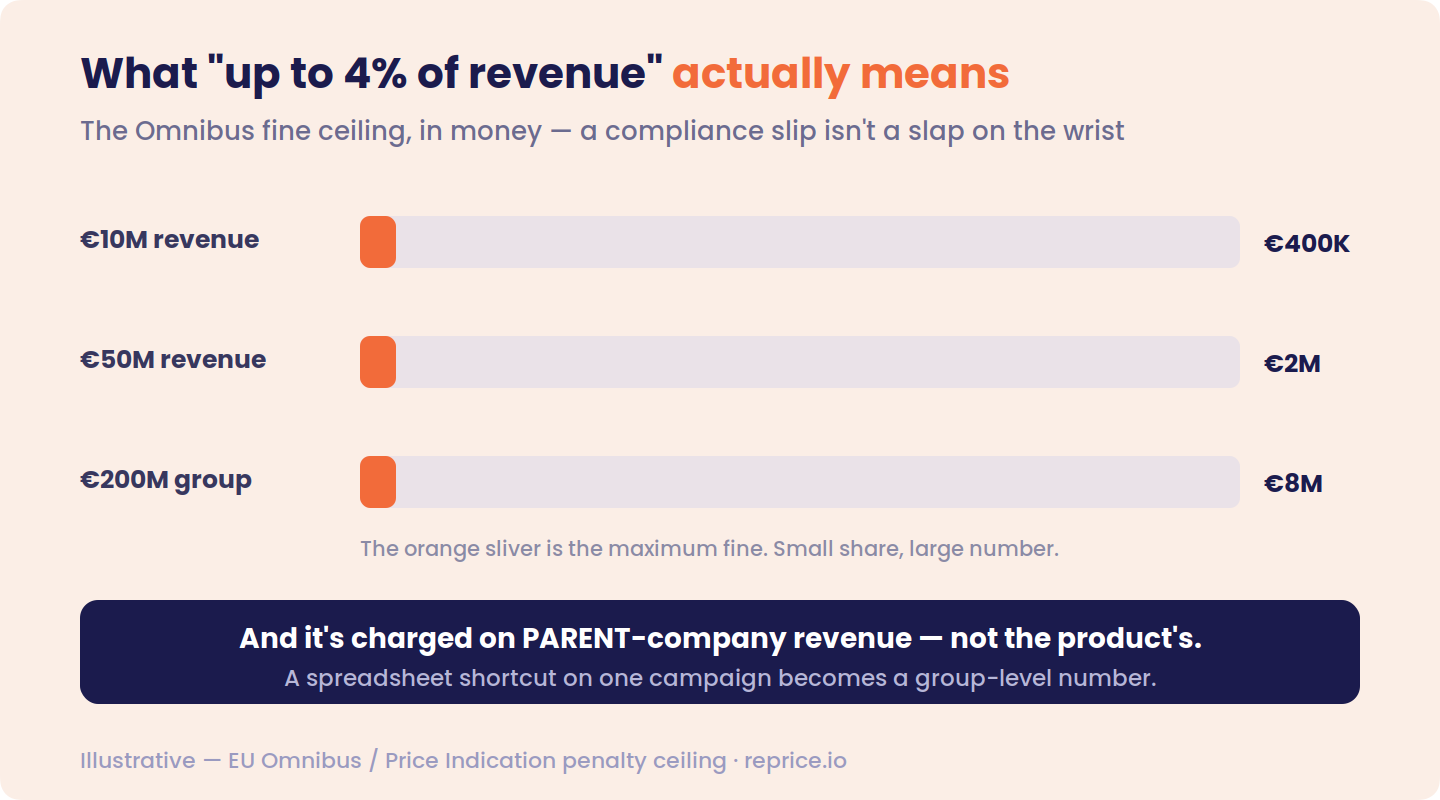
The 4% is the maximum, not the usual outcome.
What matters is what it's charged on your parent-company revenue, not the revenue of the one product that broke the rule.
A shortcut on a single discount, rushed into a spreadsheet the week before launch, can turn into a number the board asks about.
That's the bet every manual compliance check makes, whether the team knows it or not.
Our research found that 57% of companies set their Black Friday discounts a month or more before the campaign starts.
But competitor prices and market conditions can change during that time. A discount that seemed right a month ago may no longer be necessary.
For example, imagine you planned to offer a 40% discount on a product. But closer to Black Friday, you discover that a 25% discount would still make your price competitive.
If you stick with the original 40% discount, you're giving away margin you could have kept.
Across hundreds or thousands of products, those unnecessary discounts can add up to a significant amount of lost profit.
The fourth cost turns a bad Black Friday into a worse one next year.
Half of companies can't say for sure whether their last Black Friday made money once discounts, ad spend, shipping and returns are counted.
And 46% are planning a bigger one anyway.
Scale up a campaign you can't measure and you scale up its mistakes with it.
If you don't know which products were profitable, you risk offering the same discounts next year, even on products where the margins were already too low.
Getting Black Friday pricing right means having the information you need to make good decisions, even when the market is changing quickly.
But that information is often spread across different systems. Competitor prices are in one place, while your product costs, margins, stock and sales data are somewhere else. Pulling it all together manually takes time, especially when you're managing hundreds or thousands of products.
Reprice brings this information together in one platform, so you can see where you stand against competitors and make pricing decisions based on your own business data.
You can set pricing rules that protect your margins, check campaign prices against the 30-day rule before launch, and track performance by product to understand what worked and what didn't.
That helps you respond to market changes, avoid unnecessary discounts and use what you learned to plan a better campaign next time.
Competitive pricing, discount campaigns and insights in one system.
This is general information, not legal advice; penalty ceilings and rules vary by market. Data: The Black Friday Freeze, a survey of 180 European e-commerce companies.