

We asked 220 people who set or approve prices at online retailers how they track competitors, run campaigns, protect margin and measure results. The retailers growing margin are the ones that build checks into how they price: 78% of those that calculate the 30-day reference price automatically grew margin last year, compared with 54% of those checking it by hand. The same survey found that nine in ten retailers admit a pricing practice a regulator would question, while only one in 25 sees compliance as their biggest problem.
Retailers have spent the last few years learning to move prices faster, with more automation, more AI and more competitor data.
The Nordic E-commerce Pricing Benchmark looks at what that investment has delivered, across every part of the pricing job from competitor tracking and everyday prices to discount campaigns, margin floors and campaign reporting.
The findings point to how the work around each price is set up, with reaction speed making far less difference than expected. Here are the results that matter most, with the full data in the free report.
We surveyed 220 retailers on pricing, campaigns, margin and compliance. 18 pages, every chart, no form to fill in.
Gross margin rose for 65% of the retailers in the benchmark last year.
The ones most likely to be in that group share three habits: they run competitive pricing and discount campaigns from the same system, they measure each campaign's margin product by product, and they calculate the 30-day reference price automatically.
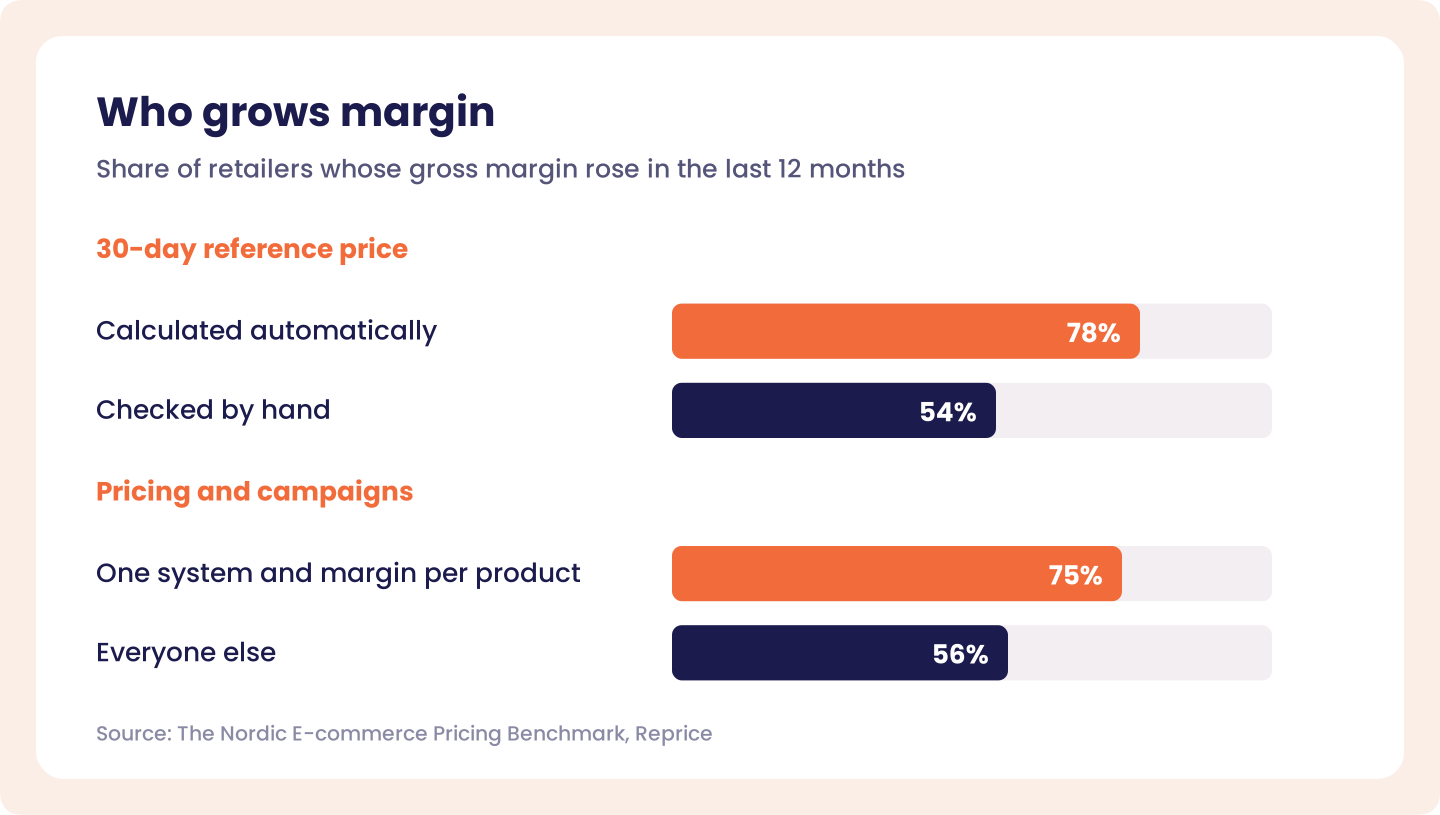
Retailers that combine one system with margin measured per product grew margin at a rate of 75%, compared with 56% of everyone else, and the gap widens to 79% and 49% among retailers selling 5,000 or more products.
When a campaign discount and a competitive price change are set in the same place, neither can quietly undercut the other, and the margin effect of both shows up in one report.
The automatic 30-day check goes with the largest gap in the survey.
Retailers that calculate the reference price automatically grew margin at a rate of 78%, while those checking it by hand came in at 54%, because a manual check is the one that gets skipped when a campaign is under time pressure.
Retailers that respond to a competitor the same day grew margin at a rate of 68%, compared with 61% of those taking one or two days.
The number of approvals a price change needs made almost no difference either, with retailers needing three or more sign-offs growing margin at the same rate as those needing one.
Speed decides whether a retailer keeps the sale when a competitor drops their price, while the checks around each change decide whether it keeps the margin.
The benchmark shows those checks are where the retailers growing margin pull ahead.
88% of retailers did at least one thing in the last 12 months that a consumer authority would question. 55% used an "up to" claim that few of their products could back up, 43% raised prices shortly before a sale and 28% showed a before-price they had never charged.
Only 4% name compliance as their biggest pricing challenge.
Under the EU's 30-day rule, every advertised discount has to be measured from the product's lowest price in the 30 days before the sale, yet 31% of retailers still measure discounts from their normal price or the supplier's recommended price.
The gap between what retailers do and what they worry about is one of the clearest findings in the report, and the rules for "up to" discount claims explain why the Nordic regulators take it seriously.
46% of retailers already let AI change prices automatically, and those retailers showed a before-price they had never charged at twice the rate of everyone else (38% compared with 19%).
An AI that moves prices without the 30-day reference and the campaign calendar in view can't know when a price rise will turn next week's discount into a misleading one.
The same pattern shows up in margin protection.
3% of retailers keep their minimum margin as a guideline or in a spreadsheet, outside the system that changes the prices, which only works while a person reviews every change.
Only 16% of retailers have reviewed more than three-quarters of their catalogue in the last 90 days.
Bestsellers get regular attention, with 43% changing their prices weekly, while the long tail is priced once and left to drift as competitors move.
That drift costs money in both directions.
75% of retailers say they raise prices when they find a product priced far below the next competitor, but with so little of the catalogue reviewed, few of those gaps are ever found.
The report models what closing them is worth: around 1.1 million kr a year for a Norwegian retailer with 50,000 online orders, using the same logic as raising prices without losing the sale.
The report has ten chapters on the pricing team, competitor tracking, catalogue coverage, price setting, margin protection, discount campaigns, compliance, measurement, AI and what the margin leaders do differently.
It also includes a section on retailers with 5,000 or more products, the revenue model in kroner and six recommendations for the year ahead.
The retailers growing margins have built their checks into the system that moves their prices, so every competitive change and every campaign discount is tested against the margin floor and the 30-day rule before it goes live.
The benchmark shows how far the rest of the market has to go to catch up, and where to start.
We surveyed 220 retailers on pricing, campaigns, margin and compliance. 18 pages, every chart, no form to fill in.
Data: The Nordic E-commerce Pricing Benchmark.