

An e-commerce pricing strategy is the method a retailer uses to set the price of each product, whether that starts from the cost, the competitor price, the supplier's recommended price or what shoppers will pay. In The Nordic E-commerce Pricing Benchmark, 35% of retailers set most of their prices from competitor prices, 22% use cost plus a markup and 16% follow the supplier's recommended price. The retailers growing margin rarely rely on one method, and they choose the strategy product by product and run everyday prices and campaigns from the same data.
A catalogue of several thousand products holds bestsellers that shoppers compare across a dozen shops, niche products with no direct rival, new launches and end-of-season stock.
A single pricing strategy applied to all of them overprices some products and gives margin away on others, which is why the choice of strategy works best at the level of each product group.
Each strategy below suits a different kind of product and a different goal, from winning the comparison-site click to protecting margin on products nobody else sells.
Knowing where each one fits makes it possible to build a pricing setup that covers the whole range.
Competitive pricing, discount campaigns and insights in one system.
The Nordic E-commerce Pricing Benchmark asked 220 people who set or approve prices how they price most of their products.
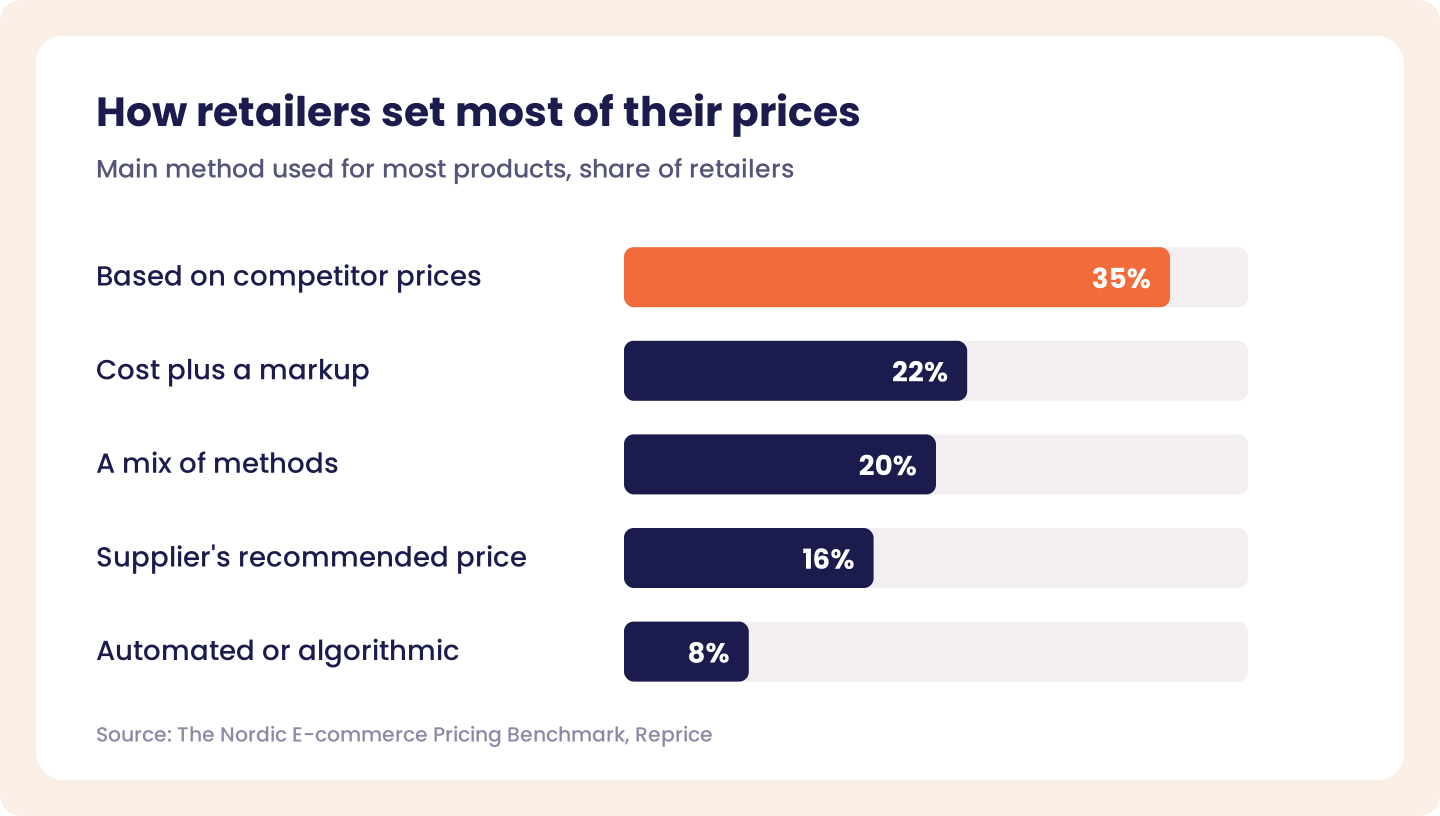
Competitor prices lead at 35%, which reflects how much of e-commerce happens on comparison sites, followed by cost plus a markup at 22% and a mix of methods at 20%.
16% still follow the supplier's recommended price, and only 8% rely on automated or algorithmic pricing as their main method, even though 82% price at least a quarter of their products through rules or software.
Cost-plus pricing adds a fixed markup to what the product costs to buy, so a product bought for €60 with a 50% markup sells for €90.
It is simple and guarantees a margin on every sale, while ignoring the market completely, which leaves products overpriced where competition is strong and underpriced where shoppers would pay more.
It works best as a floor under market-based strategies such as competitive pricing, where it stops any price going below the margin a product needs.
Competitive pricing sets each price against what competitors charge for the same product, below, level with or above the market depending on the product's role.
It is the natural choice for products listed on Prisjakt, PriceRunner and Google Shopping, where shoppers sort by price, and it needs exact product matching, a chosen set of competitors and a margin floor to work well.
Value-based pricing sets the price from what shoppers will pay, and premium pricing deliberately sits above the market.
Both suit products where shoppers choose on availability, delivery, brand or service more than price, such as niche products with few rivals, and both need a ceiling so the premium doesn't grow large enough for shoppers to notice.
Following the supplier's recommended retail price saves time and keeps prices consistent with the brand, and it leaves a retailer exposed when competitors sell below it.
The RRP also can't serve as the "before" price in a discount under the EU's 30-day rule, which requires the product's own lowest price from the previous 30 days.
Dynamic pricing changes prices automatically as competitor prices, stock and demand change, which keeps thousands of prices in line with the market without manual work.
It needs a margin floor, a ceiling and a clear list of products it may touch, because an automatic cut in the month before a campaign lowers the reference price the discount is measured from.
Promotional pricing cuts prices for a limited time to drive sales, clear stock or win new shoppers, from weekend sales to Black Week.
A 20% discount on a product with a 40% margin needs twice the sales to earn what full price would have, so promotional pricing pays when the products and the discount depth are chosen from the margin up.
Psychological pricing uses price endings and price points to shape how shoppers read a price, such as 499 kr instead of 500 kr.
It is a finishing step on top of another strategy, and it needs care when prices change automatically or when a percentage discount produces an uneven price that has to be rounded.
Both strategies apply to new products.
Skimming launches at a high price and steps it down as competitors start selling the same product, while penetration pricing launches low to win shoppers quickly and rises later.
With no sales history to go on, pricing new products depends on the competitor prices that appear in the first weeks.
The retailers that price well assign a strategy to each group of products and let it run inside the same limits:
Cost-plus pricing sits under all of them as the margin floor, the price no strategy may go below.
That combination covers the whole assortment, where only 16% of retailers have reviewed more than three-quarters of their catalogue in the last 90 days.
The benchmark links margin growth to how the strategies are run.
Retailers that run competitive prices and campaigns from one system grew margin at a rate of 72%, compared with 52% of those using separate systems, and those measuring campaign margin per product reached 72%, compared with 54% of those judging campaigns on revenue.
The largest gap comes from the 30-day rule.
Retailers that calculate the 30-day reference price automatically grew margin at a rate of 78%, compared with 54% of those checking it by hand, because a discount campaign built on top of dynamic and competitive prices only stays compliant when every reference price is checked.
Speed made far less difference, with retailers responding to competitors the same day growing margin at 68%, compared with 61% of those taking a day or two.
Reprice runs competitive pricing and discount campaigns from the same product data. Products are matched to competitors by GTIN, with price and bestseller data from Prisjakt, PriceRunner and Google Merchant Center, and rules are set per product group so each group can follow its own strategy above the margin floor you choose.
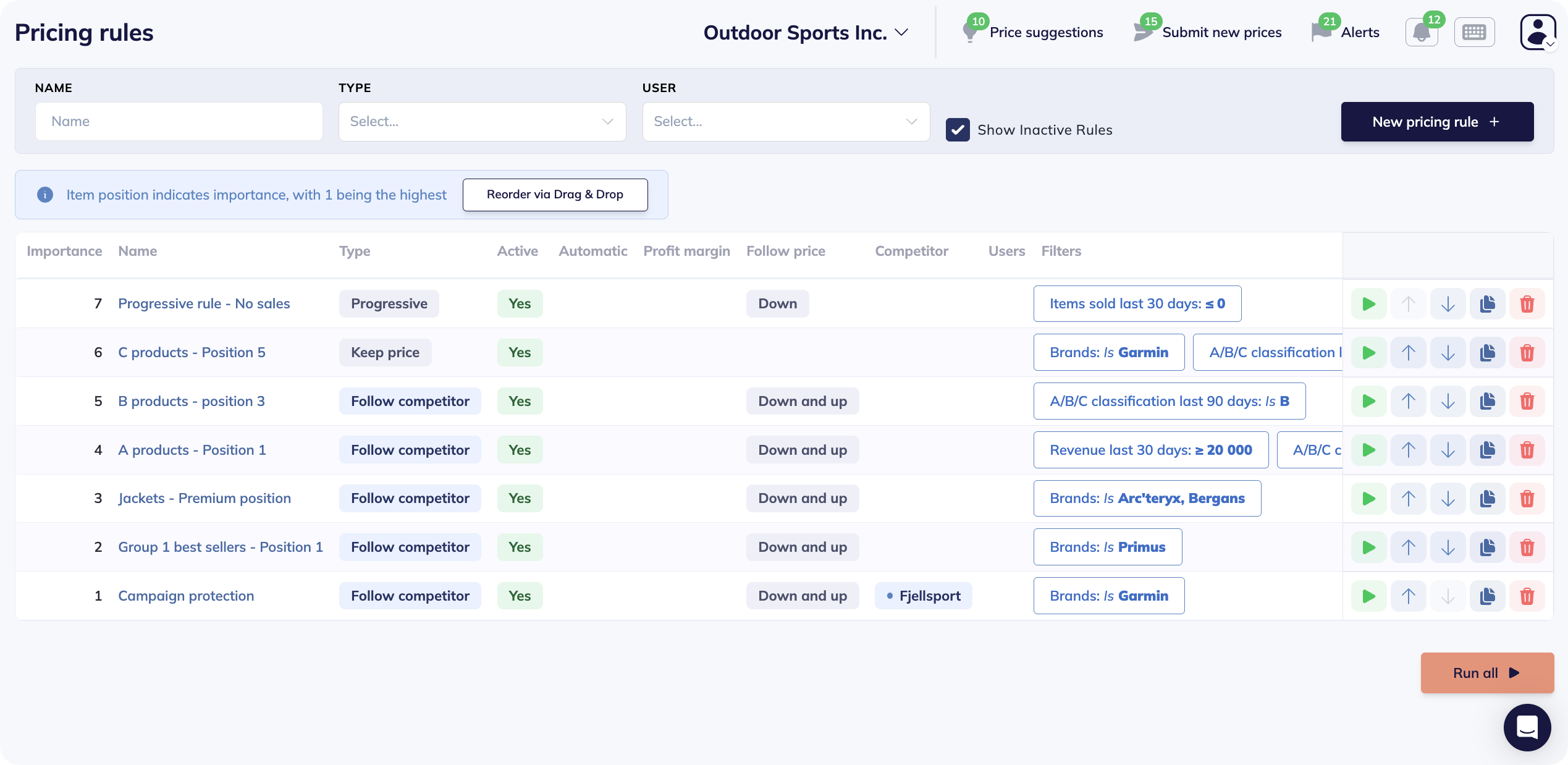
Every recommended change shows its effect on margin before it goes live, changes can be approved one by one or applied automatically, and every change is logged.
Campaign products stay protected from the everyday rules while a campaign runs, each campaign product is checked against its own 30-day lowest price before launch, and campaign results are reported by revenue, margin, stock and product.
No single pricing strategy fits a whole e-commerce catalogue.
Competitive pricing suits the products shoppers compare, value-based pricing suits the products they can't easily find elsewhere, promotional pricing suits stock that needs to move and cost-plus pricing sets the floor under all of them.
The retailers growing margin choose those strategies product by product and run them from the same data, so dynamic prices, campaigns and the 30-day reference never work against each other.
The strategy decides where each price should sit, and the way the strategies are connected decides whether the margin holds.
Competitive pricing, discount campaigns and insights in one system.
Data: The Nordic E-commerce Pricing Benchmark. Example figures are illustrative.