

A competitive pricing strategy sets your prices in relation to what competitors charge for the same products, pricing below, level with or above the market depending on what you want each product to do. In e-commerce, where shoppers compare offers on Prisjakt, PriceRunner and Google Shopping in seconds, it is the most common way to price: in The Nordic E-commerce Pricing Benchmark, 35% of retailers set most of their prices from competitor prices. The strategy pays when each product gets its own position and a margin floor, and when competitive prices and campaigns run from the same data.
A single rule for the whole shop, such as "always 2% below the cheapest", is easy to set up and expensive to run.
It cuts margin on products where nobody was competing, chases sellers your customers never buy from and moves prices on products that are part of a running campaign.
The retailers that get competitive pricing right treat it as a set of decisions made product by product: which position to take, which competitors count, how low and how high the price may go and how quickly it should follow the market.
Those decisions also explain much of the difference in margin growth between retailers, more than reaction speed does.
Competitive pricing, discount campaigns and insights in one system.
Every competitive price takes one of three positions against the market, and each one trades margin for something else:
None of the three is right for a whole catalogue.
A retailer that prices everything below the market gives away margin on thousands of products nobody was comparing, while one that prices everything above it loses the products shoppers use to decide where to buy.
Cost-plus pricing has the opposite problem, because it ignores the market entirely and puts the same markup on products with very different competition.
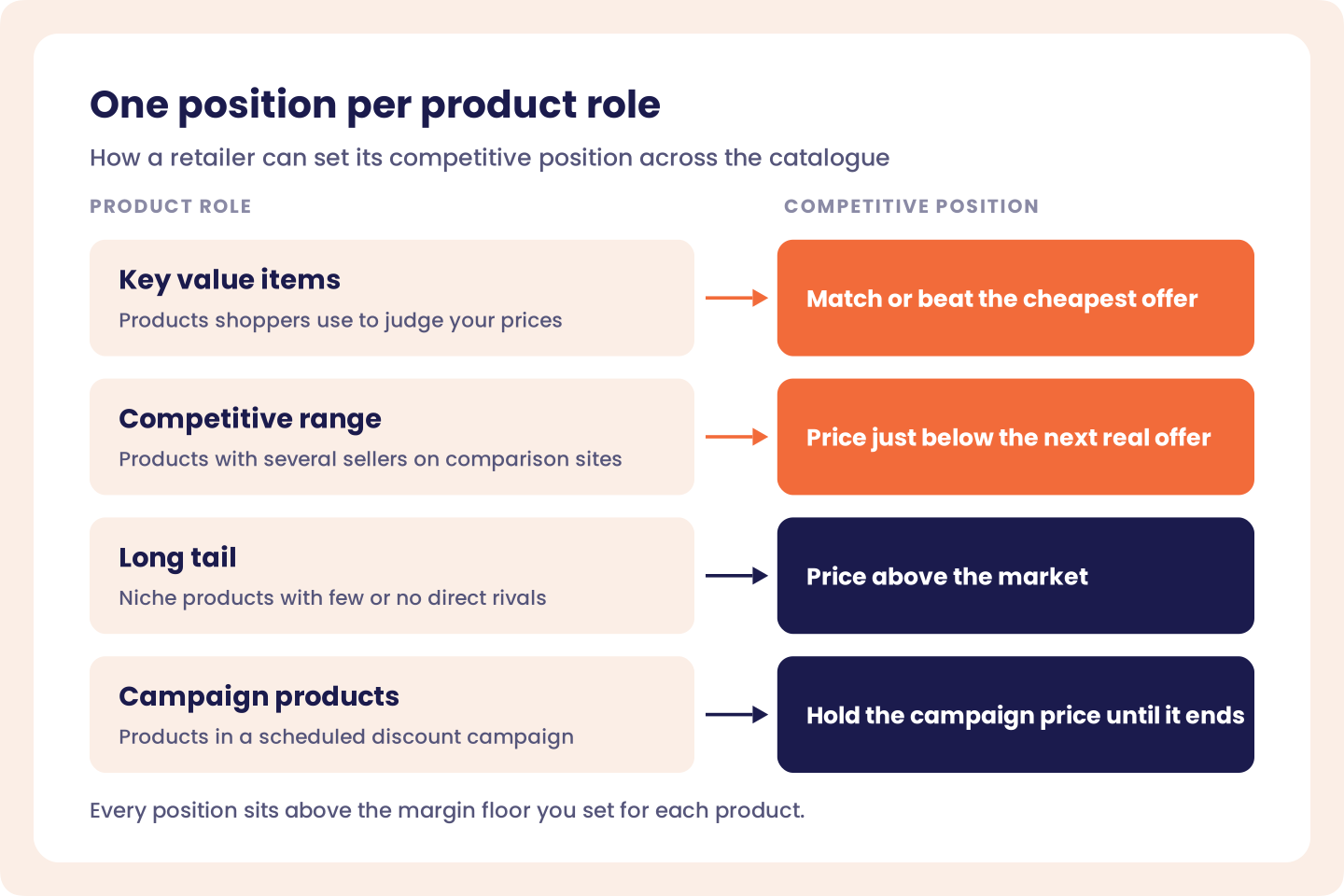
Grouping products by the role they play lets each group take its own position, with the same rule applied to every product in it.
Key value items are the well-known products shoppers use to judge a shop's prices, and a visible lead on them is worth more than the margin it costs.
The competitive range covers products with several sellers on comparison sites, where the best position is just below the next real offer, because a €2 lead wins the same click as a €20 lead and keeps €18 more on every unit, as shown in raising prices without losing the sale.
The long tail is where margin is easiest to earn.
Niche products with few or no direct rivals can sit above the market, inside a ceiling you set, because shoppers who find them are choosing on availability.
Campaign products are the fourth group, and they hold their campaign price until the campaign ends, whatever competitors do in the meantime.
A competitive price is only as good as the competitors it follows.
The right set is the sellers your customers would buy from instead, which usually means a handful of domestic shops and the largest marketplace sellers, and leaves out cross-border shops, resellers with no stock and sellers your customers don't trust.
Matching has to be exact as well.
Comparing on the GTIN, the barcode number that identifies one specific product, keeps a price from following a lookalike model or a different pack size.
The Nordic E-commerce Pricing Benchmark shows how much of this work is still manual, with 70% of retailers checking competitor sites by hand even though 77% use pricing software, and the same judgment applies to price matching, where not every competitor price deserves a response.
A competitive rule with no limits follows the market wherever it goes, including below cost when a competitor clears stock.
A margin floor sets the lowest price each product can reach, and a ceiling sets the highest, so the rule can move freely between them without anyone checking each change.
The benchmark shows what the floor is worth.
Retailers with no minimum margin were the least likely to grow margin last year, at 41% compared with 66% to 68% of those with one.
43% of retailers keep their floor as a guideline or in a spreadsheet, which only works while a person reviews every change, so the floor needs to live in the system that changes the prices.
Response speed matters for winning the sale, and it matters less for margin than the industry assumes.
Retailers that respond to a competitor the same day grew margin at a rate of 68%, compared with 61% of those taking one or two days, a smaller gap than any of the setup choices above.
The right speed depends on the product's role.
Key value items and the competitive range need to follow the market closely, while long-tail products can be reviewed far less often, the same logic behind repricing frequency.
When a competitor cuts a price overnight, the question of whether to follow at all comes before the question of how fast.
Competitive pricing runs alongside discount campaigns, and the two can work against each other.
An automatic rule can move a campaign product's price in the middle of a promotion, and a price raised before a campaign changes the 30-day reference price the discount is measured from.
Retailers that run both from one system avoid those clashes, and the benchmark shows it in their margin: 72% of them grew margin last year, compared with 52% of retailers using separate systems.
Keeping competitive pricing and discount campaigns in the same product data means every price is set with the market, the margin and the campaign plan in view.
Reprice matches your products to competitors by GTIN and brings in price and bestseller data from Prisjakt, PriceRunner and Google Merchant Center, so every comparison is made against the same product.
Competitors your customers don't buy from can be excluded, and alerts flag when a key competitor moves.
Competitive pricing rules are set per product group, always above the margin floor you choose, and every recommended change shows its effect on margin before it goes live.
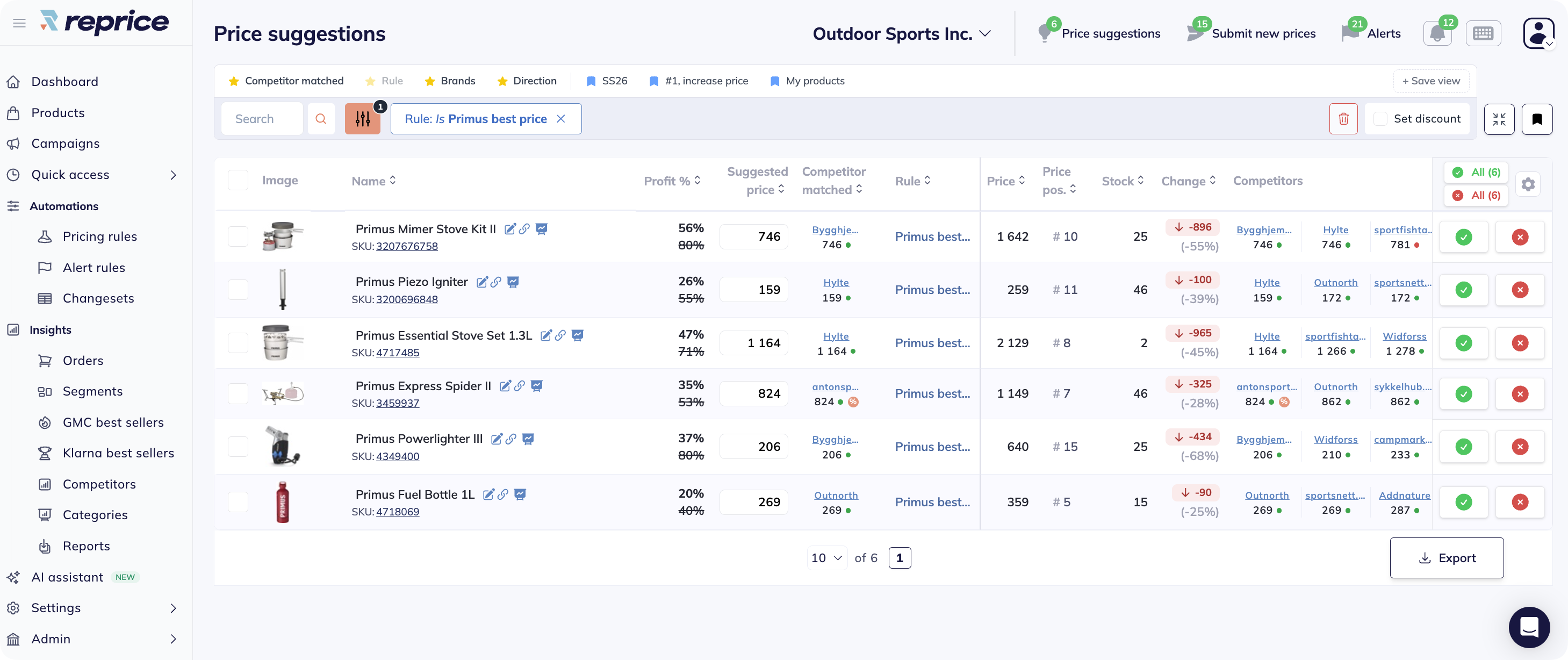
Changes can be approved one by one or applied automatically, every change is logged, and campaign products stay protected from the everyday rules while a discount campaign is running.
Pricing insights then show where your prices sit against each matched competitor as the market moves.
A competitive pricing strategy works when it covers every product with the right position, the right competitors and limits that hold without anyone watching.
Key value items stay sharp, the competitive range sits just below the next offer, the long tail earns its margin and campaign products keep their discount until the campaign ends.
The retailers growing margin set those decisions once and let the system apply them across the catalogue, with competitive prices and campaigns drawn from the same product data.
Speed then becomes a setting per product group, and the pricing team spends its time on the decisions that need a person.
Competitive pricing, discount campaigns and insights in one system.
Data: The Nordic E-commerce Pricing Benchmark.