

The recommended retail price, or RRP, is the price a supplier suggests a product should sell for, known as MSRP in the US and as veiledende pris in Norway, vejledende pris in Denmark and rekommenderat pris in Sweden. It is a recommendation and not a rule, because suppliers in the EU and Norway can't force retailers to sell at or above it. In The Nordic E-commerce Pricing Benchmark, 16% of retailers set most of their prices from the supplier's recommended price, and 9% measure their discounts from it, a reference the EU's 30-day rule doesn't allow for a price reduction.
The RRP is a convenient starting point, especially for retailers with thousands of products and a small pricing team.
It arrives with the product data, it keeps prices consistent with the brand and it saves the work of deciding a price for every new product.
The convenience comes at a cost once the product is listed on comparison sites.
The RRP is often well above what the market charges, so a retailer that follows it sits behind cheaper offers, and a retailer that advertises its discount from it risks a claim regulators treat as misleading.
Competitive pricing, discount campaigns and insights in one system.
The RRP is set by the manufacturer or brand owner and shared with retailers in price lists and product feeds.
It goes by several names, including MSRP (manufacturer's suggested retail price), list price and suggested retail price, and all of them describe the same thing: the price the supplier would like the product to sell for.
Suppliers may recommend a price and may set a maximum price, but EU and Norwegian competition law forbids them from fixing a retailer's price or setting a minimum it must charge, known as resale price maintenance.
The US practice of a minimum advertised price works differently and limits only the price a retailer advertises, which is why an RRP in the Nordics leaves the final price entirely to the retailer.
On a comparison site, the RRP is often the highest price on the page.
Retailers price against each other, and the cheapest offers for a well-known product can sit 10% to 20% below the supplier's recommendation.

In the example, the supplier recommends 1,499 kr, while the product sells for 1,190 kr to 1,269 kr across the market.
A retailer that prices at the RRP sits 18% above the next competitor, and on Nordic comparison sites such as Prisjakt and PriceRunner, where shoppers sort by price, it is unlikely to be clicked at all.
The RRP is a reasonable price when the market has no better reference.
That applies to products only a few shops sell, to new launches before competitors have listed them and to brands that sell through a small group of selected retailers, where shoppers find similar prices everywhere.
For new products, the RRP works as a launch price that the market then corrects.
Once competitors start selling the same product, the price that matters is theirs, and pricing new products becomes a question of how quickly to move from the RRP to a competitive position.
Under the EU's 30-day rule, Article 6a of the Price Indication Directive, a price reduction must be measured from the lowest price the retailer itself charged in the 30 days before the reduction.
The supplier's recommended price is not that price, so "30% off" calculated from the RRP doesn't meet the rule unless the retailer has sold the product at the RRP.
The European Commission's guidance on Article 6a treats a comparison with the RRP, such as "our price 1,249 kr, RRP 1,499 kr", as a separate kind of price claim that falls outside the 30-day rule and remains fully covered by consumer protection law.
The same guidance warns that if shoppers read the comparison as a price reduction, it can breach both, which is the risk with wording like "save 17%" next to a crossed-out RRP.
The Nordic E-commerce Pricing Benchmark shows how common the practice is. 9% of retailers measure their discounts from the supplier's recommended price and 22% from their own normal price, against 68% who use the 30-day lowest price, and retailers using the RRP grew margin at a rate of 65%, compared with 78% of those calculating the 30-day reference automatically.
An RRP comparison is safest when it can't be mistaken for a sale.
In practice, that means:
The same care applies to "up to" discount claims: a banner saying "up to 40% off" has to rest on each product's own 30-day reference, and RRP comparisons can't be used to reach the headline number.
For products sold by several shops, the market price is a better guide than the RRP.
A competitive pricing strategy sets each price against the competitors your customers would buy from, and a price index shows how far each product sits above or below them.
Moving away from the RRP can mean raising a price as well as cutting it.
A product priced at the RRP in a market where nobody else sells it may be well placed, while one priced below the next competitor by a wide gap can rise and keep its top spot, so the market tells you which direction each price should move.
Reprice matches your products to competitors by GTIN and brings in price data from Prisjakt, PriceRunner and Google Merchant Center, so each product's price can be set against the market instead of the supplier's recommendation.
Pricing insights show where your prices sit against each matched competitor, and competitive pricing rules keep each product group at the position you choose, above its margin floor.
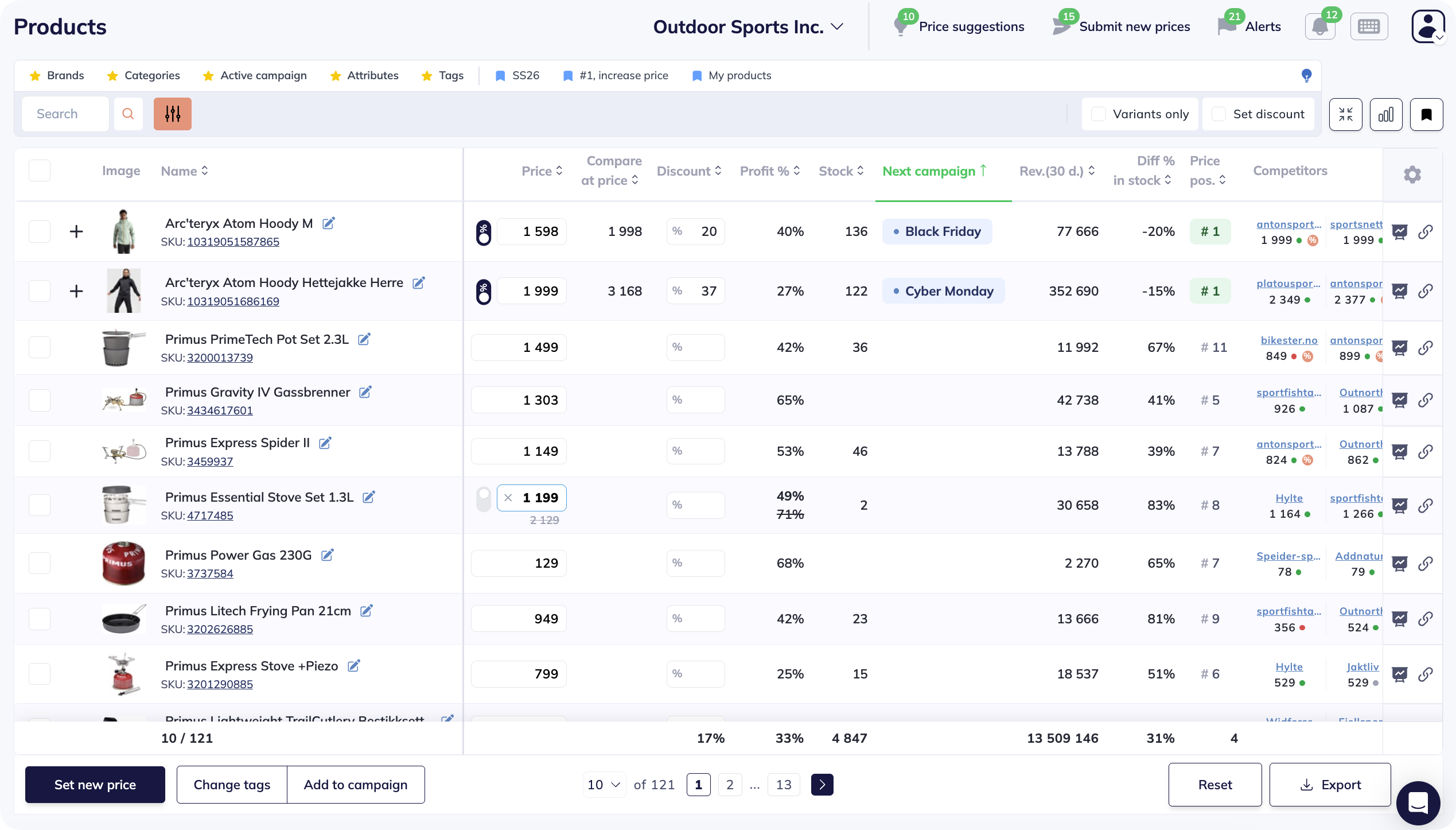
When a product goes into a discount campaign, Reprice checks the campaign price against the product's own lowest price from the last 30 days.
Each product is marked as ready, needing attention or not to be discounted yet, with its old price, new price and margin shown side by side.
The recommended retail price is useful information about where a supplier expects a product to sell, and a sensible launch price for products the market hasn't priced yet.
For products listed by several shops, the price that wins the sale is set by the market, and following the RRP leaves a retailer behind the cheaper offers on every comparison site.
The RRP also has no place in a discount claim.
Measuring every price reduction from the product's own 30-day lowest price, and showing the RRP only as a clearly labelled recommendation, keeps campaigns within the rules while the everyday price follows the market.
Competitive pricing, discount campaigns and insights in one system.
Data: The Nordic E-commerce Pricing Benchmark. Example figures are illustrative. This is general information, not legal advice.