

Price skimming launches a new product at a high price and lowers it in steps as demand from early buyers is met and competitors start selling the same product. In e-commerce the high-price window is short, because comparison sites show every seller of the same product side by side and other shops list a new launch within weeks. Once they do, the launch price meets the market: 35% of retailers in The Nordic E-commerce Pricing Benchmark set most of their prices from competitor prices, and 63% of the companies in The Black Friday Freeze check competitor prices before setting their own.
Skimming suits products that some shoppers want on day one and will pay more to get first, such as new phones, game consoles, popular sneakers and the latest model of a well-known appliance.
For those shoppers, availability is worth more than the difference between the launch price and the price a few months later.
The skill is in the timing.
Holding the launch price too long leaves a retailer above every competitor on the comparison site, while dropping it too early gives away margin on sales that would have happened at the higher price.
Competitive pricing, discount campaigns and insights in one system.
The name comes from skimming the top of the market first.
A product launches at the highest price early buyers will pay, and the price falls as that group is served and the next group, more sensitive to price, becomes the buyer, which lets the seller earn more across the product's life than one fixed price would.
Penetration pricing does the opposite, launching at a low price to win buyers, reviews and rankings quickly and raising it later.
Both are ways of pricing new products before there is any sales history to go on, and both fit into a wider set of e-commerce pricing strategies.
In physical retail, a store can hold a launch price for months because shoppers rarely compare across shops.
Online, a new product carries the same GTIN at every seller, so Prisjakt, PriceRunner and Google Shopping list all the offers on one page from the day the second shop adds it.
That makes the competitor's arrival the event that ends the first price step.
The Nordic E-commerce Pricing Benchmark found that 35% of retailers set most of their prices from competitor prices, and in The Black Friday Freeze, 63% of companies check competitor prices before setting their own.
When a new product appears on a comparison site, competitors start pricing against each other within days, and the launch price has to respond.
A skimming plan sets the price steps in advance and ties each one to a trigger in the market, so the price falls when the market moves and not on a fixed date.
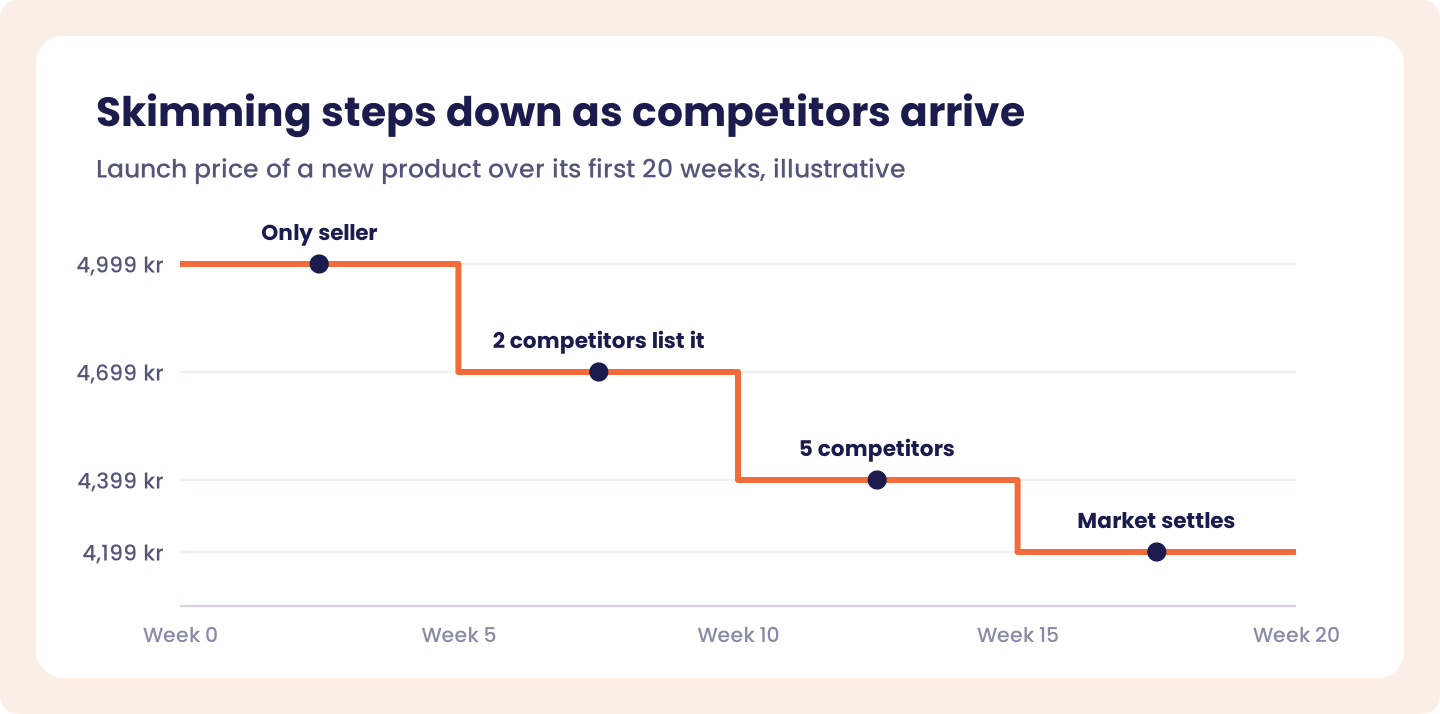
In the example, a retailer launches a product at 4,999 kr as the only seller.
When two competitors list it, the price steps down to 4,699 kr, just below their offers, then to 4,399 kr once five shops sell it, and finally settles at 4,199 kr as prices across the market level out.
The triggers that work best are the ones a pricing team can watch:
Every step stays above the product's margin floor, and once the market settles, the product moves from its launch plan into the everyday competitive pricing strategy for its product group.
Penetration pricing suits products where being first in the ranking matters more than early margin, such as a new own-brand product that needs reviews or a product line entering a market where shoppers already know the competitors.
A low launch price wins the comparison-site click and the first reviews, which help the product sell at a higher price later.
The risk lies in the later rise.
A product launched low and raised after a few weeks has its low launch price as the reference for any discount in the following 30 days, so a campaign soon after the rise can't advertise the reduction from the new price.
Stepping a launch price down is an everyday price change and not a discount, so it needs no reference price.
The difference matters when the reduction is advertised: a banner saying "now 600 kr off" is a price reduction under the EU's 30-day rule, and it has to be measured from the lowest price the product had in the 30 days before.
During a skimming plan, that lowest price keeps falling with each step.
A campaign planned for week 12 in the example has 4,399 kr as its reference, not the 4,999 kr launch price, and advertising the saving from the launch price would repeat a mistake 19% of companies in The Black Friday Freeze admitted to, discounting against a price older than 30 days.
Reprice brings in price data from Prisjakt, PriceRunner and Google Merchant Center and matches it to your products by GTIN, so competitor offers for a new product show up against it as they appear.
Alerts flag when a key competitor changes a price, and every recommended change shows its effect on margin before it goes live.
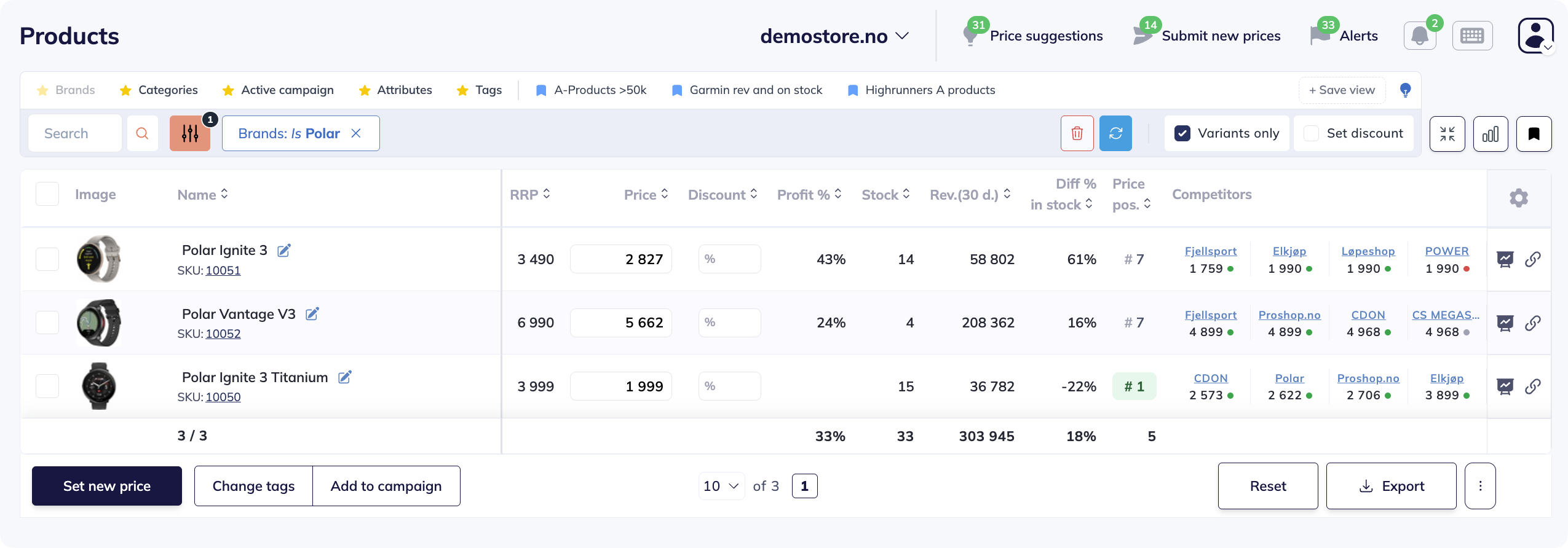
Once the market has settled, the product joins the competitive pricing rules for its product group, always above the margin floor you set.
If it goes into a discount campaign, each product is checked against its own lowest price from the last 30 days before launch, so a skimming step earlier in the month shows up before the headline is written.
Price skimming earns extra margin from the shoppers who want a product first, and in e-commerce that window lasts only until the next shop lists the same product.
A skimming plan that ties each price step to a competitor's arrival, stays above the margin floor and hands the product over to everyday competitive pricing gets the most from the launch without being left above the market.
Penetration pricing is the better choice where early ranking and reviews matter more than early margin, and both strategies end in the same place: a new product priced against the competitors that now sell it.
The retailers that plan the steps in advance, and check every advertised reduction against the 30-day reference, keep the launch margin without the compliance risk.
Competitive pricing, discount campaigns and insights in one system.
Data: The Nordic E-commerce Pricing Benchmark; The Black Friday Freeze. Example figures are illustrative. This is general information, not legal advice.