

Value-based pricing sets a price from what shoppers will pay for a product, and premium pricing deliberately places it above the market. In e-commerce, both work on the products where shoppers choose on something other than price, such as niche products with few sellers, products competitors have run out of and products that arrive faster or come with better service. Those products often sit unpriced in the long tail: in The Nordic E-commerce Pricing Benchmark, only 16% of retailers had reviewed more than three-quarters of their catalogue in the last 90 days.
Retailers in high-competition e-commerce spend most of their pricing effort on the products shoppers compare, and with good reason, since a few kroner decide the click on a comparison site.
The same focus leaves thousands of products priced once at launch, often at the same markup as everything else, even where no competitor is close.
A premium on those products earns margin that the competitive range can't.
A 10% premium on a product with a 40% margin lifts the margin per unit by a quarter, so the product earns as much as before even if it loses a fifth of its sales.
Competitive pricing, discount campaigns and insights in one system.
alue-based pricing starts from the shopper.
The price reflects what the product is worth to the person buying it, given the alternatives they have, the urgency of the purchase and what comes with it, such as fast delivery, easy returns or advice before the sale.
Premium pricing is the competitive form of the same idea: the retailer knows the market price and chooses to sit above it.
Both differ from cost-plus pricing, which ignores the shopper, and from competitive pricing, which ignores everything except the competitor's price, and both fit into a wider set of e-commerce pricing strategies applied product by product.
A premium holds where shoppers have few alternatives or a reason to choose you beyond price:
A premium rarely holds on key value items, the well-known products shoppers use to judge a shop's prices.
Pricing those above the market costs more in lost trust across the whole range than it earns on the products themselves.
A premium raises the margin on every unit, so the product can sell fewer units and still earn the same total margin.
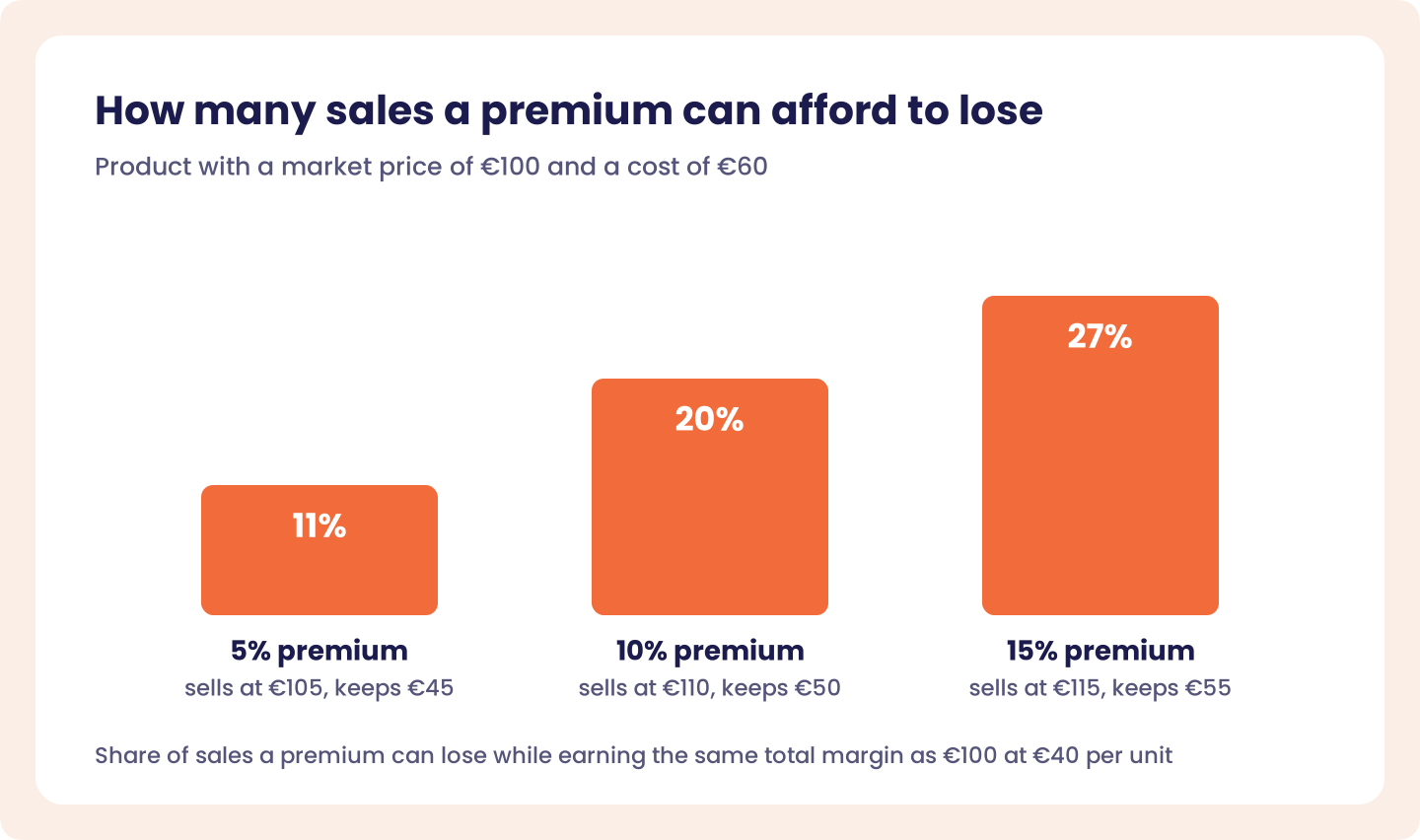
Take a product with a market price of €100 that costs €60, leaving €40 of margin per unit.
At a 5% premium the margin rises to €45, so the product can lose 11% of its sales and earn the same total.
At 10% the margin is €50 and the product can lose 20% of its sales, and at 15% the margin is €55 and it can lose 27%.
On a long-tail product with no direct rival, a 10% premium is unlikely to cost a fifth of the sales.
On a product listed by five shops on a comparison site, it can cost far more, which is why the premium has to match the competition each product faces.
Competitor data shows where a premium is possible.
Products with no matched competitor, products where every competitor is out of stock and products where you are already the cheapest seller by a wide gap are the first places to look, and the last group is the quickest win, since raising the price to just below the next competitor keeps the top spot while adding margin to every unit.
The Nordic E-commerce Pricing Benchmark shows that retailers want to make these moves, with 75% saying they raise prices when they find a product far below the next competitor.
Few of those products are ever found, because only 16% of retailers review most of their catalogue within 90 days and the whole assortment beyond the bestsellers rarely gets a second look.
A premium needs a ceiling, the highest price the product can reach, usually set as a percentage above the next real offer or above the market price where there is one.
Without a ceiling, a premium that started at 10% can drift to 30% when a competitor runs out of stock, and shoppers who compare will notice.
The market around a premium product also changes.
A new seller listing the same product, a competitor restocking or a comparison site starting to show the product all erode the reason for the premium, so a price index above 100 for long-tail products is worth tracking, with the premium reviewed whenever a new competitor appears.
A premium product can still go into a campaign, and the premium price is a legitimate reference as long as the product has sold at it.
Under the EU's 30-day rule, a discount is measured from the lowest price in the 30 days before the campaign, so a product priced at a steady premium for the month before can be discounted from that price.
The line is crossed when the premium is added just before a campaign to make the discount look bigger.
43% of retailers in the benchmark admitted raising prices shortly before a sale in the last 12 months, and a premium set for that purpose is exactly what regulators look for, so premiums belong to the everyday price and should be set well ahead of any campaign.
Reprice matches your products to competitors by GTIN and brings in price and bestseller data from Prisjakt, PriceRunner and Google Merchant Center, which shows the products that have no direct rival and the ones where competitors have dropped out.
Its recommendations flag the products where you are the cheapest by a wide gap, with the margin you would gain from moving to just below the next offer.
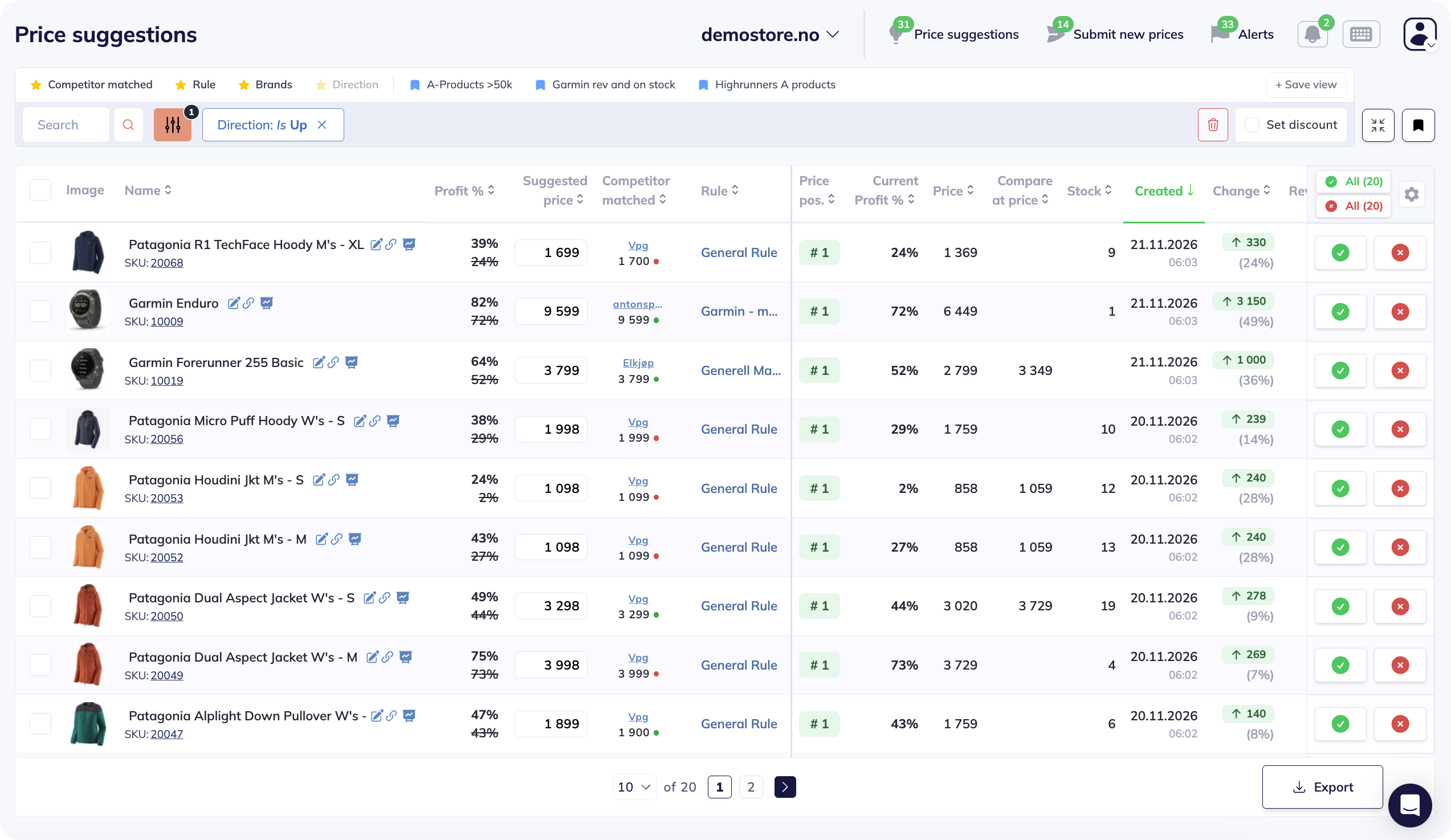
Competitive pricing rules are set per product group, so the long tail can hold a premium position while the competitive range stays sharp, all above the margin floor you choose.
Pricing insights show where each product sits against matched competitors as the market changes, and every price change is logged.
Value-based and premium pricing earn margin on the products where shoppers are choosing on availability, speed or service, and those products make up a large part of a typical e-commerce catalogue.
The math is forgiving: a 10% premium on a product with a 40% margin pays off as long as it costs less than a fifth of the sales.
The retailers that capture that margin find the products that can carry a premium with competitor data, set a ceiling so the premium stays reasonable and watch for the new seller that ends it.
Their competitive range stays sharp on the products shoppers compare, while the rest of the catalogue earns what it can.
Competitive pricing, discount campaigns and insights in one system.
Data: The Nordic E-commerce Pricing Benchmark. Example figures are illustrative. This is general information, not legal advice.