

Price monitoring is the ongoing tracking of competitor prices for the products you sell, across competitor web shops, marketplaces and comparison sites such as Prisjakt, PriceRunner and Google Shopping. Retailers have plenty of it: in The Nordic E-commerce Pricing Benchmark, 77% use pricing software to track competitors, yet 75% of those still check competitor sites by hand and one retailer in three only learns about a competitor's price change a day or more after it happens.
Monitoring is the first step in competitive pricing, and the quality of every price decision depends on it.
A price that follows the wrong product, a seller with no stock or yesterday's data gives the shop a worse price than no monitoring at all, because the decision looks informed when it isn't.
The value of monitoring also depends on what happens after the data arrives.
A feed of competitor prices that someone has to export, compare and turn into price changes by hand leaves the slowest part of the work untouched, which is why so many retailers with monitoring tools still spend their week in spreadsheets.
Competitive pricing, discount campaigns and insights in one system.
The headline price is only part of what a competitor offers, and a monitoring setup that ignores the rest compares the wrong numbers.
For each matched product, the useful data is:
Where the data comes from matters too.
In the Nordics, Prisjakt and PriceRunner show most of the market for a product on one page, so comparison site data covers sellers that a list of competitor web shops would miss, while Google Shopping adds the offers from shops that advertise there.
A price comparison is only valid when both sides are the same product.
Matching on product names breaks on variants, pack sizes and model years, so a monitoring tool can end up comparing a 128 GB phone with a 256 GB one or a single item with a two-pack.
The GTIN, the barcode number that identifies one specific product, removes that problem for any product that carries one.
Products without a GTIN, such as own brands and bundles, need matching by hand or by a combination of brand, model number and attributes, and those matches are worth checking before any automatic rule relies on them.
Competitor prices reach a monitoring tool in one of three ways.
Scraping reads prices directly from competitor web pages, which covers any shop but breaks when page layouts change and needs constant maintenance, and 25% of retailers in The Nordic E-commerce Pricing Benchmark run their own scraper.
Comparison site and marketplace data covers many sellers at once in a consistent format, and feeds such as Google Merchant Center add bestseller and price benchmark data for the products you list.
Whichever method a retailer uses, the data needs to be current, matched to the right product and available where the pricing decision is made.
Collecting prices that nobody acts on until the end of the week adds cost without changing a single price.
How quickly a retailer sees a competitor move sets the limit on how quickly it can respond.
20% of retailers find out about a key competitor's price change within an hour and 65% by the end of the same day, which leaves 36% working on prices that are a day or more out of date.
For products on comparison sites, where shoppers sort by price, a day behind the market is a day of lost clicks or a day of margin given away.

The right check frequency still differs by product.
Products with many sellers on comparison sites need checking several times a day, while niche products with few rivals can be checked far less often, the same logic behind repricing frequency.
Checking everything at the same rate either wastes effort on quiet products or leaves the busy ones behind.
The benchmark shows the gap between having price data and acting on it.
75% of retailers using pricing software still check competitor sites by hand, and only 16% have reviewed more than three-quarters of their catalogue in the last 90 days, so the data covers far more products than anyone looks at.
The decisions happen somewhere else.
78% of retailers need two or more approvals before a price change goes live, approvals are the most common thing slowing price changes down, and the margin floor sits in a spreadsheet at 43% of retailers.
Monitoring tells the team that a competitor moved, while the work of deciding the response, checking it against the margin and the campaign plan and getting it approved still happens by hand, usually in a spreadsheet exported from the monitoring tool.
A monitoring tool is worth choosing on what it does with the data as well as how it collects it:
The last point separates price monitoring software, which reports what competitors charge, from price optimization software, which uses the same data to recommend and apply your prices.
Reprice matches your products to competitors by GTIN and brings in price and bestseller data from PriceRunner, Prisjakt and Google Merchant Center, so monitoring covers the Nordic market on the same product data your prices run from.
Competitors your customers don't buy from can be excluded, and alerts flag when a key competitor moves.
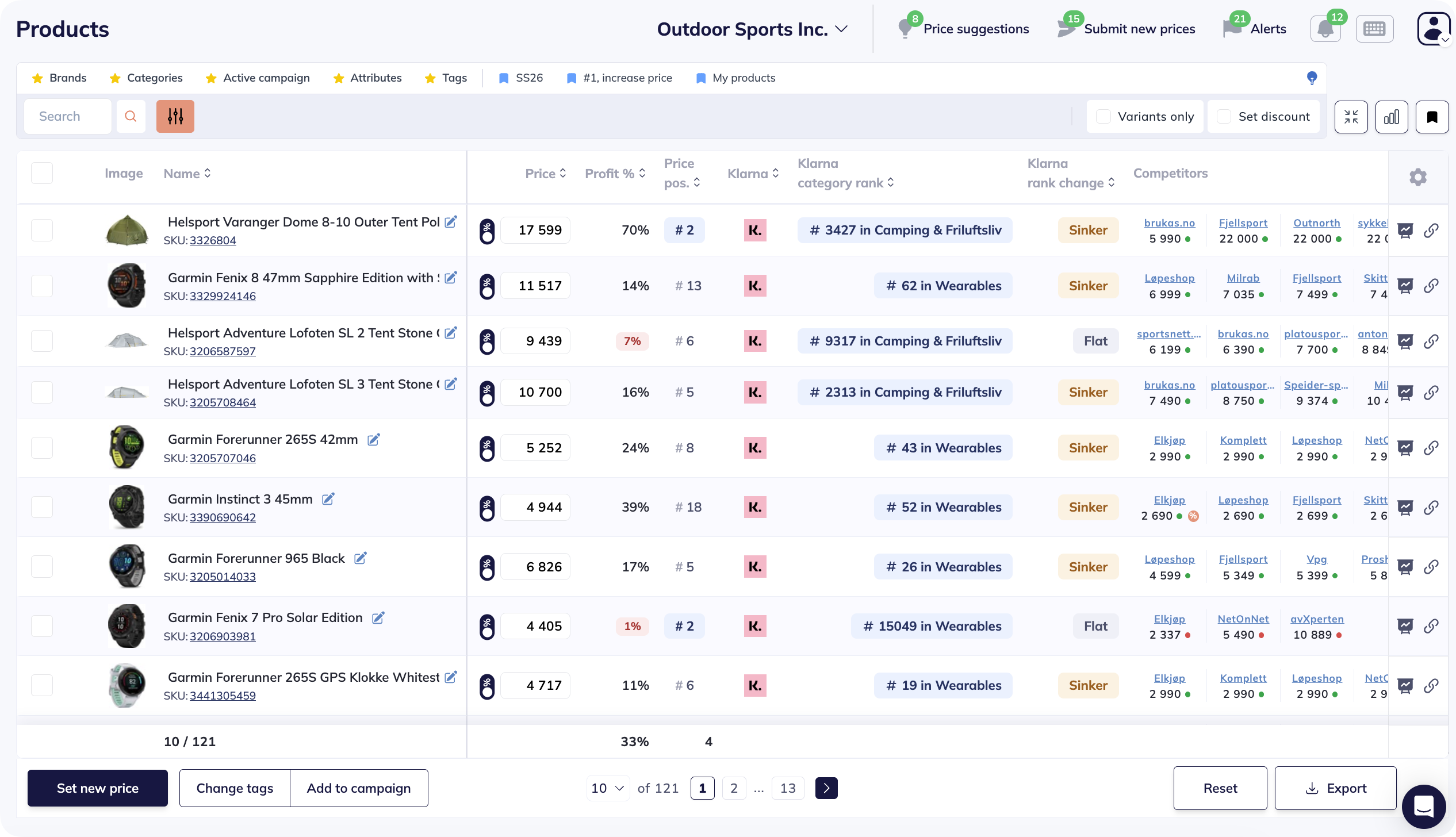
The data feeds straight into competitive pricing.
Recommended changes show their effect on margin before they go live, rules apply changes automatically above the margin floor you set, every change is logged, and pricing insights show where your prices sit against each matched competitor over time.
Price monitoring earns its cost when the data arrives matched to the right product, refreshed as often as each product's market moves and in the same place where the price is decided.
Without that last step, retailers end up with competitor data they pay for and still check by hand.
The retailers that close the gap connect monitoring to the rest of the pricing process, so a competitor's move turns into a recommended price, checked against the margin floor and the campaign plan, without a spreadsheet in between.
The monitoring itself stays the same, and the time from a competitor's move to your response shrinks to the time it takes to approve a recommendation.
Competitive pricing, discount campaigns and insights in one system.
Data: The Nordic E-commerce Pricing Benchmark.