

61% of retailers start planning Black Friday three months out, and 57% lock their discounts a month before it begins. Then the week lands and 74% can't change a price when they need to. The discount you set in September can't move in November, long after you can finally see what competitors are charging and which products are selling without any help at all. The preparation is real. It's also what locks you in place.
It's the biggest week of the year, so teams prepare for it like a launch: products picked, discounts set, campaigns scheduled and signed off weeks out.
Every box ticked.
Then a competitor moves on the Monday and the plan has no answer.
Planning early and reacting fast are two different skills.
Competitive pricing, discount campaigns and insights in one system.
A September planning meeting and a Friday-morning price war need opposite things. One rewards deciding early and sticking to it. The other rewards seeing a competitor's move at 9am and answering it by 9:15.
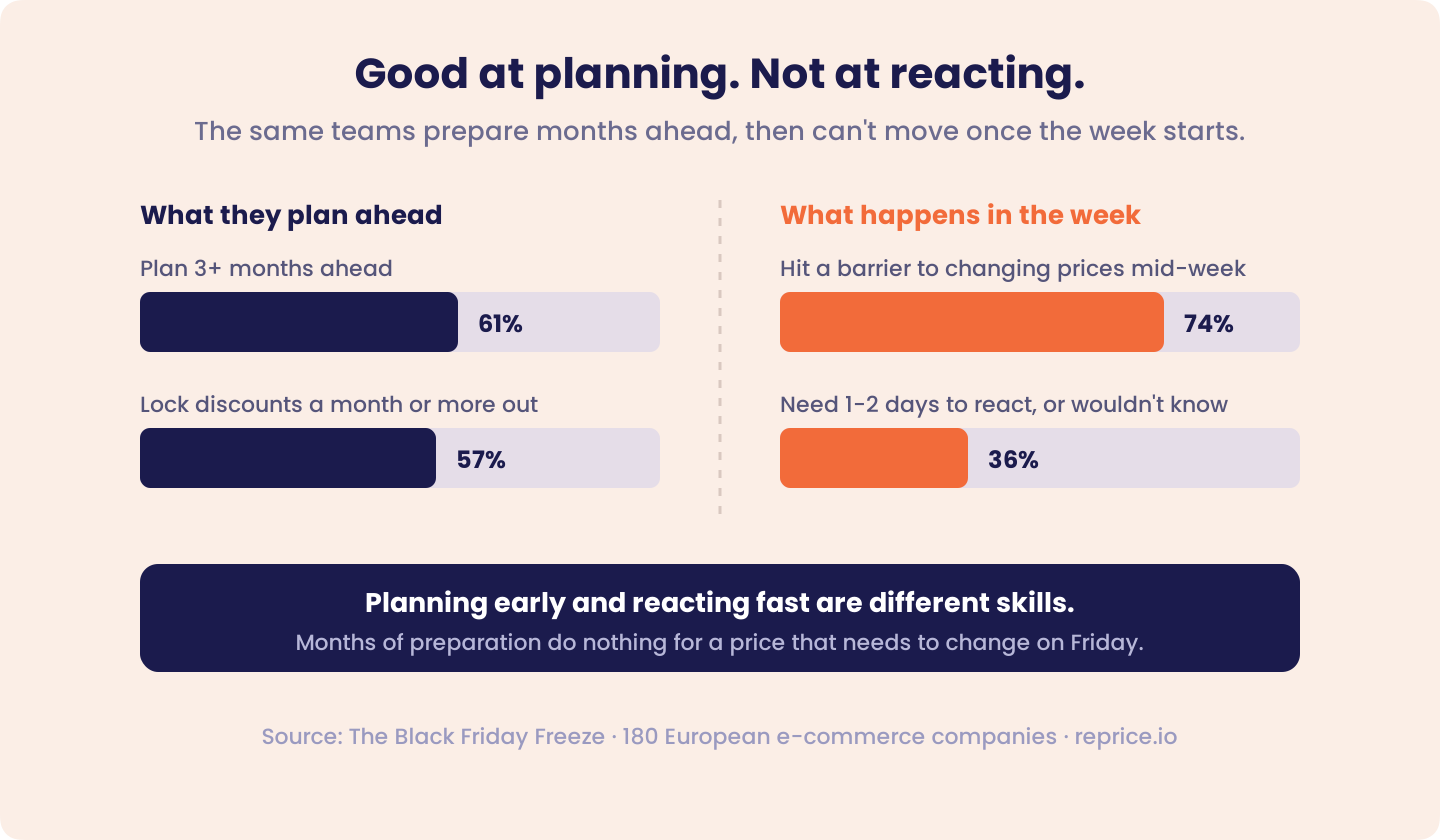
The numbers from our Black Friday Freeze report show the split.
A clear majority prepare months ahead and lock their discounts well before the week. Then three in four hit a barrier to changing a price once the week is live, and more than a third would need a day or two to respond to a competitor, by which point the week is half over.
It's the same teams in both numbers.
They spend months on the half that's finished before the week starts, and have nothing left for the half that decides it.
The earlier you lock a price, the less you know when you lock it.
In September you can't see what competitors will charge, what your stock position will be, or which products will sell at full price without any discount at all.
You set the number anyway, because the campaign has to be signed off.
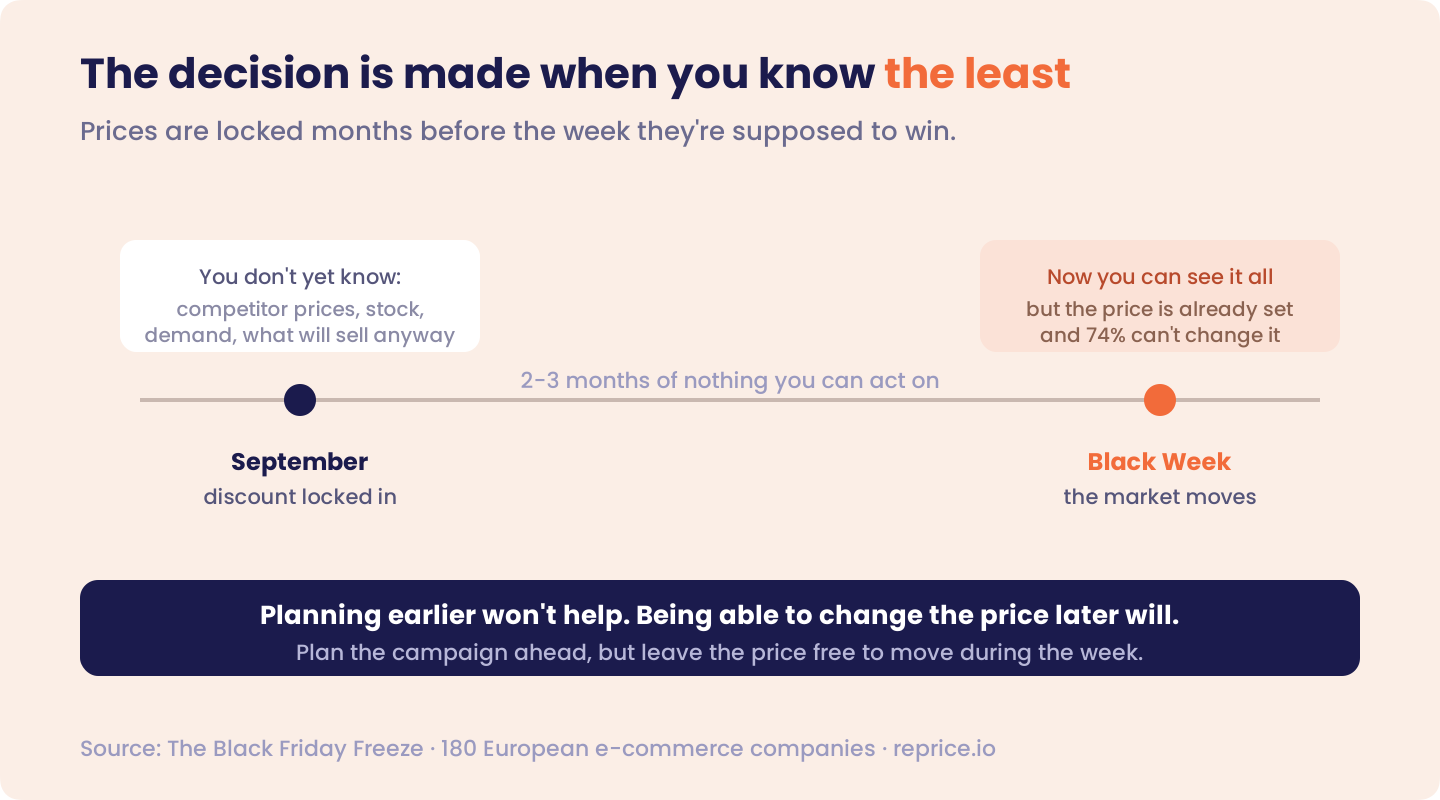
By November the picture is clear and the price is fixed.
You cut 40% off a product that was selling fine at full price. A competitor went lower on the one item you needed to win, and you couldn't follow.
Pricing the whole assortment well depends on current data, and a locked campaign gets that data too late to use it.
The usual response to a bad Black Friday is to plan earlier next year, lock the discounts further out, get more sign-off.
Each extra layer of advance approval is one more reason no one can touch a price mid-week.
The teams who plan hardest end up the most frozen, because the campaign is too thoroughly signed off to change once it's live.
This is the freeze in the Black Friday Freeze.
30% of companies change no prices at all during the week. They decided everything in advance and left themselves no room to move.
Plan which products go on promotion, what the campaign looks like, how deep the budget goes. All of that should happen months ahead.
The one thing that shouldn't get locked that early is the price itself.
Plan the campaign in advance, but leave the price free to move during the week, inside limits you set now.
You decide in September that a product is in the campaign and that its price can sit between a floor that protects your margin and a ceiling that keeps it competitive.
During the week, the price moves within that band in response to what competitors do, without anyone reopening the plan or chasing a sign-off. The plan sets the rules; the week sets the price.
Reprice keeps the two jobs apart.
You build and schedule the promotion in discount campaign management, with every discount checked against the 30-day rule before it goes live.
That's the advance work you already do.
Outside the campaign, competitive pricing keeps each price following the market through the week, down to a margin floor that stops it dropping into a loss.
Campaign products stay protected from those daily rules so a scheduled discount holds, and everything else stays live.
Both run from the same product data, which is the part a spreadsheet can't do: a price can be decided in advance and still change on the day.
That's the difference between the 30% who freeze and the teams who keep moving through the week.
Competitive pricing, discount campaigns and insights in one system.
Data: The Black Friday Freeze, a survey of 180 European e-commerce companies.