

Retailers with a serious tech stack — Microsoft Business Central for the ERP, an ecommerce platform like Norce, a WMS, a PIM, and a set of manual pricelists holding it together. The data needed to set one good price is spread across five systems, so pricing means logging into each of them, exporting, cross-checking and updating by hand, per market. They usually frame their pricing as a pricing problem. It's closer to a control problem. What's missing is a single place to control it all.
This is the reality for most mid-market and enterprise e-commerce retailers, and it gets worse with every system added.
Each tool does its job well.
Business Central owns cost, the ecommerce platform owns live prices and campaigns, the WMS owns stock, the PIM owns product data.
But pricing needs all of them at once, and no single system sees the whole picture.
So the picture gets assembled manually, in spreadsheets and pricelists, over and over.
A pricing layer that connects these systems solves this problem, without replacing any of them.
Competitive pricing, discount campaigns and insights in one system.
When a retailer tells us pricing is slow and error-prone, the instinct is to look for a better pricing method.
But the method is rarely the issue.
The issue is that setting a single competitive, compliant, margin-safe price requires data that lives in different places, and pulling it together is a manual job that has to be repeated every time anything changes.
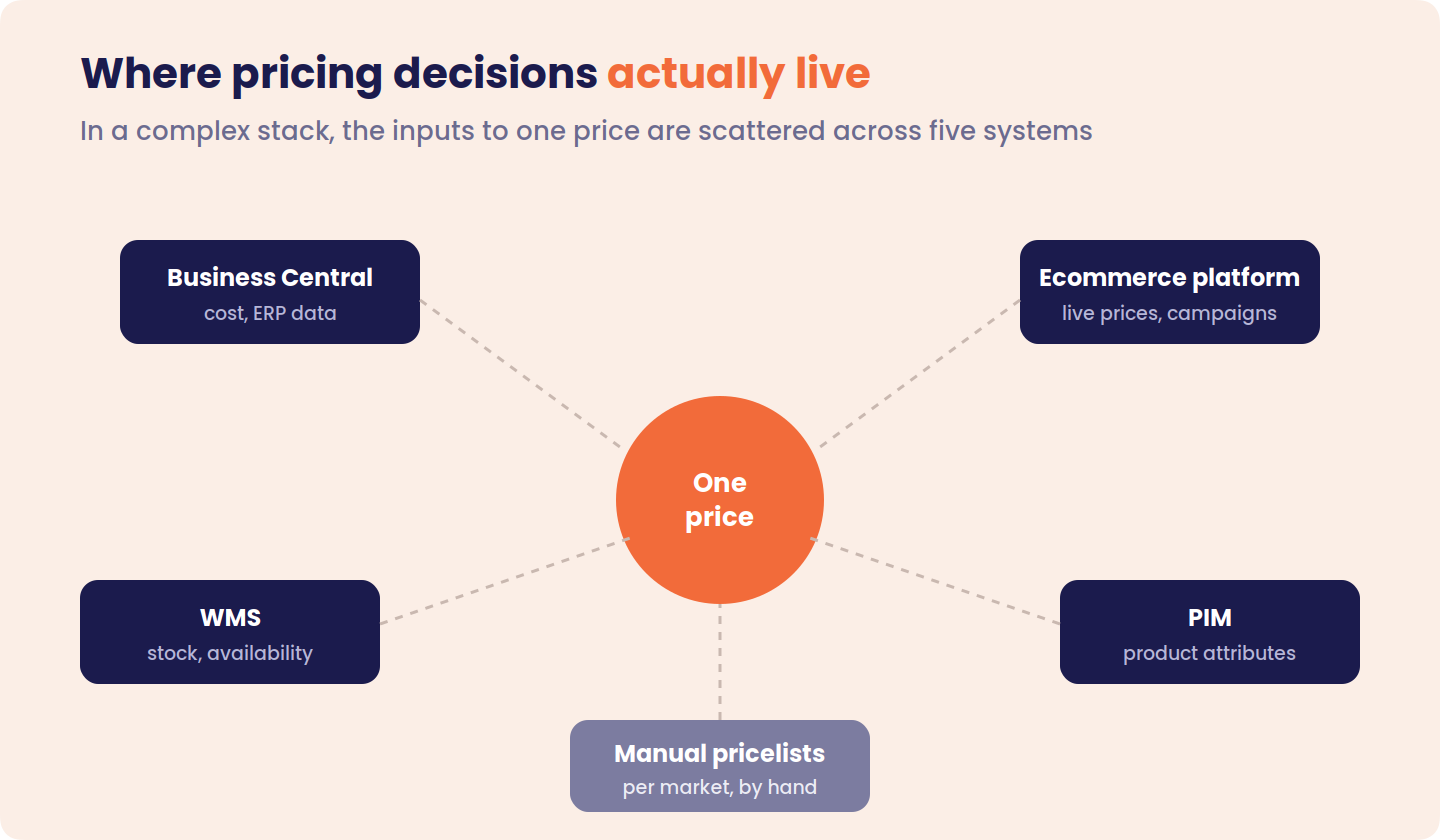
Look at what one price actually depends on.
Cost sits in Business Central. Live prices and campaigns sit in the ecommerce platform. Stock and availability sit in the WMS. Product attributes sit in the PIM.
And the reconciliation, the actual pricing decision per market, happens in manual pricelists by hand.
Every system is doing its job.
What's missing is a place where they come together to be controlled.
No amount of refining the pricing method fixes that, because the constraint is the architecture, not the method.
The counterintuitive part is that adding good tools can make pricing harder, not easier.
Each new system in the stack owns another slice of the data a price depends on, which means another export, another login, another manual cross-check before a price can move.
That's why the teams with the most sophisticated stacks often have the least control over pricing. Every system points inward at its own job, and none of them owns the full pricing view.
And the more markets you run, the more the manual reconciliation multiplies.
What the stack needs is a pricing layer that integrates into the systems you already run, pulls the relevant data together, and becomes the single place you actually price from.
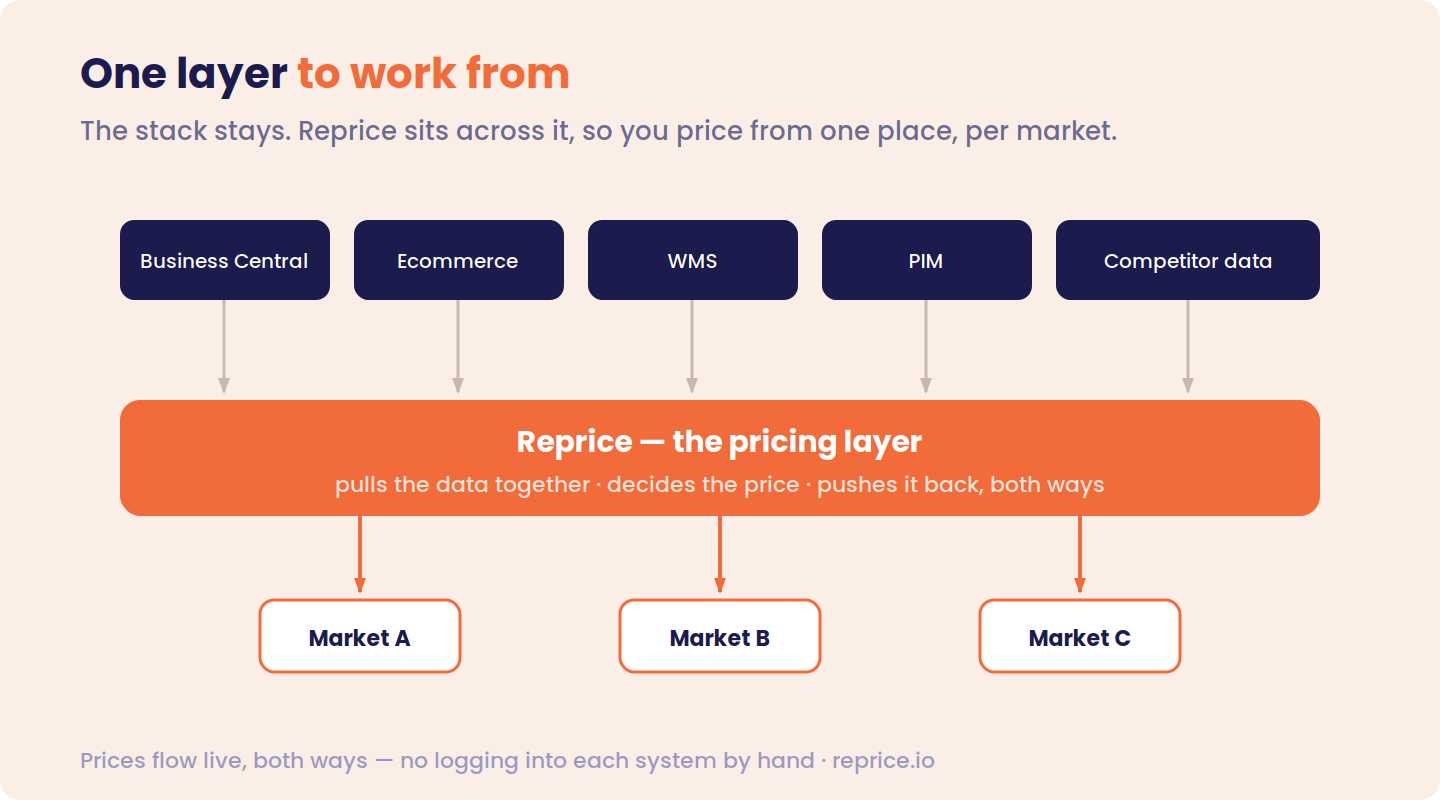
This is the set-up that fixes the control problem.
The stack stays exactly as it is; nothing gets ripped out.
Reprice sits across it: cost from Business Central, live prices and campaigns from the ecommerce platform, stock from the WMS, attributes from the PIM, and competitor data all flow into one place.
You make the pricing decision there, once, and it pushes back out to each system and each market automatically.
For a retailer running this kind of stack across several markets, the change is stark: instead of logging into the ecommerce platform and every other system to maintain prices by hand, you work almost entirely from the pricing layer, fully integrated, per market.
There's a second benefit to integrating deeply rather than adding on a monitoring tool, and it compounds over time.
Pricing quality is a function of data quality.
A price set on competitor data alone is weaker than one that also knows your true landed cost, your real-time stock position, and your full product attributes, because those are the things that tell you when not to follow the market, when you have room to hold margin, and when a product should be protected.
That depth is only available when pricing is connected into the whole stack, not fed a thin export.
A standalone monitoring tool sees competitor prices and little else.
A pricing layer wired into Business Central, the ecommerce platform, the WMS and the PIM sees the full context, and richer context is better pricing.
Enriching the data feeding your pricing enriches what your pricing can do, in a way a surface-level integration structurally can't match.
This is exactly the setup Reprice is built for, and where it's investing.
Reprice already integrates with Business Central, and as a certified Business Central ISV partner, that connection is built to the platform's own standard rather than bolted on.
Support for ecommerce platforms including Norce is next.
The target is precisely the complex, multi-system stack this article describes: ERP, ecommerce platform, WMS, PIM and more, spread across markets.
Reprice gives you the control of a single pricing layer and one place to price from, with the information you need to make pricing decisions for each market.
Competitive pricing, discount campaigns and insights in one system.
Reprice is a certified Business Central ISV partner; support for further platforms including Norce is in development.